The proposed dissolution of the longstanding Cambridgeshire Association for Local History highlights how the economic growth of and house-price inflation in Cambridge has undermined civic society organisations – with no local government safety net in place
I got an email from the Cambridgeshire Association for Local History earlier which reads as follows:
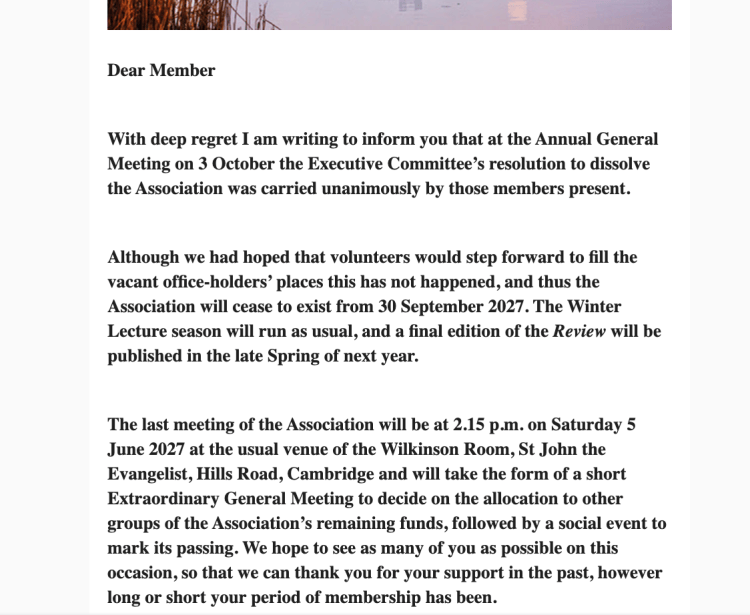
The text reads:
“Dear Member
With deep regret I am writing to inform you that at the Annual General Meeting on 3 October the Executive Committee’s resolution to dissolve the Association was carried unanimously by those members present.
Although we had hoped that volunteers would step forward to fill the vacant office-holders’ places this has not happened, and thus the Association will cease to exist from 30 September 2027. The Winter Lecture season will run as usual, and a final edition of the Review will be published in the late Spring of next year.
The last meeting of the Association will be at 2.15 p.m. on Saturday 5 June 2027 at the usual venue of the Wilkinson Room, St John the Evangelist, Hills Road, Cambridge and will take the form of a short Extraordinary General Meeting to decide on the allocation to other groups of the Association’s remaining funds, followed by a social event to mark its passing. We hope to see as many of you as possible on this occasion, so that we can thank you for your support in the past, however long or short your period of membership has been. …
In the unlikely event that you and others want the society to continue, you can get in touch with them here.
But I’m not hopeful – being one of the former committee members who had to step back on health grounds.
The bigger picture is one of how a rapidly-growing Cambridge is not supporting its civic society organisations
And that is a *structural problem* that ultimately needs to be resolved by the people and institutions responsible for those structures, whether they be ministers, senior Cambridge University executives and college officers, to the people who decide what gets invested in and where. It’s not something that can be thrown at the feet of councillors who consistently have been prevented from taxing the wealth generated in and around Cambridge to provide sufficient support for the voluntary and community sector.
“But look at Cambridge Pledge! Aren’t they doing great things?”
That’s a response to a symptom – asking people to make charitable donations or to make a commitment to donate from a return on an investment. It’s similar to when people tell the Patriotic Millionaires group that if they want to pay more tax, they should write a cheque to HM Treasury. Their campaign is not about asking rich people to donate to HM Treasury coffers.

Above – Patriotic Millionaires: Their campaign ***is to change government’s policies on taxation of the very wealthy***
That’s why they have Tax Reforms on the header bar of their website. No membership fee for joining online, no appealing for money.
Which is very different to charitable appeals
Who should you donate to? The local history society or the local food bank? Or someone else?”
At the same time as reading the email, on one of my social media pages I saw another appeal from the Cambridge Foodbank on the CambsNews website – itself created by former local print press newspaper editor John Elworthy and run on a shoestring following further cuts to local and regional media in Cambridgeshire.
You can’t compare the two and decide which one is ‘better’ because they serve very different purposes. One is primarily involved in poverty alleviation for those in need, while the other serves a broader civic society function whose benefits are much less tangible/quantifiable but whose presence is a reflection of well-functioning places. That’s not the same as ‘affluent places’. A well-functioning place doesn’t need to be financially loaded in order to be well-functioning. (You might say that excessive wealth is a sign of a place that is malfunctioning – especially when it is extracted from elsewhere leaving such places deprived of the essentials)
There are over 30 different types of top tier charitable activities according to the Government
The list dates from 2013 but it’s still a useful one Furthermore, groups don’t have to be charities to provide social benefits – as this useful guide from The Resource Centre in Brighton and Hove shows.
“[An unincorporated association] can be whatever its members want it to be, and carry out whatever activity the members choose. It is the easiest, quickest and cheapest way for a group to set itself up. It is ideal for many small groups, especially those without staff or premises. A large number of groups fall into this category (sometimes without knowing it). To set up an unincorporated association, your group simply needs to draw up a constitution, setting out the rules under which it will be run.”
Above – Resource Centre, Brighton and Hove
How the malfunctioning of Cambridge’s housing market contributes towards the decline of civic society organisations
I’m still pondering the meaning of this chart in Cambridge City Council’s State of the City Report 2026 which I wrote about here.
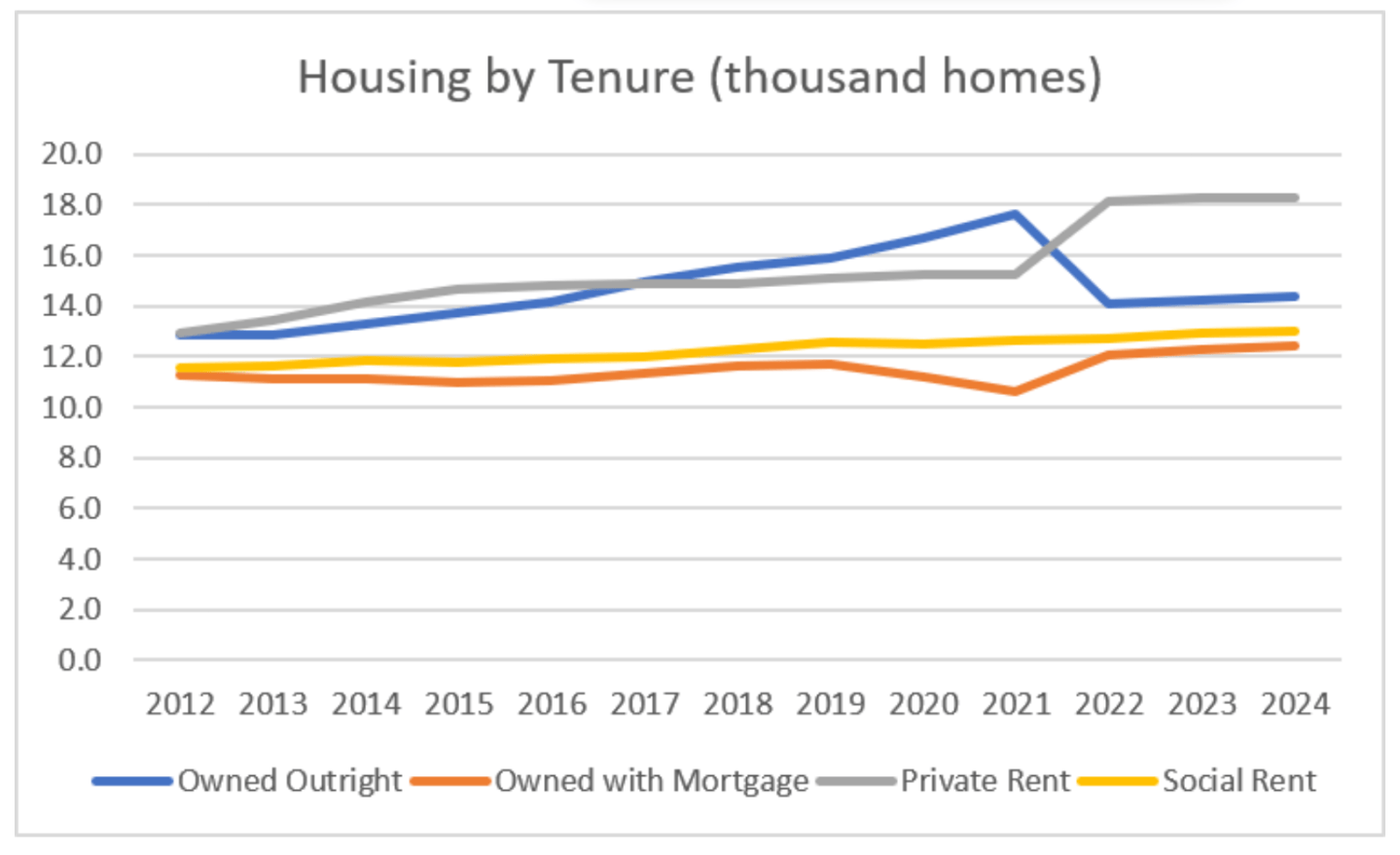
Above – Housing Tenure in Cambridge 2012-2024. State of the City 2026, p23 of the second report at item 12 here.
I wrote:
“The fall in the number of homes owned outright by 4,000 between 2021-2022 and the rise in private rent by around 3,000 gives the impression that a number of owner-occupiers died during the pandemic, and that when their former properties were put on the market, around three-quarters ended up in the hands of already-wealthy property owners to put out onto the rental market, while only a quarter went to people with mortgages (rising by just over 1,000).”
Does this mean that up to 3,000 homes that were previously lived in by long-term owner-occupiers are now lived in by tenants living on much shorter tenancies, resulting in a much higher turnover of population?
Given the state of the rental market, the opportunity to extract huge wealth from tenants in the forms of excruciatingly high rents is something that estate agents are more than happy to use as a selling point on ‘expected annual returns’. It is also something the electorate has not been slow to pick up on – with The Green Party currently the official opposition at The Guildhall with its longstanding policy of giving local government powers to restrict rent rises. And prior to what their opponents consider a self-inflicted defeat on everything to do with the lack of peace in the Middle East (a topic I steer clear from because I don’t have the headspace for it), housing policy and a rent freeze were the issues that The Greens wanted the media to be talking about going by their press releases.
And my hunch is that one of the reasons why far more voters within Cambridge have turned to The Greens in recent elections rather than TeamNigel is that they can see enough of the structural problems and where power lies so as not to blame society’s problems on those with the least.
Generation Rent on 20-40 year olds leaving London: Could the same happen with Cambridge?
You can see the report from 2016 by Generation Rent here. Now look at London’s travel to work map for train passengers.
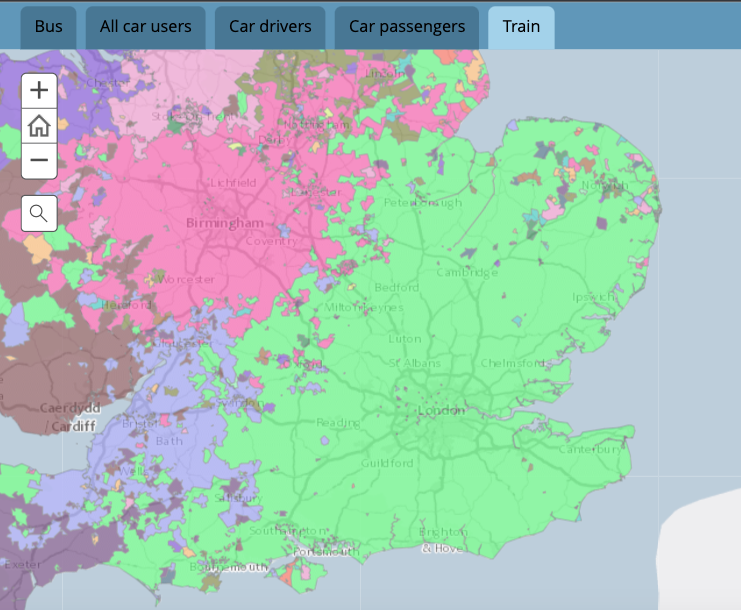
Above – ONS Travel to Work Map which I included in this blogpost from 03 March 2023
Hardly surprising that the city ends up with housing issues when so many properties are advertised as being suitable for London commuters – of which I was one (the loss of 3 hours a day every day crushed me).
One thing the London commute does not do is leave time for anything else in life – as I found out the hard way. That was one of the main reasons why I left the civil service: I could not see how I could sustain such a lifestyle where I lived to work and did nothing else.
And that may be one of the patterns that we are seeing in Cambridge today: People either with such long commutes to work (whether into Cambridge or from Cambridge into London) that they simply do not have time to commit to anything else
‘History isn’t just bricks and mortar – it’s people‘
“Families are being pushed out because they cannot afford to stay here. Many have lived here for generations and have helped build the Cambridge that we know today. I have worked with those builders, from the 1970s-1990s. And when they go, so does part of our history… We ask for the growth to be matched by the infrastructure for the people that already live here’.
Above – Speech from Wayne Nightingale presenting his petition to Cambridge City Council, 01 October 2026
For me there were two key themes in Mr Nightingale’s speech to the council. The bit I understand but ‘conditionally’ disagreed with him was on was about what to do about motor cars. I say ‘conditionally’ because I also have spent the past decade-and-a-half disagreeing with the county council, GCP, and CPCA on their transport policies as well! Basically had the GCP and CPCA listened to those of us making the case for a light rail for Cambridge and had they chosen early on to fund serious feasibility studies in the mid-2010s, we might have been in a position today where motor traffic levels and traffic pollution were substantially lower due to a completed and functioning first light rail line as proposed by Connect Cambridge.
The theme where I agree with him is about the families that have moved out – primarily my generation who otherwise might have stayed in the local area but instead have moved out to the surrounding villages and small towns. Which in part explains why I said to one of the former mayors of Cambridge, a longstanding resident himself that such has been the population turnover that it feels like I don’t know anyone in my neighbourhood anymore – in that I don’t have a shared history of life experiences. In addition over the past decade people who have been pillars of local community groups and organisations have either passed away or moved away for a variety of reasons. No one has been able to replace them in the functions that they have carried out. And it shows – despite the best efforts of other volunteers who were already committed in other ways.
This is also a retrofitting challenge
It applies to other towns and cities as well in that the houses and residential estates were not built for ownership by wealthy asset-holders gaining revenues from very short term lets or annual population turnover associated with academic years. So it’s not just an increasingly extreme climate that our built environment needs to adapt to. Where are the social spaces and social institutions that can bring people together? Not surprisingly these issues are now much more familiar in public policy debate than 15-20 years ago.
One of the party-political battle grounds as mentioned earlier has been strengthening the rights of renters over length of rents and restricting rent rises. But what are the facilities needed to integrate and strengthen communities where an increasingly large proportion of an otherwise settled residential population becomes short-term rental? And international? Speaking to a number of staff (not just medical) from all over the world as a patient in both Addenbrooke’s and also Royal Papworth, I remember feeling frustrated and angry at the failure of Conservative ministers to provide the public service essentials such as a decent public transport to work, or sufficient capacity of GPs and dentists in a fast-growing city for people who had been invited to move to a new country to carry out essential work for people in our city and county.
Those experiences reflected what I could only see as a political and executive class in Westminster unwilling (ideologically) or unable (lacking in calibre) to make the big structural changes needed.
The reports supporting the draft Greater Cambridge Local Plan that I have blogged about and provided a list of links to in my Future Cambridge page here highlight in the evidence bases the chronic community infrastructure shortages. But given how long it takes for the nice stuff to get done, I may well be plant food by the time it is all complete!
The growth of the University of Cambridge and its linked institutions has not been matched by the infrastructure needed to support both it and our city
This was one of the points Mr Nightingale was making. Furthermore, he raised the case of the Beehive Centre redevelopment by RailPen. That was a planning application that the city council was recommended to refuse by its planning officers only to see it snatched from them by ministers following very heavy lobbying by RailPen, resulting in ministers approving the planning application over the heads of the local council planning committee.
In the case of the University of Cambridge, it likes to promote Eddington as an exemplar development but the reality for the rest of the city, especially those with the least, is that it is one of the most inaccessible parts of the city by public transport because the bus services do not go point-to-point from most of the residential areas of the city, and because passengers have to buy a separate ticket because we don’t have shared ticketing between bus companies. (i.e. you’re paying over £10 per person to get to and from Storey’s Field by bus for any events they put on there).
The University of Cambridge and its STEM-related industries risk suffocating other important sectors of the city
I’m not sure that the decision-makers and the promoters of all things STEM realise how many of the people who work in STEM-related fields also have strong interests and hobbies in fields outside of their workplace. In the 2000s before I moved to London, most of the people I got to know in all things arts, dance, and music worked or studied in sci-tech subjects and fields. I can’t recall many people studying things like law, politics or history. Which I could never get my head around!
The science/technology park owners have belatedly realised that their workers want something more than just a place of work, but are yet to figure out what additional facilities that involves installing and how to do so on their existing sites. Which perhaps explains the proposed natural swimming lake recently added to the Cambridge Science Park planning application.
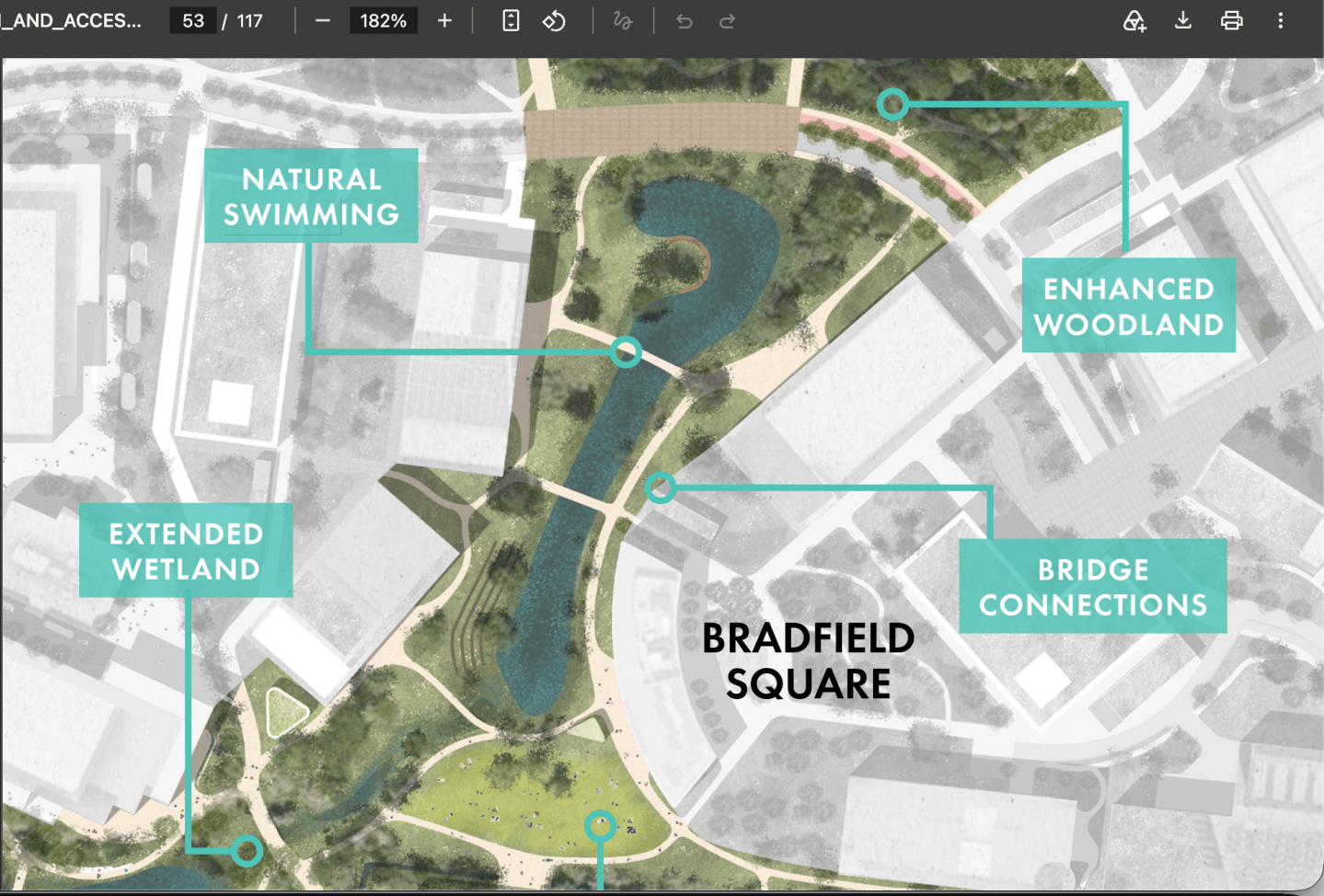
Above – Cambridge Science Park’s intensification which I wrote about here – which also reminds me that they are still adding more documents to the application
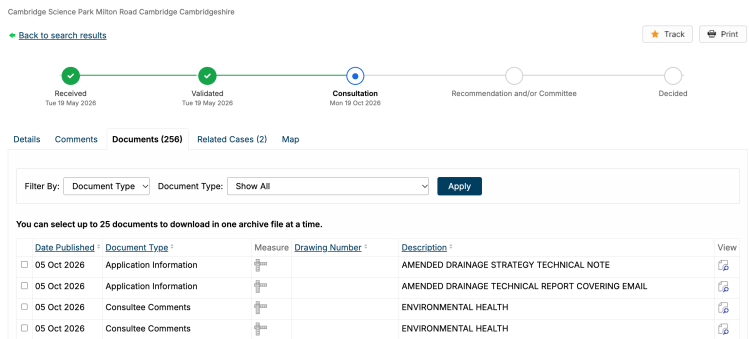
Above – four new documents added to the files yesterday – for residents and others to examine and comment on
***By the year 2047, the Cambridge Science Park expects the densified site to employ an additional 23,360 workers***
I spotted this statistic later on and wrote about it in this recent blogpost. The point raised by Mr Nightingale about the infrastructure not being put in place for the people already here? That’s a medium-sized town’s worth of workers. Which is why the busways plans feel incredibly obsolete in comparison to the ambitions of ministers.
Keep an eye out on The Budget which is in just over three weeks to see if any further details on public transport infrastructure funding is forthcoming.
If you are interested in the longer term future of Cambridge, and on what happens at the local democracy meetings where decisions are made, feel free to:
- Follow me on BSky
- Spot me on LinkedIn
- Like my Facebook page
- Consider a small donation to help fund my continued research and reporting on local democracy in and around Cambridge


