The Cambridge Independent featured a petition about how Cambridge is changing. This post looks at the content of the responses in the context of the Minister for Housing and Planning’s statement to Parliament about ‘exemplary engagement structures’ that the Greater Cambridge Development Corporation will have to establish.
“‘I feel a growing sense of sadness watching parts of the city I’ve known all my life change in ways that many residents feel have not been shaped by meaningful public consultation,” says Cambridge resident Wayne Nightingale, who is calling for a “more balanced approach” to transport, planning and development.”
Above – Cambridge Independent on FB with over 200 responses
See also:
- The text of the petition
- The Cambridge Independent’s article
- Responses from Cherry Hinton residents (over 100)
- The response from the GCP to the Petition (which I’ve added at the very end of this blogpost)
“What does the petition call for?”
“This petition calls for a full independent review of the overall impact of transport policies, planning decisions and major developments on the future of Cambridge.”
Above – Petition: ‘Cambridge is being changed without you and is at breaking point – have your say”
The context I’m applying is the statement to Parliament made by the Minister for Housing and Planning in the meeting where MPs voted to approve the establishment of the new Greater Cambridge Development Corporation, which I wrote about and linked to here
This is because the Minister was clear about public engagement going forward.
“[The Development Corporation] will be asked to create exemplary engagement structures to enable broader community participation, including from residents, community representatives, and town and parish councillors.”
“What likelihood is there that there will be an independent review of transport policies, planning decisions and major developments?”
Very unlikely from the perspective of the petitioner and signatories because Government Policy for Cambridge is to enable fast growth. The judgement of ministers from both Labour and previous Conservative Governments was that the existing institutions and policies were not delivering what they wanted, hence Michael Gove proposed the development corporation and appointed Peter Freeman CBE to make the initial arrangements. The incoming Labour Government in 2024 chose to continue with those arrangements, leading to the Parliamentary approval of, and the creation of the Greater Cambridge Development Corporation on 24 July 2026.
The exchanges between the petitioner and others – supporters and opponents are for readers to decide for themselves. I’m not going to comment on them because I know too many of the individuals involved and they all have different opinions. I know better than to stir up that metaphorical hornets’ nest!
The benefits of growth have been distributed in a way that is highly inequitable
And successive governments have been unwilling and/or unable to make the policy changes to deal with this. Furthermore, they have been called out repeatedly on this.
Back in 2018, eight years ago at the time of blogging, two Cambridge University students – Joe Cook & Abdullah Shah, produced a film about inequalities in Cambridge. It was called A Choice to Look, and you can watch it here. (I took part as a filmed interviewee).
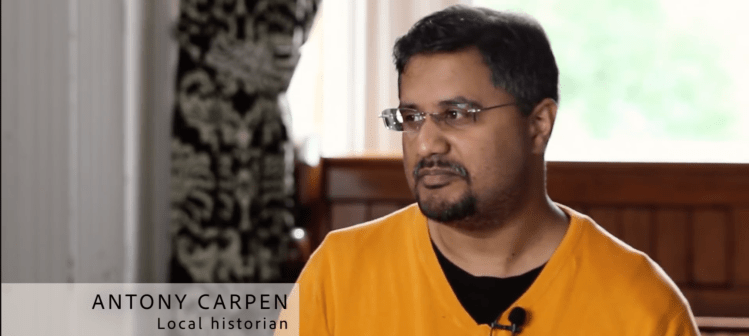
Above – A Choice to Look (2018) by Cook/Shah, with yours truly with far fewer grey hairs
Fast forward eight years and Mr Cook is now a politics producer for Sky News.
Eighteen months later, Donna Ferguson wrote this piece for The Guardian (Jan 2020) on unequal Cambridge. (Note this is the same person who has been campaigning on the issue of HMOs in Cambridge, which I blogged about here)
The inequalities have gotten so bad, and the inability/unwillingness of central government to act, that private sector organisations started making moves themselves, for example with the Cambridge Pledge established in late 2024. (See also this BBC News article from April 2025). Later in 2025, Cambridge 2030 was launched to deal with similar problems.
“What have people said in response to the petition?”
Themes that I have picked up include:
Highlighting specific planning applications and developments:
- RailPen and the Beehive Centre’s conversion to a Sci-Tech development, with the loss of retail park (although some of the more popular/highly frequented stores will be moving across the road to the Cambridge Retail Park. (Note this application was ‘called in’ by ministers, and approved by the Building Safety Minister)
- The Grafton Centre’s conversion into a sci-tech development. I moaned about this at the time it was proposed in 2021, and raised concerns about the lack of community facilities in the proposals in 2023.
- ‘Tacky’ shops in the city centre with garish shop fronts that have no links to the city (eg the ‘wizard shops’, but then with college landlords raising rents combined with 10million tourists visiting each year, it has become inevitable that shops with high turnover of stock will be the ones that dominate
Highlighting the decline of old shops and facilities used by local residents:
- Shops that are/were affordable for people on low incomes and also ones that provided employment for working class communities – again referring to The Grafton Centre (whose previous owners could/should have dropped their rents to enable new tenants to set up, but they didn’t – and chose to market the site for sale as a sci-tech ‘opportunity’)
- The closure of some large institutions such as the old Warner/VUE Cinema at the Grafton Centre which in the mid-1990s was buzzing
The poor state and lack of maintenance of the general street scenes
- This comes as no surprise in the face of the massive cuts to local government grants from central government since 2010. As with so many other councils across the country, Cambridge City Council was faced with the choice of increasing council tax to ease the hit – especially for essential services, or cutting those services even further. Additionally, the total funds raised through Business Rates annually is over £100million – of which the city council keeps barely a tenth of that – the rest being surrendered to HM Treasury, some of which gets redistributed to poorer parts of the country. Reforming how local councils are funded – including adult social care, remains in the ‘too difficult box’.
Comparisons with other places
- Several people stated that they used to come into Cambridge for shopping but no longer do, choosing other towns over the county border
- Others noted the wider state of the high street in towns and cities elsewhere, saying that things are so much worse in other town centres
- Some reminded readers that the rise of internet shopping and changing viewing habits such as the rise of subscription TV channels has diverted income that might have gone to the high street and city centre attractions as being a cause.
- Record shops (Remember HMV/Our Price/Heffers Music/WH Smith upstairs?)
- Photo processing shops
- Video/DVD rentals
The empty sci-tech labs and office blocks
- Part of the problem here is that Cambridge is in the midst of a speculative bubble which means that premises are being built in the hope that there will be enough demand for tenants to occupy them. Hence why sites that would normally be left alone such as ones with capped landfills, are being built over using extremely expensive (and locally contentious) methods.
- People have also commented on the imbalance of the sci-tech developments over other industrial sectors and the risk that the city becomes overly dependent and vulnerable to economic shocks to that sector.
Unaffordable housing
- Former councillor Sam Davies MBE looked at the data on house building in and around Cambridge, and then the house price rises and concluded that Cambridge cannot build its way out of the international property bubble that it is in. It needs Government to change policies.
- The sale of properties abroad combined with the chronic housing shortages and unaffordable house prices and rents for the children who grew up in Cambridge is a particular source of resentment (I’ve boomeranged back into the house of Mum & Dad and I’m in my 40s – although in my case it’s due to chronic ill-health)
Complaints about shortcomings of transport infrastructure schemes and policies
- The busway inevitably got coverage in this. Ultimately it depends what you are measuring success by. Defenders of the busway will point to the current number of passengers using it. Opponents will point to the original proposals and original budget – what was delivered was far more expensive and much shorter than the original planned route from Cambridge to Huntingdon
- Complaints about the bus gate on Mill Road – the party-politically contentious policy that is popular with local residents living close to Mill Road (judging by them returning first Labour, then this year Green Party councillors at city council elections for both Petersfield and Romsey wards).
- Complaints about some roads being narrowed/restricted in favour of cyclists. Interestingly the issue of ‘Car Spreading’ from car manufacturers was not raised – and even if it was, it’s something that would need UK-EU co-ordination to legislate to reduce the width of motor vehicles because globalisation means manufacturers do not manufacture for individual nations (give or take steering wheel placement!)
- Existing poor bus services in the face of announcements of expensive transport infrastructure projects – the difference between revenue funding to subsidise bus services, vs capital funding used for building new infrastructure seldom explained to the public. (In particular the restrictions on diverting funding allocated for capital projects that generally create assets, going to revenue/consumption which does not)
Disagrements with / challenges to the petition
- It was by no means 100% wave of support for the petition, with people stating:
- Change happens – Cambridge should not be a museum
- The sci-tech boom is beneficial for the city and the wealth it brings
- The olden days were not as pleasant as some stated
There is a lot of misinformation out there, and unsubstantiated accusations being thrown around
I state this as an observation rather than as an accusation or finger-pointing. Recall that the context of this post is about the new Greater Cambridge Development Corporation being asked (i.e. required) to develop exemplary engagement structures by the Minister for Housing and Planning.
As the UK found out with the EU referendum, sound public policy cannot be made in a political environment plagued with misinformation and [active, deliberate] disinformation.
I don’t pay much attention to the accusations thrown around about organisations such as CamCycle (declaration of interest, I am a member – as I am of Cambridge Area Bus Users, and also the Light Rail Transit Association. (Just Cambridge’s branch of Living Streets to go and I have the quartet!)
In the case of CamCycle, their annual reports are available online, and their meetings and AGMs are well-attended. Additionally, people can read about what they do in their magazine published online, which is also distributed to members in print – and also available to read in public libraries.
Should democracy education for adults be part of the new public engagement response?
It has to me much wider than that – mindful of the Government’s Local Media Action Plan from March 2026. A series of evening classes for one term would not be nearly enough. Additionally, adult education and lifelong learning are outside of the scope of the Development Corporation. Furthermore the Combined Authority has stated it’s not prepared to go beyond what ministers have provided it with both funding and policy directions for.
This means that Political discussions will need to be had between ministers, the CPCA Mayor, and local council leaders on what any public information/education campaign may be like. For children and teenagers, the review of the National Curriculum – including citizenship, provides an ideal opportunity to develop suitable content for them that aligns with what schools are doing. (See the Association for Citizenship Teaching for more). Given what the Minister for Housing and Planning said about the composition of the board of the development corporation, that’s where the discussions between ministers, CPCA Mayor, and council leaders might take place. Furthermore, the lifetime of the development corporation will be far longer than the GCP.
The Greater Cambridge Partnership’s democratic legitimacy ran out ***ages ago***
This is a lesson for the Development Corporation noting that Mr Pennycook said that as with the Peterborough Development Corporation which existed between 1968-88 the Cambridge Development Corporation’s lifespan will be ’25 years, if not longer’. When the GCP was established in June 2014, it had support from Conservatives and Liberal Democrats in central government, and from their local Parties and Cambridge Labour locally. Post-2021 the GCP lost the support of the Conservatives, and the CPCA Mayor Paul Bristow has said repeatedly that it should be taken over by the Combined Authority.
The electoral backlash at the 2023 city council elections against proposed congestion charging proposed by the Greater Cambridge Partnership – which had to abandon the plans exposed the lack of ‘democratic consent’ from the electorate. (*I stood as an independent candidate that year in Queen Edith’s calling for the abolition of both GCP and CPCA, and for a new ‘Great Cambridge’ unitary council with boundaries broadly matching the economic subregion). The public consultation and the public debates showed that many people did not know what the GCP was, where it got its powers and authority from, and who was really shaping the policies – officers or councillors?
The GCP’s funding expires in 2030, in less than four years time.
Given the local government restructure and the due date for the commencement of successor councils scheduled for April 2028, central and local government need to come up with a succession plan because the GCP’s local government representation on its assembly and board are made up of three component councils. (Cambridge City, South Cambs District, Cambridgeshire County). That will be reduced to one post-April 2028. That plus the by then established functioning of the Development Corporation *plus* the additional powers granted to the Combined Authority by the English Devolution and Community Empowerment Act 2026 means that a host issues will come to a head.
Keep an eye out for some big decisions from central government (and responses from local government) this autumn.
If you are interested in the longer term future of Cambridge, and on what happens at the local democracy meetings where decisions are made, feel free to:
- Consider a small donation to help fund my continued research and reporting on local democracy in and around Cambridge
- Follow me on BSky
- Spot me on LinkedIn
- Like my Facebook page

Response to Mr Nightingale from the Greater Cambridge Partnership (see this FB post and scroll to the end for the source)
“Dear Mr Nightingale,
Thank you for taking the time to write and for sharing your perspective on transport in Cambridge.
We recognise that travelling by car in and around Cambridge can be challenging. Forecasts show that, without intervention, the area will see around 26,000 additional daily car journeys over the next decade. Our role is to plan for this growth by encouraging more people to travel by public transport, cycling and walking. This is essential if we are to reduce congestion, improve air quality and lower carbon emissions, while ensuring the transport network remains functional for those who need to drive.
On parking, we are investing in additional Park & Ride capacity at existing sites, including the redevelopment of Newmarket Road Park & Ride, and creating new facilities such as the Waterbeach, Cambridge South East, Dry Drayton and the Cambridge South West Travel Hubs. These projects are designed to make it easier for people to access the city without adding to congestion. The Greater Cambridge Partnership (GCP) does not have responsibility for parking charges.
You raised concerns about whether decisions reflect the experiences of long-standing residents. Many of our schemes are developed in close collaboration with local communities. For example, the recent Adams Road project, mentioned in your first email, was shaped through detailed engagement with the residents’ association, who asked us to take action to improve safety on the street. The Dutch-style roundabout you reference is not a GCP scheme.
Our Joint Assembly and Executive Board includes local councillors and representatives from business and the university. The Executive Board makes decisions on our projects, which we then work to as officers. We carry out extensive public consultation at different stages of our projects. We would welcome your input into our consultations, including our current consultation on the future of the Riverside area.
Finally, I need to address the fact that your earlier email contained abusive language. We understand that people may feel strongly about these issues, but we have a zero‑tolerance policy towards abusive, offensive or threatening communication directed at our staff. This applies across all channels, including email, phone, social media and in‑person interactions. We are always willing to engage constructively, and we ask that all correspondence remains respectful so that we can continue the conversation.
We hope you will continue to share your views through our consultations and engagement processes.
Kind regards,
Greater Cambridge Partnership”

