Back in November 2025 I asked “Ministers could save time and money by legalising and regulating e-scooters. So why won’t they?” Now the BBC has published an in-depth report on the Government’s e-scooters policies
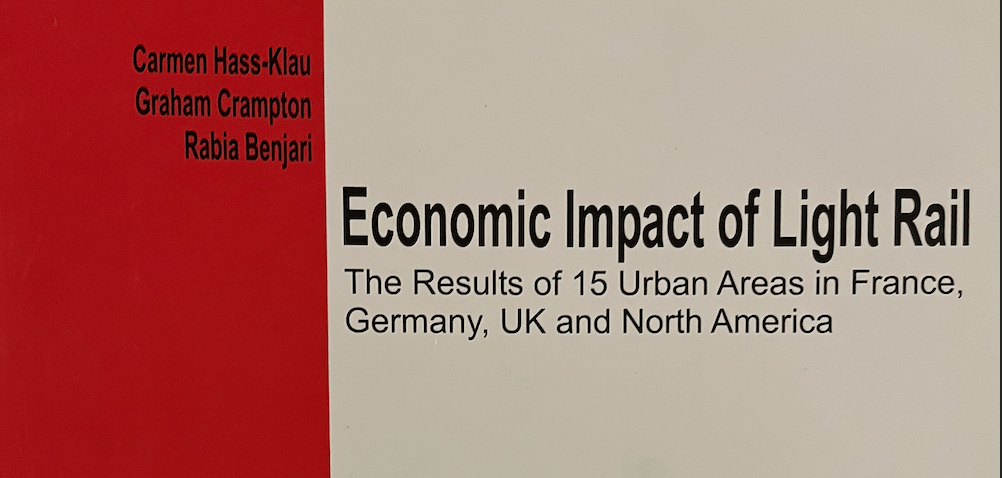
Image: Economic impact of light rail (2004) summarised here
“But six years since the trials started around England, there’s still no conclusion…So why is it taking so long for the government to decide what to do, and what are the consequences of delay?”
Above – Katy Austin, BBC’s Transport Correspondent, 23 June 2026
Good question.
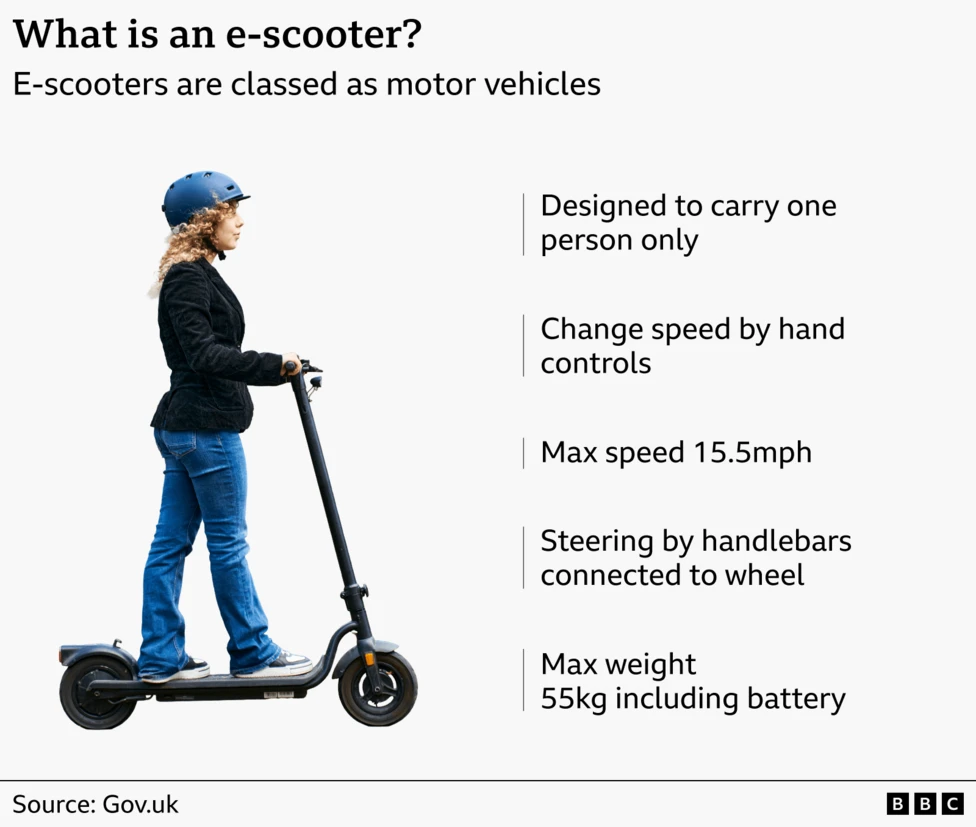
Above – from Katy Austin’s article 23 July 2026
In the meantime, advice from Cambridgeshire Police on e-scooters is here
It’s not just e-scooters
I’ve also said that ministers should go further and encourage and regulate the new generation of quadricycles/mini e-cars coming out.

Above: “It’s basically a lego brick with some wheels on it” Car Culture Club which makes the case for this new class of vehicles.
Never-ending e-scooter trials…
In the case of Cambridge / The GCP orange e-scooter ‘trial’, it’s gone beyond a joke to the extent that what should be a preferable, more convenient and less environmentally damaging method of transport has become more of a nuisance, losing the support of people who might otherwise be sympathetic to, if not fully supportive of it.
“The trial began in October 2020. There are about 50 bikes and 300 scooters available around Cambridge.”
Above – Cambridge City Council on the e-scooter trial (last updated May 2024
The ‘trial’ has been repeatedly extended, the latest to 31 May 2028 according to the approval from the Combined Authority’s Transport Committee of November 2025. Which tells me that it’s not a trial because no micro-e-vehicle trial scheme needs ***eight years*** to figure out whether the scheme is good or not, and what teething problems it needs to address. This is because successive governments have been unable or unwilling to come to an agreed policy as to what to do with these new and increasingly popular methods of transport.
Mass Transit Thinkforce Call for Evidence
I borrowed the term ‘Thinkforce’ from the football fanzine When Saturday Comes which 30 years ago lampooned a celebrity fan’s year-long journey through football having decided it was cool. And being a celebrity he was invited to join a ‘Government Thinkforce’ (prophetically lampooning David Mellor’s Football Taskforce). I think I used it in previous blogposts because it reflected the ‘policy fatigue’ I feel about various things that get clogged up in an over-centralised Whitehall where nothing gets done because someone up top has too little time to make a meaningful decision on it, or that Whitehall has too little capacity to consider the policies.
Above – the Mass Transit Taskforce
Call for evidence – Trams and Light Rail
The list of themes they want evidence from indicates that this is a consultants/experts/technical consultation rather than a general public one.
The Economic Impact of Light Rail (2004) Paper
The paper summarised the benefits as:
“Residential property and rent values were often higher when near a light rail line; office prices were also higher in many cases. New city centre tram stops can increase the number of pedestrians and hence retail turnover: car ownership was seen to be lower per household along tram corridors. It seemed that economic benefits of tram lines accrued to smaller towns as well as larger.”
However, the UK case studies are for city regions (Birmingham, Manchester, Tyne & Wear). That said, the case studies are for smaller towns for other countries. Given the current forest fires erupting across Western Europe, the urgency to decarbonise has gone up several levels.
(You can also get the book version if you’ve got the funds to spare!)
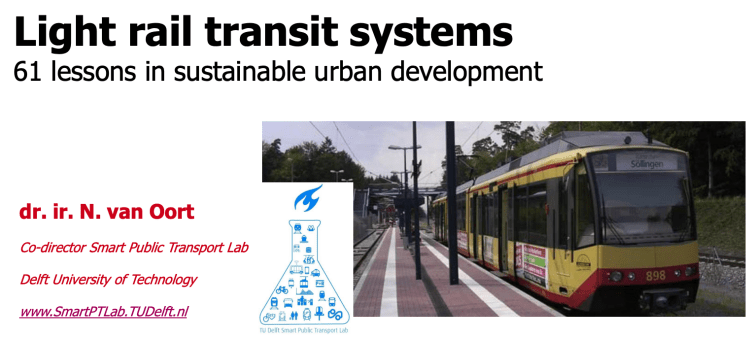
Above – Light Rail Transit Systems (slides) from Dr Niels van Oort, Jan 2019
The general success findings included:
- Project conception – Focus on ‘why’ the project (short term and long term);
- Politics – The timeframe of contracts for the project must be consistent
with political timeframes; - Communication – Residents and citizens must be involved in the project;
…and the general failures found:
- Project conception – Too few project variants or alternatives. Solutions for a good
project are often found in the combination of different alternatives. - Project organisation – Innovative public tendering (e.g. DBFMO and alike) comes
with risks; - Politics – Changing political climate;
- Communication – A technocratic attitude jeopardises the project;
Above – Van Oord (2019) slides 11 & 12
How does this relate to the fun and games of the Cambourne-Cambridge busway?
The Greater Cambridge Partnership was and still is officer-driven. From my perch having attended and filmed many of the meetings and protests between 2014-2020 (after which I a) gave up engaging, b) didn’t need to film once the lockdowns forced the issue of making local councils install AV and livestreaming systems in chambers and meeting rooms, and c) standing for election in 2023 calling for the GCP’s abolition (along with the CPCA, replacing both with a competent unitary council), it seemed clear to me that the senior officers at the start had already decided on the busway option. Their successors also appeared to rely on the elected councillors to deal with any electoral or Political opposition to the proposals. It remains the case that no senior politician stood on an electoral platform making a very high profile case for busways. (Let alone get elected).
So in Cambridge’s case:
- Project conception: pre-conceived solution to problems identified in the early 2000s that took little account of what was happening in the real world – including but not limited to Michael Gove’s ‘Case for Cambridge’ from 2023.
- Project organisation – such was the over-complicated structures of Cambridge’s governance that it was never clear to the public who was responsible for what. There was the GCP signed off by ministers with three senior elected councillor representatives from three separate councils which between 2018-21 involved 3 different political parties, with a combined authority added on in 2017 leaving the county council wondering what it was left to do.
- Politics – My take is that The GCP and the CPCA were effectively created by the Conservatives to ensure the city of Cambridge was not controlled by non-Conservative politicians. Unwilling to create a new unitary council, this is what they came up with in 2014 and again in 2017 respectively. Neither policies were properly thought through from a sound public policy-making process, and the GCP in particular was left with a declining political legitimacy from the electorate as the 2023 backlash against the proposed congestion charge showed.
- Communication – Not surprisingly, the communications has been a failure in part because the policies and governance structures were broken. It was confusing enough for the electorate to have a two-tier council. Adding more tiers made things even more confusing for the vast majority of people who understandably don’t follow closely the activities of local government. (Even more so given the decline of local newspapers). As the GCP found out the hard way with congestion charging, they assumed consent when none was clearly granted in the eyes of the electorate.
All of this matters to the new Greater Cambridge Development Corporation
“[The Development Corporation] will be asked to create exemplary engagement structures to enable broader community participation, including from residents, community representatives, and town and parish councillors.”
Above – Matthew Pennycook MP, Minister for Housing and Planning, 08 July 2026
The Minister made the comment in the delegated legislation committee meeting where he was asking MPs to approve the creation of the development corporation. (I wrote about it here). His remarks were in response to questions from MPs.
There’s more further reading on contemporary light rail and tramways via the LRTA
I should get a t-shirt made really. Which reminds me of this one from a long lost proposal from the 1970s.

Above: “Cambridge Monorail – Live the dream!”
If you are interested in the longer term future of Cambridge, and on what happens at the local democracy meetings where decisions are made, feel free to:
- Follow me on BSky
- Spot me on LinkedIn
- Like my Facebook page
- Consider a small donation to help fund my continued research and reporting on local democracy in and around Cambridge


