
‘Cambridge Delight’
“We are delighted to welcome the expansion of their presence here in Cambridge, and excited to see the impact we can deliver together.”
Above – Statement from Cambridge Biomedical Campus
Reporting the same story is the local newspaper in and around Stevenage, The Comet.
“GSK announces closure of Stevenage centre that employs 1,800”
Which is a huge blow – around 5% of the total number of people employed in the post-war new town. Don’t underestimate how much of a blow this is to the town – it is one of the major pillars for the future of the town, and now it is going.

Above – Stevenage / Even Better – a place for everyone – published in February 2026, which is meant to cover an investment period up to 2040. And now they have to review it.
“35 minutes by train – a doddle of a change for the skilled workers! And then there’s a prime real estate site for some nice new tower blocks for London commuters! What’s there not to like?!?”
When Stevenage was first planned, the aim was to move people ***and jobs*** out of London. That’s one of the reasons why there are a number of large industrial parks in the town, and in similar post-war towns. The aim was to avoid designing post-war dormitory towns. 1990s GCSE Geography told us this so it must be true.
Unfortunately by the time we got to the 1990s, the manufacturing sector had taken a huge hit due to the policies of Thatcher in the 1980s, and a number of big firms closed. Inevitably with the railway station a short train journey away from London, many people ended up commuting. My late uncle James was one of them, driving into the railway station from the village he and my late aunt lived in for 20 years, covering my entire childhood where we spent almost every summer and every other Easter. In those days it was often the only summer holiday away we had – this being the days before ‘cheap flights’.
In 1990, Stevenage was the coolest place ***on the planet*** (So ten year old me thought)
What was there not to like?
- Swimming pools that were better than in Cambridge
- An ice rink (which we didn’t have at the time and which was shockingly closed in the late 1990s even though it was packed every time we went)
- A bowling alley (that we also didn’t have at the time)
- A McDonalds (which effectively banned from Cambridge until about 1994 because no property owner would allow them to establish an outlet!)
- Adults to drive you ***everywhere*** in new, company cars (which public sector workers didn’t have in those days)
Actually, we were sheltered from the impacts of the recessions of that era. We were just too young to notice what was going on and how different communities coped. But the signs were there, from the division between those children that went to local state schools vs private – my late aunt telling teenage me that the state schools in Cambridgeshire were of a far higher standard than those in Hertfordshire in the early 1990s. I only found out after she passed away when I went onto do my A-levels at Hills Road SFC that a sizeable number of my new classmates crossed county boundaries to get to college every day, while I just trundled up the road.
Even though Stevenage had a smaller population (just over 70,000 to Cambridge’s just over 103,000) in 1991, the former seemed to have far more going for it than Cambridge did.
“What should Cambridge do to help Stevenage deal with the loss of those jobs?”
First of all ask the people who live there. It’s their town. (Here’s a reminder of the prospectus).
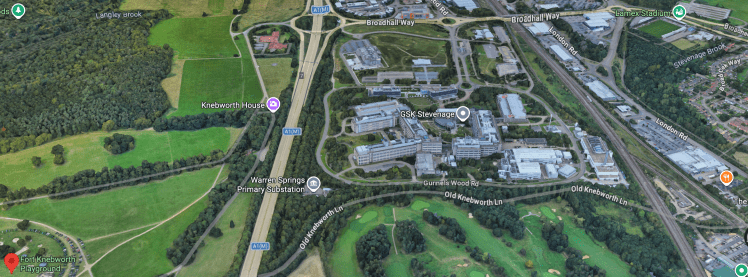
If GSK and the local council (and ministers) wanted to go down the route of a property-based comprehensive redevelopment scheme, ballpark figures are up to 1,500 lowish density Barratt-box-style homes, to up to 5,000 cram-them-in-pile-them-high tower blocks aiming for the London (or even Cambridge) commuter market. Either way, it would be a substantial suburban conversion and expansion of Stevenage if they did that. And at what benefit to existing residents I don’t know.
One option is for Cambridge’s sci-tech community to persuade ministers to designate the GSK site as a ‘landing spot’ for expanding Cambridge start ups looking for new, cheaper premises.
I followed that up in 2025 asking if Bedford and Northampton could be designated as such landing spots (with the consent of the residents there). A similar proposal could be made for Stevenage alongside an infrastructure investment plan that upgrades the Stevenage-Cambridge line (eg four-tracking part of the Hitchin-Cambridge section) and/or creating a new spur south of Stevenage to create a new railway station for the GSK site and extend it onto Luton Airport Parkway.
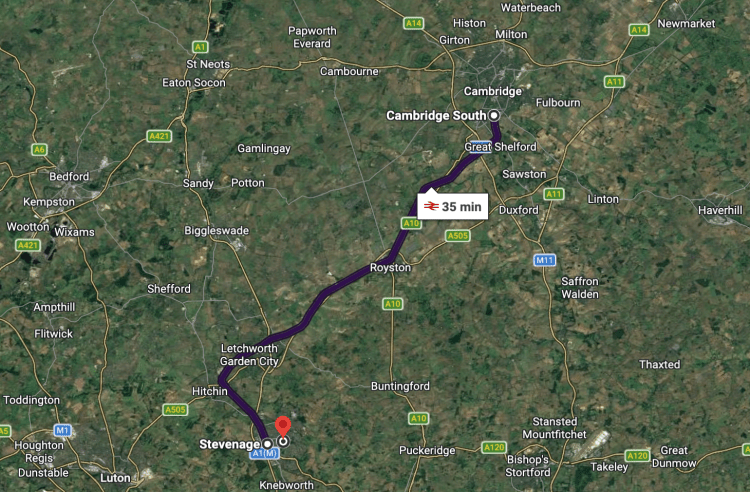
Above – 40 mins from Stevenage Station to Cambridge South
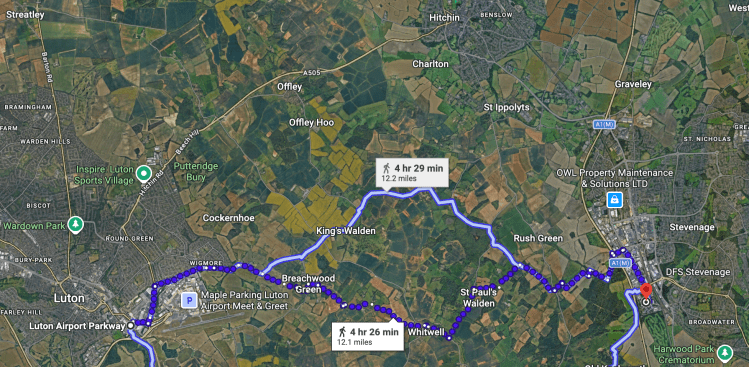
Above – Both Stevenage and Hitchin are less than 15 miles from Luton – connecting the latter to Stevenage creates the option of linking up three of East Anglia’s largest settlements by rail – Luton, Cambridge, and Norwich.
That would also make Luton airport much more convenient for Cambridge-based travellers (not that I want to encourage fossil-fuelled / environmentally destructive travel, but hey) and also makes Cambridge commutable from Luton, helping ease some of the housing pressure off of Cambridge further. (Mindful that Luton is the largest settlement in East Anglia – more people than Peterborough).
It’s a long term option – not one that I’ll live long enough to see completed given how long UK infrastructure projects take!
If you are interested in the longer term future of Cambridge, and on what happens at the local democracy meetings where decisions are made, feel free to:
- Follow me on BSky
- Spot me on LinkedIn
- Like my Facebook page
- Consider a small donation to help fund my continued research and reporting on local democracy in and around Cambridge


