
Also, Stevenage Borough Council has responded to the news of GSK moving to Cambridge – something that will have a devastating impact on the Hertfordshire New Town (and one of the coolest places on the planet back in 1990 as ten year old me thought)
I’ve saved the most complicated bit until last – Vision for the Oxford Cambridge Growth Corridor (2026) Oxford Cambridge Supercluster Board report (scroll down to the full report) and its comparisons with other clusters around the world. In a nutshell it does not ask what it is about institutional, governance, and Political structures allow places in other countries to have ‘better’ metrics than the Ox-Cam-Arc. Scroll to the foot of this post if that’s what you want to focus on.
In the meantime…
Helping out Stevenage
The briefing papers and motion passed by Stevenage Borough Council on 10 September 2026 is here
‘How is the Cambridge sci-tech community going to help Stevenage following GSK’s relocation to the CBC?’
…was the question I asked in this blogpost of July 2026
So far I’ve not heard much from Cambridge’s institutions. It would be good for some of them to show some leadership on this and start conversations with Stevenage on how Cambridge can support the future use of the very large GSK site – perhaps as a designated landing site for expanding Cambridge-based firms that need larger accommodation at lower rates of rent given Cambridge’s land price bubble.

Above – Stevenage / Even Better – a place for everyone – published in February 2026, which is meant to cover an investment period up to 2040. And now they have to review it.
Part of Cambridge’s contribution could also involve part-funding a rail connection between Luton and Stevenage in order to provide a new strategic rail link between Luton and Norwich
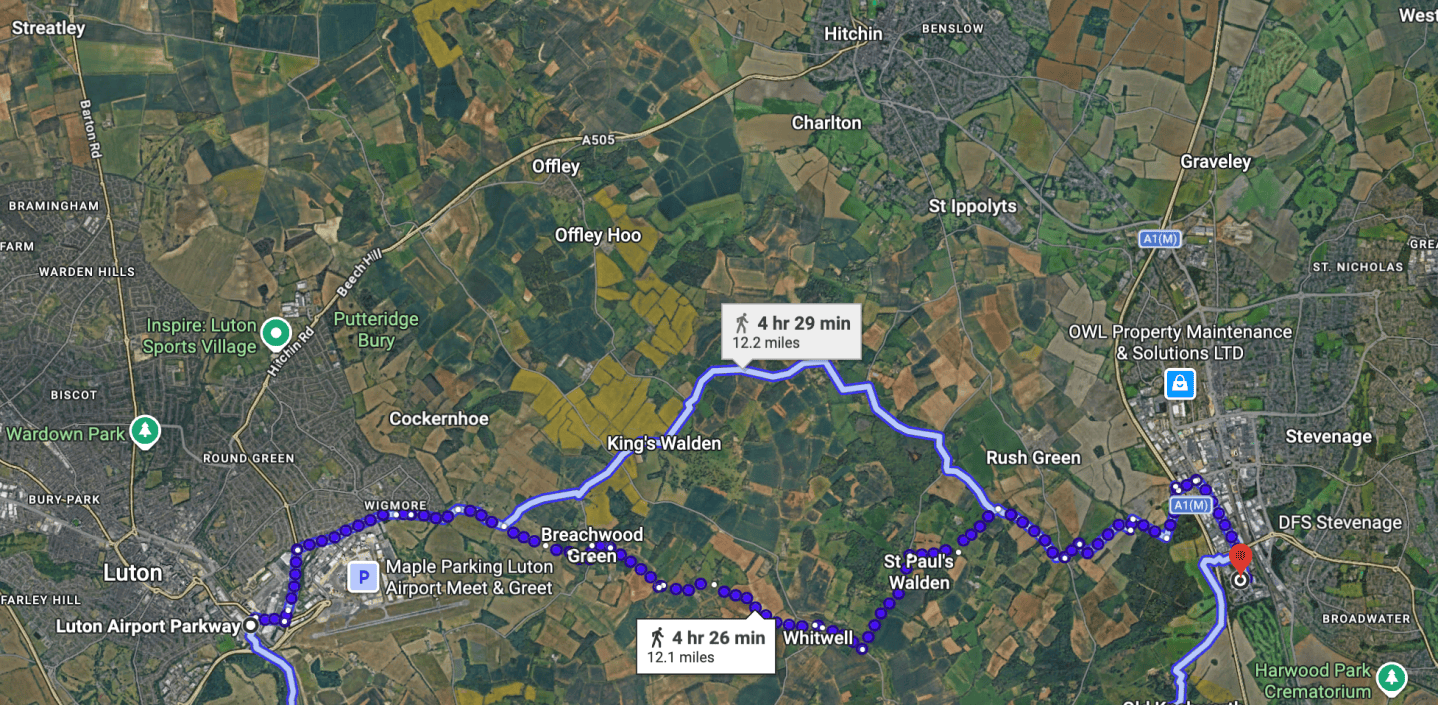
Both Stevenage and Hitchin are less than 15 miles from Luton – connecting the latter to Stevenage creates the option of linking up three of East Anglia’s largest settlements by rail – Luton, Cambridge, and Norwich.
The Ox-Cam-Arc/Corridor as a Combined/Strategic Authority
The map in the Public First report hints at what they want – the explanatory text noting that “The Oxford to Cambridge Corridor Vision’s first priority is to integrate the corridor into a single innovation ecosystem and labour market, with infrastructure like East West Rail the backbone.” (p43/p45pdf)
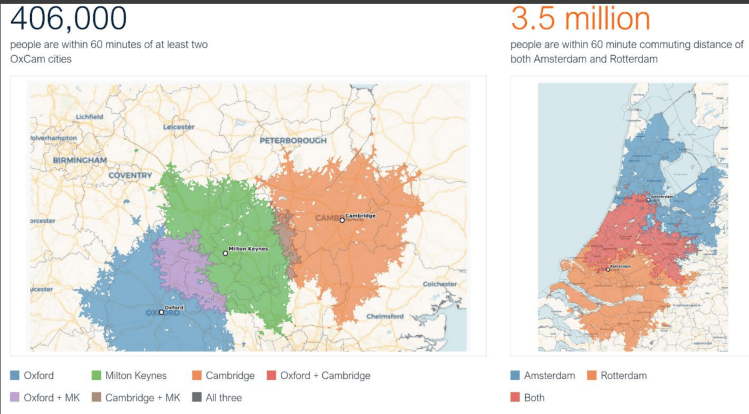
Above – Scaling OxCam (2026) Public First, p44/p46pdf
“….OxCam operates more as a collection of local economies linked individually to London than as one integrated ecosystem.”
I don’t think the comparison with Rotterdam and Amsterdam is the right one because both cities have significant industries that are not just restricted to the sci-tech bubble that the growth of the Ox-Cam-Arc is associated with. Amsterdam is a major European capital city and Rotterdam is one of the largest and most historic of trading ports in the world. Furthermore, their decades-long investment in public transport and active travel infrastructure puts them in a different league. And Schiphol Airport has six runways.
The Supercluster Board – dazzled by Oxford and Cambridge at the expense of the county towns?
“The Supercluster Region includes 11 local authorities:
- Bedford,
- Cambridge,
- Central Bedfordshire,
- Cherwell,
- Luton,
- Milton Keynes,
- North Hertfordshire,
- Oxford,
- South Cambridgeshire,
- Stevenage,
- Vale of White Horse.”
Above: “The Economic Power of the Oxford – Cambridge Growth Corridor (2026) p11)
The above report was published before the announcement that GSK was going to move to Cambridge.
“Won’t Local Government Reform and Devolution consolidate the above?”
Some of it, but not all of it.
“The recent announcement of consultation around planning areas (MHCLG 2026) that would create three authorities in the Oxford to Cambridge corridor moves in this direction and could provide spatial scaffolding for building out other governance structures.”
Above – Vision for the Oxford Cambridge Growth Corridor (2026) Oxford Cambridge Supercluster Board p61
I mentioned the existence of the report back in June 2026 but I got distracted by the legislation on the Greater Cambridge Development Corporation that I didn’t write about it. Perhaps I was hoping someone else would pick up on it!
At the moment ministers are still considering their options, so at the time of blogging we don’t know what things will look like.
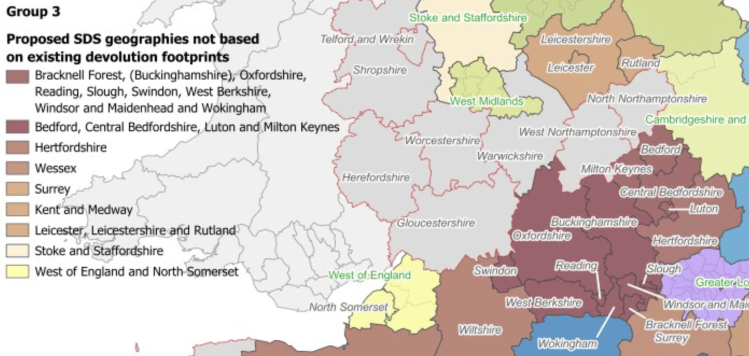
As things stand, the Cambridgeshire and Peterborough Combined Authority will become our new Strategic Authority, taking responsibility for very long term spatial planning – co-ordinating local development plans over a wider area.
Some of you may have noticed that a number of local authority areas outside the Supercluster Board area / OxCamArc fall within a proposed Strategic Authority that includes Oxfordshire and Berkshire amongst other places. How that will workout in practice I don’t know.
The Politics and democratic processes are still too difficult for private sector actors to get to grips with
This was highlighted recently in Konstantina Stamati’s paper which I wrote about here
“The most immediate risk is not collapse but gradual reputational divergence: a widening gap in which Cambridge retains its global innovation standing while progressively losing the local social licence that enables it to recruit diverse talent, maintain political support, and sustain civic relationships.”
Above – Stamati (2026) p20 / p23pdf
Coming back to the Vision for the OxCamArc by the Supercluster Board, let’s have a closer look at what they say about politics and governance.
“Enacting these recommendations would be easier in the context of a single combined authority, or even across a string of combined authorities, with core competencies in skills, transport, and economic development capable of coordinating strategic objectives and encouraging planning authorities to adopt supportive frameworks”
Above – Vision for the Oxford Cambridge Growth Corridor (2026) Oxford Cambridge Supercluster Board p61
But that’s not what we have – and the history of regional government in England is a colourful one!
“However, the currently fragmented structure of governance across the Oxford to Cambridge corridor creates challenges to coordinated strategic planning (Valler et al. 2023) that must be acknowledged in the delivery of the Supercluster vision.
…which shows that they have acknowledge the problem.
Back in 1969 Lord Redcliffe-Maud suggested a creation of regional provinces in his epic report of the Royal Commission on Local Government in England 1966-69 (I digitised my copies of the main report and maps – see the links here) which, if established might have resulted in only two provinces and three unitary councils having to work things out.
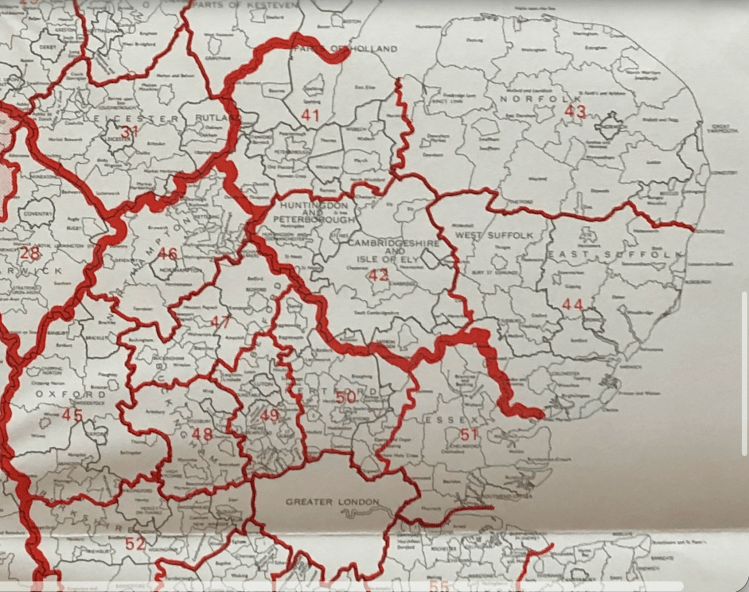
Above – Redcliffe Maud (1969) Maps to the main report, detail of the Commission’s proposals
“So what’s their plan?”
Sort of what I expected when the first proposals for local government reform came out. When ‘Greater Cambridge’ was first proposed, I said that it was unlikely that this would be a permanent set of new councils. Not least because the nearby market towns over the county borders were excluded – even though they fell within Cambridge’s economic sphere of influence just as they did back in the 1960s when Nathaniel Lichfield did his study.
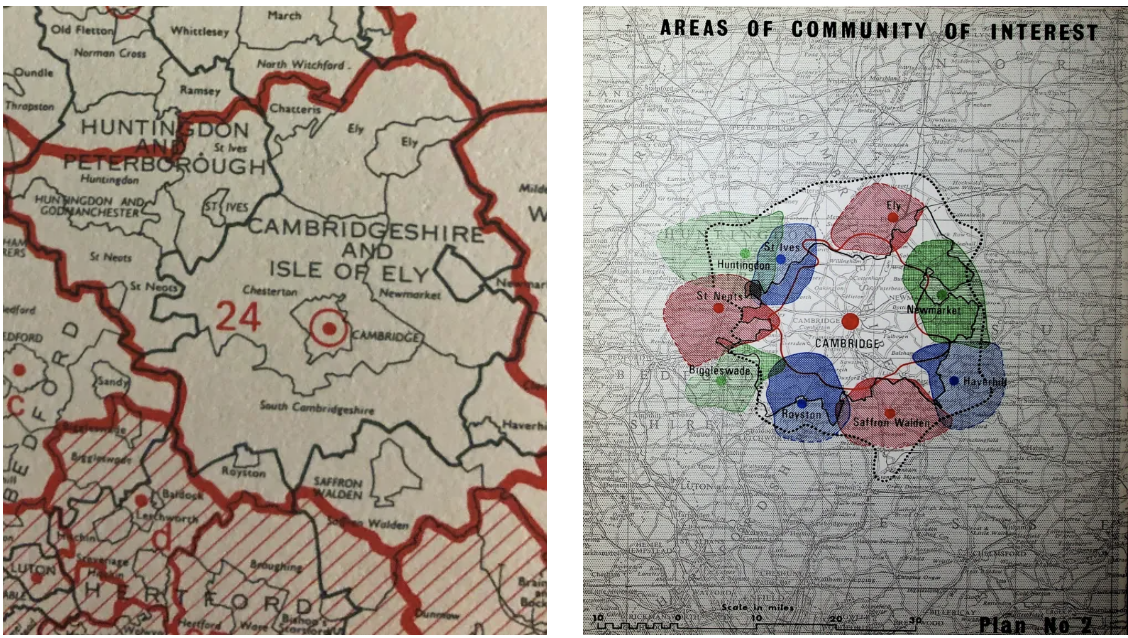
Above-Left – Redcliffe Maud (1969) proposed boundary for a Cambridge Unitary, and, Above-Right – Lichfield (1965) showing Cambridge’s economic footprint in the mid-1960s
We should find out something about LGR and the future of Greater Cambridge come the Budget on 28 October. But in terms of the here and now, the lack of transport and communications infrastructure means a single strategic/regional authority won’t have legitimacy in the eyes of the voters. Recent history has shown that the public do not like over-complicated governance structures that don’t have clear democratic oversight.
“The region is too large and diverse for a single authority, so the reform process should focus on building core competencies to support local capacity at appropriate spatial scales and coordinative mechanisms (around policy negotiation, decision-making, and delivery) to work across boundaries in the Supercluster. The initial result does not have to be the perfect governance arrangement for all time but may be more effectively conceptualised as a series of phases where the first focuses on enhancing the governance capabilities of the core (Oxfordshire, Cambridgeshire, and Bedfordshire) with an aim to expand boundaries or add areas as planning agendas begin to take root.”
Above – Vision for the Oxford Cambridge Growth Corridor (2026) Oxford Cambridge Supercluster Board p61
It may well be that if ministers get the growth they want across the Ox-Cam-Corridor/Arc (assuming that the rail-based transport infrastructure or equivalent gets built *and used*), then the way people live may evolve to make such regional arrangements more acceptable to the voting public.
Alternatively in 20 years time we might get fried by the effects of the climate emergency in which case this is all irrelevant
In which case the Supercluster Board could be putting pressure on the private sector to show some leadership on mitigation in their investment decisions – including on mitigation within their workplaces and on their buildings and assets. How many source electricity from renewables? How many have invested in (or put pressure on landlords/freeholders to invest in) making their buildings more sustainable? Including but not limited to rainwater harvesting and solar panels on roofs and car parking spaces?
The comparison of the Ox-Cam-Arc with other clusters
Going back to the Scaling OxCam (2026) report, there’s a table which summarises ‘lessons’ for OxCam.
But what assumptions are attached to those lessons, and how many of those lessons are actually transferrable?
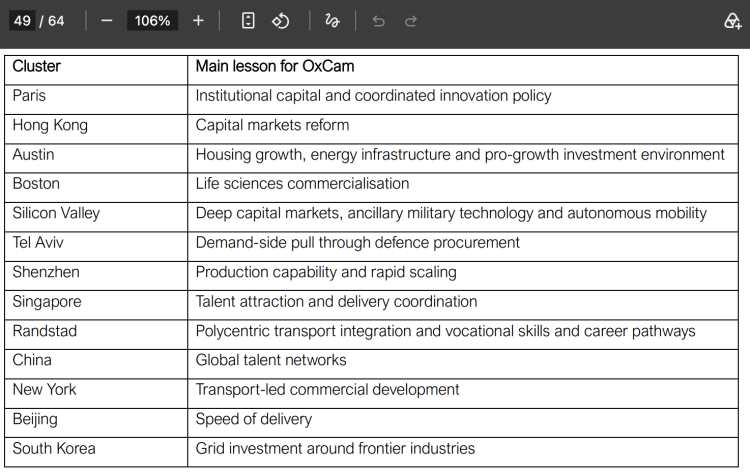
Above – Scaling OxCam (2026) Public First, p47/p49pdf
- Paris: Capital city, with municipal government having far greater powers (including revenue-raising) than their UK equivalents
- Hong Kong: Powers to reform capital markets are very unlikely to be devolved to strategic authorities
- Austin, Texas, USA: Count the number of councillors on Austin City Council, sits within Travis County that has its own functions, all of which sit within Texas State (with its own governor, house of representatives and state senate) which sit within the Federal Government. Powers to change local government arrangements differ from state to state within the US, not with the Federal tier. Such changes made to local government by individual states must comply with the constitution of the relevant US State making the change. The UK does not have a written codified constitution – hence why local and regional tiers are vulnerable to central government policy changes.
- Boston, MA, USA: Count the number of councillors on Boston City Council. Unlike Austin, the old county tier that Boston was in (Suffolk County) was abolished in 1999. The state of Massachusetts has a population that is larger than that of Scotland.
- Silicon Valley: Population of over 3million so larger than that of Wales. “Dynamics of regional leadership and decision making in Silicon Valley, a complex region composed of 40 cities and four counties without any overarching framework for governance. Formal and informal institutions shaping outcomes in the region”. What are the governance issues that they have? Ditto on democratic accountability? Think in particular of how it deals with negative externalities of the economic and business operations within its area.
I won’t go further given that for several of those areas mentioned they don’t have the sorts of checks and balances that exist in UK local and national government. Especially on infrastructure planning. Speed of delivery may well be a benefit, but unforeseen or over-looked negative externalities (big city smogs for example) and different public tolerances of them mean the comparisons are not nearly straight forward as the tables imply. Also, some of the past historical examples that sometimes crop up can be more myth than fact. Eg Italy’s dictatorship of a century ago and the trains. Furthermore, there are some things that might have nothing to do with economic growth issues per se, but are related to things completely unrelated. Such as living in a city with beautiful old buildings in the centre. Or easier access to nature and the countryside that isn’t possible in a megacity.
The harder questions involve who is willing to give up what
In Cambridge the extensive petition calling for an independent review into the growth of Cambridge secured nearly 2,000 signatures. It was presented recently to Cambridge City Council and was followed by a debate with representations from each of the four political parties represented in the Guildhall. You can watch the video in full here from 17mins, followed by further public questions which raised ‘costs of growth’ issues. You can find the text of the petition at Item 5.
My point?
Those promoting growth (and those benefiting financially from it) may have to make many more concessions to residents than they currently anticipate. This includes not getting the go-ahead for certain projects, and having to accept lower financial returns because the mitigations for negative externalities, and compensation for losses have to come from those profits.
If such concessions are not forthcoming, voters reserve the right to act accordingly at the ballot box. With The Green Party holding its biggest annual conference ever this weekend and with the Cambridge City Council elections now going ahead in May 2027, how will organisations such as the Supercluster Board, or even the University of Cambridge respond to a scenario where The Green Party is the largest party at The Guildhall in Cambridge? (Note in the past few weeks they gained one councillor – ex-Labour councillor Dave Baigent, and also lost one councillor – Elliot Tong resigning more recently and for now sitting as an Independent on both city and county councils.)
We live in increasingly turbulent times.
If you are interested in the longer term future of Cambridge, and on what happens at the local democracy meetings where decisions are made, feel free to:
- Follow me on BSky
- Spot me on LinkedIn
- Like my Facebook page
- Consider a small donation to help fund my continued research and reporting on local democracy in and around Cambridge


