The Oxford-Cambridge Supercluster will never achieve its aims if it continues to avoid the difficult questions on governance structures – something that is inherently Political. In the meantime, two senior Liberal Democrats respond to the development corporation news.
You can:
- read the OxCam Supercluster paper here
- read the news update from the Cambridge Growth Compan
- read the press release from South Cambridgeshire District Council
- read the press release from Cambridgeshire County Council
- read the short statement from Cambridge MP Daniel Zeichner
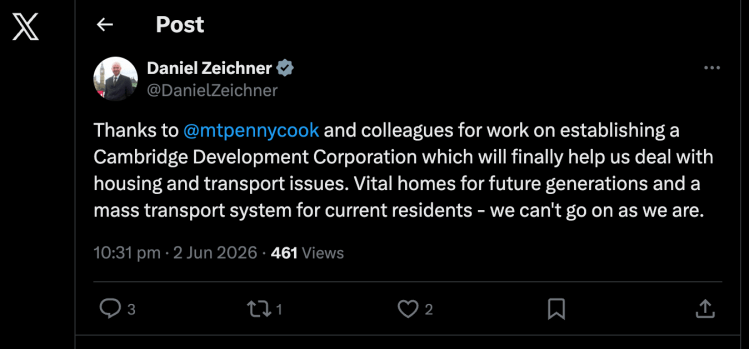
There is nothing yet from Cambridge City Council – understandable given that their leadership arrangements were only agreed a few days ago.
I remain of the view that ministers should make themselves available for a public meeting to take questions from the full councils or at least a select committee local councillors and/or Members of Parliament in Greater Cambridge on behalf of residents on the decision to establish a development corporation.
One of the striking omissions in the press releases on Cambridge’s future is the absence of local government figures in the quotations (With the exception of the Combined Authority Mayor Paul Bristow, who stated:
“Our Local Growth Plan is intentionally the most ambitious in the country, and delivering it means tackling infrastructure constraints we’ve put off for too long.
“As Mayor, I will work closely with a Development Corporation to support delivery at pace and make sure that collaboration translates into real progress on the ground.”
Above – CPCA Mayor Paul Bristow, quoted in the Government’s press release of 02 June 2026
Corporate reports on the future of Cambridge
I have been repeatedly critical (split infinitives I know) of various institutions and partnerships that have the ears of ministers and strong Westminster connections but who avoid the very difficult challenges of designing democratically-accountable governance structures.
The paper only deals with some of the issues in a superficial manner – acknowledging some of the issues but refraining from going into any depth. And it’s that depth that is the really difficult challenge that, if the OxCamArc is as good at innovation as it says it is, would be bold enough to take on those challenges. All too often the governance and public administration issues are seen as challenges for someone else to do.
Polly Curtis’ paper for Demos is a timely intervention on democratic improvement
You can read her paper here. She identifies four concepts:
- Everyday Democracy,
- Public Service Reform,
- the Citizen Economy, and
- Resilient Information Ecosystems.
Each of the above inevitably comes with baggage – my semi-comical knee-jerk trigger responses being:
- Everyday democracy -> participatory democracy -> middle class time affluent people attending workshops and telling others what to do
- Public Service Reform -> cuts, privatisation and outsourcing -> commissioning corporate consultants to do this -> pay freezes for those on the front line
- The Citizen Economy -> sounds like craft markets that don’t sell the essentials to feed the family
- Resilient Information Ecosystems -> “No you can’t censor us you freedom-hating communist!”
So, how do you overcome such knee-jerk reactions?
As Ms Curtis states:
“As the first paper in a new Demos series, The New Deal sketches out a long-term strategy for upgrading democracy. Subsequent papers will explore each of these four areas in greater depth, setting out a practical agenda for renewing trust, rebuilding civic strength, and creating a stronger democratic future.”
The Civic Voice network as a potential ally
Some of you will be aware of the national Civic Voice network And if you’ve not heard of them before, you may have heard of your local institution that is part of their network – in Cambridge’s case it’s Cambridge Past, Present and Future. Here’s Civic Voice’s Griff Rhys Jones (who nearly all of you will have watched on telly) for Cambridge Past, Present and Future back in 2022:
Above – Griff for Cambridge PPF in 2022 on the controversial CSET Busway proposals
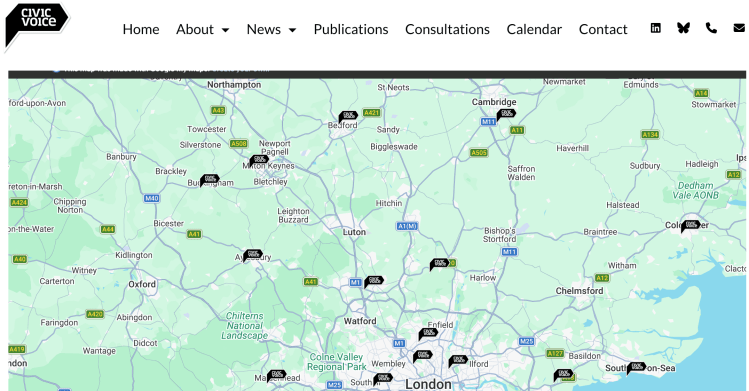
Above – who is your nearest Civic Voice member?
Cambridge Ahead and Cambridge PPF have organised joint events on the future of Cambridge in the past
The difference this time around is that we now have something tangible to work with – something that goes beyond debating the principles of what should be done. That for me means going far beyond the one-off standalone event and towards a series of events across the geographical area, covering different issues and themes. Given the timescales involved, enough flexibility needs to be given to respond to the changing wider circumstances. For example think of where we were in 2014 when the Greater Cambridge City Deal was signed off.
At these events I think it’s reasonable for the politicians and community organisations to push back against the business sector and corporate academia to persuade them not only to contribute towards the solutions needed to improve the civic and leisure infrastructure, but also to contribute the expertise of their staff towards improving and strengthening democratic oversight and accountability – and the issues that Polly Curtis raises within her report. It would be interesting to see where we might be in a decade’s time if Ms Curtis were able to bring the questions and challenges in her report to the area formerly known as the OxCamArc.
If you are interested in the longer term future of Cambridge, and on what happens at the local democracy meetings where decisions are made, feel free to:
- Consider a small donation to help fund my continued research and reporting on local democracy in and around Cambridge
- Follow me on BSky
- Spot me on LinkedIn
- Like my Facebook page


