Their most recent paper by Dr Konstantina Stamati exploring the governance shortcomings in Cambridge’s ‘innovation ecosystem’ should become a starting point for further research papers on the under-researched governance issues that affect city, county, and economic sub-region as well as the University of Cambridge and its member institutions
“Inclusive innovation fails in Cambridge not because of a lack of intent or activity, but because of a governance failure: interdependent actors need to coordinate around shared objectives.”
Above – Stamati (2026) Introduction
“What’s the big finding?”
Depends who you ask, but the big one for me was this:
“The most immediate risk is not collapse but gradual reputational divergence: a widening gap in which Cambridge retains its global innovation standing while progressively losing the local social licence that enables it to recruit diverse talent, maintain political support, and sustain civic relationships.”
Above – Stamati (2026) p20 / p23pdf
Cambridge may have already lost that local social licence judging by recent city council election results.
The Cambridge City Council elections saw the Cambridge Green Party leapfrog the Liberal Democrats to become the official opposition at the Guildhall, removing Labour’s overall majority at the same time.
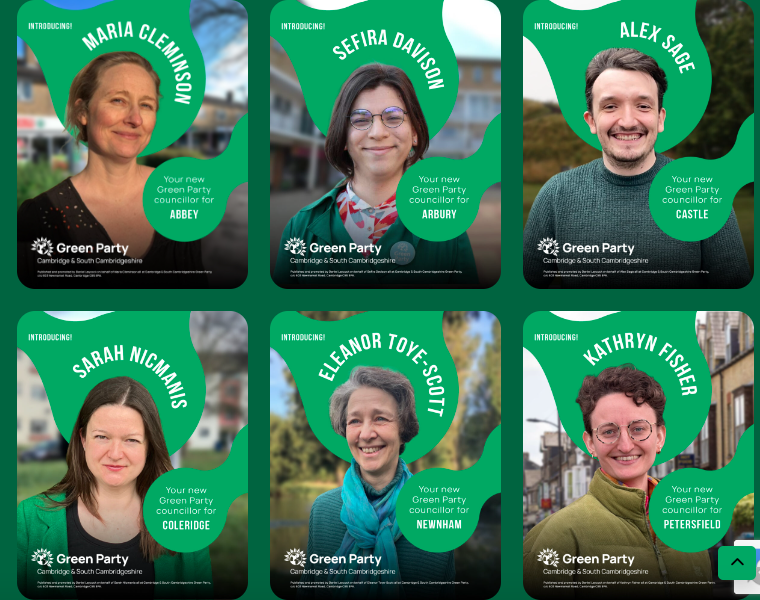
With the pause in local government reorganisation processes and the confirmation that the Cambridge City Council elections will go ahead as normal (rather than for the shadow unitary councils as previously announced), there is a very big chance that The Green Party could win further seats and become the largest party at The Guildhall. Which means that unless Labour and the Liberal Democrats combined to form either a supply-confidence agreement or a joint administration, The Green Party could lead a minority council.
“The Green Party will change the way success is measured in our economy, with new indicators that take account of the wellbeing of people and the planet. We will challenge the government and private developers when they push for growth beyond the limits of what our water, transport and public service infrastructure can support.”
Above – Policy 6, Cambridge Green Party
This for me illustrates why Cambridge’s sci-tech and university-linked communities need to start listening and engaging much more with the wider city, and co-operating and supporting residential communities both within the city boundary and in the towns and villages where many commuters carrying out essential functions live. That means showing some humility, prioritising the projects that will benefit residents (Especially those on lower incomes, those that will benefit our collective health and wellbeing, and those that narrow the town-gown divides).
The broken governance structures of Cambridge and Cambridgeshire
I’ve written lots on Cambridge’s governance structures – even standing as an independent candidate in Queen Edith’s ward back in 2023 at Sam Davies’ request (and getting 9% of the vote which was nice!) to make the case for a unitary council covering Cambridge’s economic sphere of influence. (i.e. using Redcliffe-Maud 1969, and Lichfield 1965 as the starting point for negotiations)
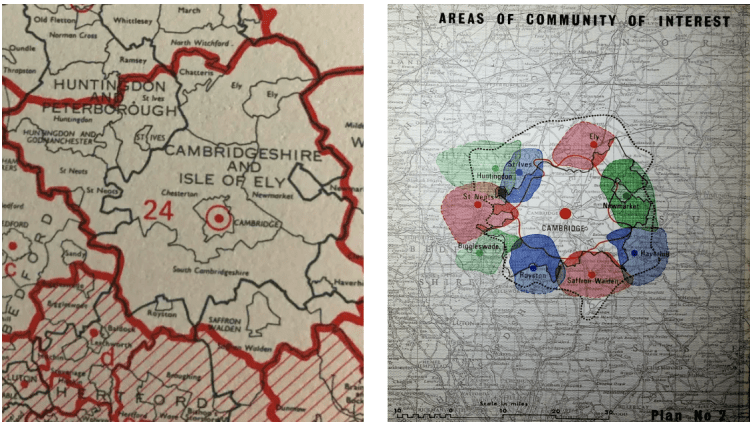
Above – Redcliffe Maud (1969) proposed boundary for a Cambridge Unitary, and Lichfield (1965) showing Cambridge’s economic footprint in the mid-1960s
It was also one of the reasons I got involved with the Cambs Unitary Campaign
Looking at Innovation institutions – some background
The context of my past blogposts have been on the gap between those taking decisions that influence the future of our city, and those of us that have to live with the consequences with little-to-no influence.
“Innovate Cambridge’s exclusivity bodes ill for the future of our city”
I wrote the above back in October 2024 following the release of a video by Innovate Cambridge – and also following prompts from former Queen Edith’s councillor Sam Davies, and journalist Terry Macalister.
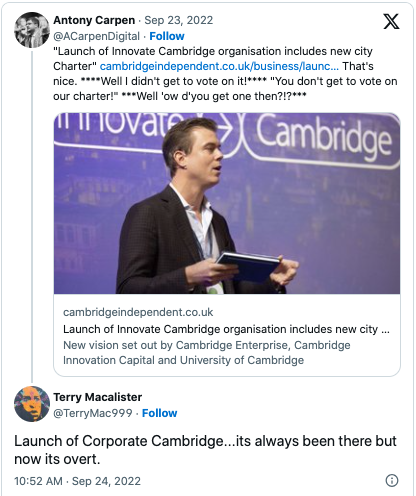
Above – Terry Macalister, 24 Sept 2022
The innovation charter that I was moaning at on Birdsite back in 2022 is still up – you can read it here. In that context I also wrote in 2022 that the University of Cambridge needed to be much more transparent with the public – especially residents, about its ambitions.
The recurring themes of the lack of democratic oversight and limited public scrutiny / input at design stage remain ongoing issues in/around Cambridge.
Above – From the Institute of Local Government at the University of Birmingham 13 Oct 2023 to me.
Am tempted to ask them for further thoughts given the scale of the Political and proposed governance changes that have since taken place.
Andrew Limb’s Inclusive Innovation Report
I blogged about Mr Limb’s report (with declared interests) here
Above – Inclusive innovation in Cambridge – Andrew Limb (2025)
As I stated in my blogpost, the statement from Mr Limb that stood out was:
“Those who have gained wealth, power, and valuable skills through the success of the innovation economy must be willing not just to donate, but to actively transfer those skills and capabilities. This shift would move less advantaged communities away from reliance on handouts and toward real agency over their own futures.”
“The reason why this is significant is because it demands the affluent and influential step far outside of their comfort zones and meet those with the least in our city on equal terms.“
The skills and learning challenge
The section where Dr Stamati explains her proposed model highlights a chronic problem Cambridge has faced, and that is the decline of lifelong learning provision. I wrote about the wider issues back in 2023 in the context of citizenship education and the collective lack of knowledge about how decisions are made that affect our futures and our day-to-day lives, especially in government policies, public service provision & delivery, and laws (rights and responsibilities).
How many people in Innovation Cambridge circles are familiar with basic public policy-making processes? Or the basic processes involved in making new laws? Or on the rights and duties of local councils?
The same questions could be put to any adults in and around our city. We have a very recent high profile case study of where politicians took for granted the public’s collective knowledge of political processes *and* their consent for the policies being implemented by what was the Greater Cambridge City Deal, later rebranded as the Greater Cambridge Partnership. That was the abandoned congestion charge.
Cambridge has no civic adult education / lifelong learning college
This for me is one of Cambridge’s biggest structural weaknesses: the inability to:
- train up its own residents in the trades and professions that are essential to the functioning of the city
- educate its own residents in civics and contemporary issues so that a critical mass of them are able to scrutinise and provide informed consent for major decisions on the future of our city
That does not mean residents have to know 100% about everything. Instead it means enough of the public know enough about the issues they care about to know a) where to find further information, and b) who to contact and put questions to / hold accountable politically.
This then brings us back to the point Mr Limb made in his 2025 report – what is Cambridge’s Innovation Community prepared to offer to enable ordinary residents interested to undertake new training and education opportunities so that they can fill the skills shortages – especially at technical level, which are essential to the economic success of Cambridge? Because at the moment the Combined Authority’s consistent line has been that it will only fund what ministers provide it both funding for, and a firm policy direction for.
And I’ve reached the logical end of where public questions for a new large lifelong learning college can get me with the CPCA.
Dr Stamati’s governance framework
Looking at table 5.3, I’ve stated above that one of the institutions or functions that Cambridge needs *does not exist*. (ie. the lifelong learning college). Furthermore, in order to create it, ministerial approval is required unless the Prime Minister makes good on his devolution ideals.
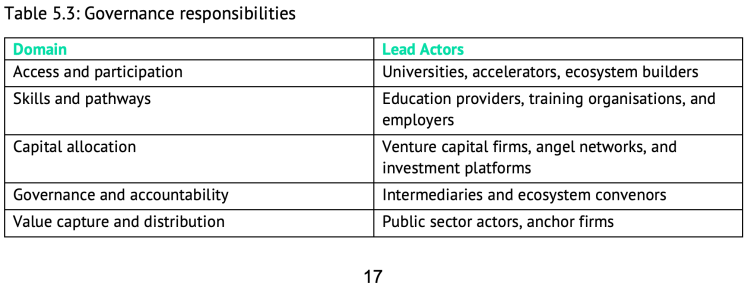
Above – Stamati (2026) p17 / p20pdf
The risk of resistance and opposition
Dr Stamati raises the interesting case of ‘resistance from high status actors‘ to her proposals. It would be interesting to see this risk explored in depth. This is because this might also reveal barriers that exist in a host of other areas. As she states:
“Actors benefiting from informational asymmetries may resist transparency, and organisations under strong performance pressure may prioritise speed over coordination. Adoption will therefore vary across actors, and resistance is likely where existing arrangements confer advantage or where the perceived costs of participation outweigh immediate benefits. In particular, actors operating within established networks or benefiting from existing decision-making opacity may have limited incentives to engage without clear strategic or reputational returns.”
Above – Stamati (2026) p13 / p16pdf
One high profile example could be that transparency and accountability requirements proposed by Dr Stamati forces the issue on transparency of where Cambridge University and its member colleges choose to invest funds. Cambridge University’s investments in the arms trade remains a live issue. Given the size of the University and its colleges as institutions, questions on whether all of them should be held to the same standard of transparency, or whether the colleges should have the freedoms to decide for themselves, becomes more high profile. A different example might involve one part of the University of Cambridge promoting inclusive innovation while another part of the same institution may want to preserve social exclusivity that the institution is associated with. Again, this remains a live issue.
Either way, the Cambridge City Council elections are likely to bring governance and accountability issues to the fore in eight months time.
If you are interested in the longer term future of Cambridge, and on what happens at the local democracy meetings where decisions are made, feel free to:
- Follow me on BSky
- Spot me on LinkedIn
- Like my Facebook page
- Consider a small donation to help fund my continued research and reporting on local democracy in and around Cambridge


