A pause in the reorganisation of local government in England means that those local councils that were otherwise due to have local elections in 2027 in the absence of a restructure, will now go ahead as planned
It was a miserable day in Parliament for the Housing Communities & Local Government Secretary Angela Rayner as the policy of local government reorganisation ran up against Judicial Review proceedings – and advice from in-house lawyers that the Government might lose.
You can:
- Listen to the summary from the Interim Permanent Secretary at the Ministry of Housing, Communities and Local Government to the Public Accounts Committee on 07 Sept 2026
- Watch Angela Rayner’s statement to the Commons followed by over 90 minutes of questions from MPs
- Read the letter from the Minister for Local Government to the leaders of local councils in England
“The review, which I will lead, will look at the programme as a whole and this will include reviewing the 14 decisions made in July. Cambridgeshire and Peterborough and West Sussex, where decisions have not yet been taken, will be considered as part of the review. The new councils for East Surrey and West Surrey are unaffected and outside of this process because they are already established in law.”
Above – Jim McMahon MP, Minister for Local Government, 07 September 2026
“On what grounds were JR applications made?”
Most JR applications are about due process, and underpin a core principle of evidence-based policy-making. Did the ministers have all of the relevant evidence to hand when they made their decision? Did they ensure that things like impact assessments (the impact of policies on different cohorts of society – eg those that might be particularly vulnerable to a policy change, or Environmental Impact Assessments for environment, climate and ecology) got commissioned and informed policy advice for ministers to consider?
‘”We’ve reached a clear conclusion. This process is deeply flawed, it is rushed, it lacks proper evidence and it risks creating huge disruption for local communities.”
It’s clear that the returning Housing Secretary Angela Rayner, appointed by Andy Burnham MP, took the view following legal advice from departmental lawyers that there was an unacceptable risk of an application for a judicial review succeeding. Hence her statement to the Commons today.
The threat of judicial review is a normal part of policy-making
Ministers don’t like to lose judicial reviews because as well as the political embarrassment that goes with being told they cannot proceed as planned, it also means they have to go back through the policy making processes and do things properly. This is what happened with the applications to extract oil and gas from the Rosebank oil field when the Edinburgh Court of Sessions blocked the Government’s approval following an application by Greenpeace and Uplift.
Hence ministers had to go through the process all over again (See the Rosebank pages and documents here – including the list and content of the many objections) with a recommendation from civil servants to be put before the Energy and Climate Change Secretary in the very near future.
The media’s lack of understanding of who has what legal powers and duties has led to headlines about Andy Burnham and the two oil fields. Legislation in the UK ***very rarely*** mentions the Prime Minister when it comes to enabling legislation or the imposition of duties. When it comes to empowering ministers or requiring them to do something, it is almost always ‘The Secretary of State’ or ‘A Minister of the Crown’. This is particularly the case where ministers are acting in a ‘quasi-judicial function’ where they have to make a judgement based on the evidence – judgements that can be challenged in the High Court via judicial reviews amongst other things. Any Prime Minister foolish enough to try and influence or pre-judge such applications would find their government on the receiving end of judicial review applications.
“So where does that leave Cambridgeshire?”
The local elections for 2027 will take place as follows:
- East Cambridgeshire District Council (Conservative controlled) – full elections
- Fenland District Council (Conservative controlled) – full elections
- Cambridge City Council (Labour minority-led) – A third of seats up for election
Which could be a potential nightmare for the Cambridgeshire Conservatives
Here’s what happened last year at the Cambridgeshire County Council elections
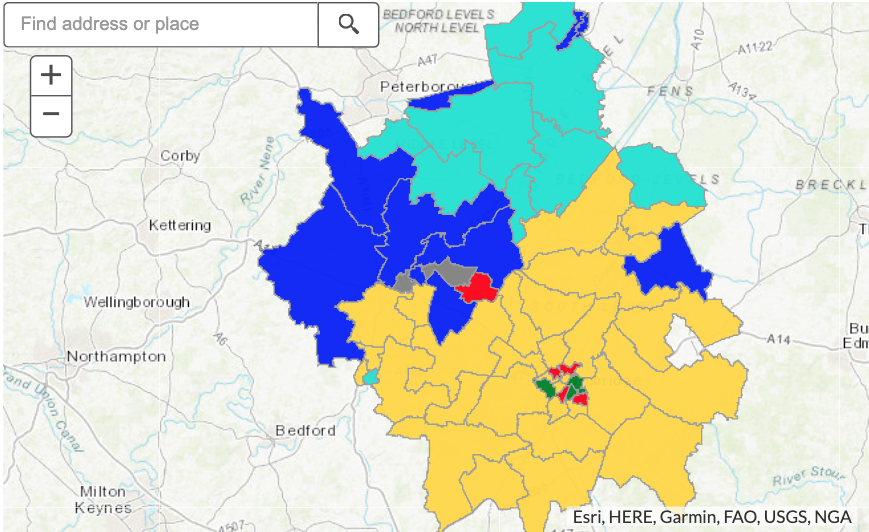
Above – Cambridgeshire County Council elections May 2025
The Cambridgeshire Conservatives got crushed in a double-pincer, with voters voting for the Liberal Democrats across swathes of East Cambridgeshire, and for TeamNigel across most of Fenland District. The loss of the political and also social infrastructure that could come with the loss of Political control of both East Cambs and Fenland would represent an incredible decline in the fortunes of a political party that until fairly recently was dominant across the county.
Cambridge MP Daniel Zeichner asks Angela Rayner if new council boundaries should be decided not on the existing district borders, but economic growth.
Unfortunately MPs ran out of time to discuss Mr Zeichner’s tabled question on the OxCamArc but given the news leaking out about local government reorganisation, only sought reassurances on the Greater Cambridge Development Corporation. This was criticised by his Liberal Democrat general election opponent Cllr Cheney Payne
This was followed by Mr Zeichner’s intervention in the debate on local government reorganisation, indicating support for the Secretary of State Angela Rayner and her decision to pause and have the Minister for Local Government Jim McMahon MP (former leader of Oldham Borough Council) review the policy for the council areas listed in the statement.
Incidents in Dover and Portsmouth
I was reminded of this video by Zack Polanski AM of the Green Party from September 2025.
Above – Zack Polanski of The Green Party, 21 September 2025
The images of large numbers of men dressed all in black with face coverings blocking roads in the context of what they were chanting is inevitably menacing if you look like me.
“What does an immigrant look like?”
Here’s a former Conservative and later UKIP MP being asked that question on Channel 4 News back in 2013. And some of us are old enough to remember the then Conservative Leader William Hague’s much-condemned ‘foreign land’ remarks from 2001 which the Liberal Democrats leader the late Charles Kennedy called him out on.
This is how Germany’s DW reported what happened. And this is how France24 reported the same.
The exchanges in the Commons with Sarah Jones MP, the Minister of State for Policing, were miserable. As has been the UK media coverage. Two of the most contrasting takes are below.
Meanwhile the right wing print press – in particular the so-called ‘quality papers’ fan the flames, both The Times…
How does that compare with their coverage of the climate protesters?
Exactly.
Also, how much did Kent Police know in advance? Expect the Home Office Select Committee to be looking into this in the near future.
And as for public sentiment on ways of protesting…
Successive governments still have not got a grip of the hybrid wars being fought against them by hostile individuals and institutions
There’s only so much the likes of Full Fact can do.
In the meantime, tumbleweed rolls past the offices of OfCom
The impotence of central government against the forces undermining society – especially online, is depressing to see.
Where is the co-ordinated international response that also includes peace-making efforts where there is war, and investment where there is poverty?
This was followed (sandwiched between a trio of TeamNigel MPs) by Sian Berry MP (Greens – Brighton Pavilion) highlighting the intimidation felt on our streets. This was towards the end of the exchanges where MPs from the smaller parties had their questions heard.
The thing is policy makers, trade negotiators, heads of government and diplomats have known about the long term transfer of wealth from the global south to the industrialised north for decades. Anyone who has studied anything to do with international economics, trade, poverty, and development at A-level or University would be able to summarise the essentials.
The lack of a resourced and co-ordinated response speaks volumes of the institutions that are responsible and/or influential in these fields.
In the meantime as politics and democracy remains in such low esteem in the eyes of the public, I was reminded of something by an interview at the TeamNigel conference. If more of us don’t get involved in democracy and democratic processes, we leave the doors open to chaps like this one in the hat to take control instead.
Above – I have no words.
If you are interested in the longer term future of Cambridge, and on what happens at the local democracy meetings where decisions are made, feel free to:
- Follow me on BSky
- Spot me on LinkedIn
- Like my Facebook page
- Consider a small donation to help fund my continued research and reporting on local democracy in and around Cambridge


