Papers in the Cambridgeshire and Peterborough Combined Authority’s Skills Committee contain principles that go beyond a specific cohort that is the focus of government policy
The meeting papers for the Adult Skills Committee of 14 September 2026 are here and the documents in Item 9 contain slides on the Youth Employment and Participation Strategy for 14-25 year olds. It’s a strategy that covers 2026-36, and inevitably a lot of things are going to change in that period of time. Not least the proposals for housing growth and new transport infrastructure, the nature of which are still yet to be agreed.
The conditions for participation apply to everyone
The context of this is dealing with the chronic youth unemployment challenge but this could easily be applied to so many other policy areas. For example the ‘One Connected Place’ experience sounds similar to the theme of One Stop Shops, the experiences of which have been assessed in academic research papers featuring a range of countries and the problems they have had in designing and building them. The same goes for ‘no wrong door’ which was picked up in a report by Australia’s Attorney General in 2009 on Access to Justice, with a section on accessing information, explored: “No wrong number, no wrong door – improving access to information for people with legal issues”. (See p79 here). This was specifically the case for complex issues that cut across public sector silos. For those young people who are NEET – Not in Education, Employment, or Training, the challenges they face are more likely to be complex and involve more than one public service area.
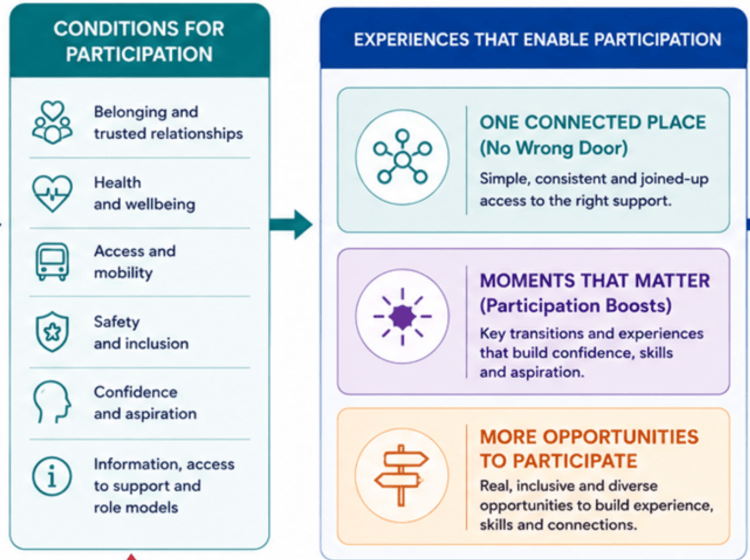
Above – Detail from the Theory of Change for youth participation – Item 9 Appendix A p9
The wider context is applying the principles to the lives that teenagers and young adults are actually living.
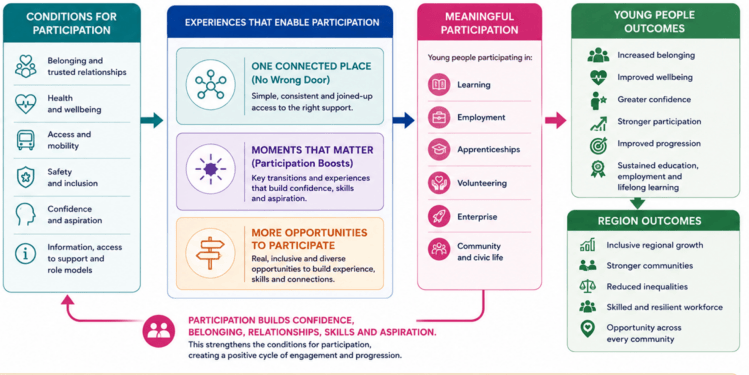
Above – Theory of Change for youth participation – Item 9 Appendix A p9
How do the conditions of participation apply to adults?
From a personal perspective, none of the conditions are met. I explored some of the underlying issues of belonging in this recent blogpost, identifying three points important to developing a sense of belonging within a community, and what are essential to the forming of strong local social friendships and relationships:
- Proximity (geographical)
- Regularity (frequency)
- Affinity (things you have in common with another person/other people)
In that blogpost I looked at a range of government policies and social changes that undermined all of these things – including the conversion of homes designed for families into short-term lets (whether for AirBnB or student accommodation). And more than a few of those are former council properties, with the great sell-off still happening at a faster rate than councils can build them, despite recent legislative changes restricting the types of homes (Eg recently-built ones) and size of discounts available.
Wider context from Cambridge City Council’s Housing Advisory Board papers
You can read the papers for the meeting on 14 September 2026 here
The report that is of interest as always is the one that takes up the most memory – which means it has pictures and diagrams in it which make for easier reading. In principle.
The Tenant Satisfaction Measures Report at item 8 (the briefing and the full report at Appendix A) are worth browsing through
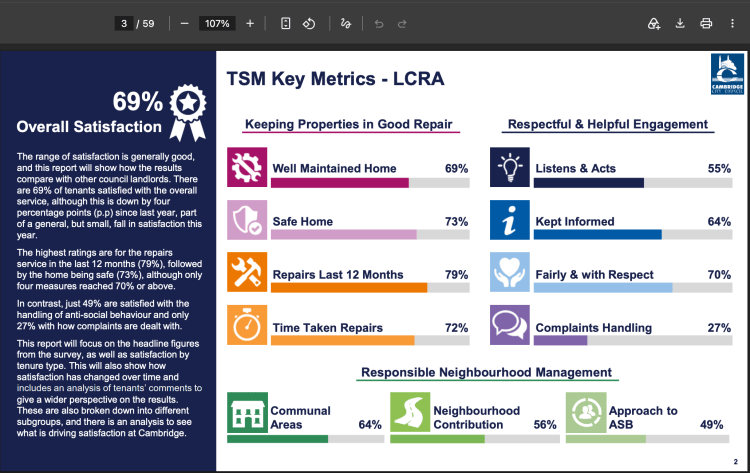
Above – Appendix A of Item 8, p3
The 49% Satisfaction Rate with the Approach to Anti-Social Behaviour (ASB) is of particular concern
That said, the authors caution that this statistic tends to be lower compared to other satisfaction measures across the sector, so it’s not just Cambridge City Council that struggles with this.
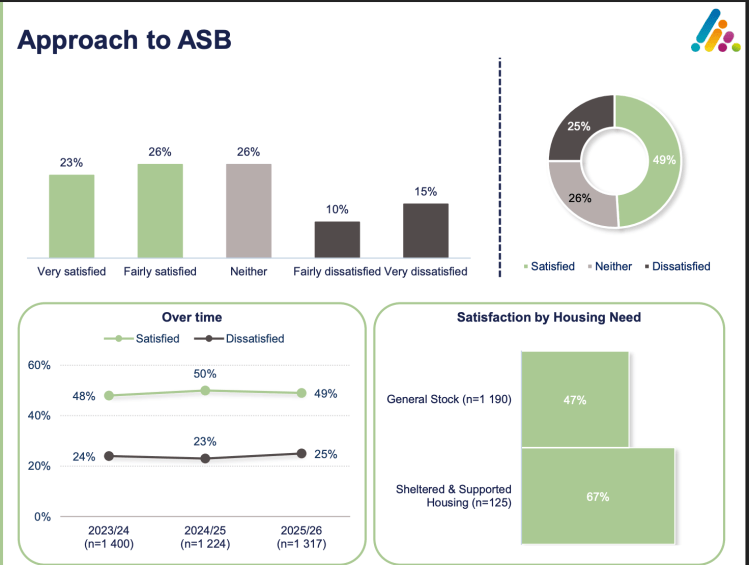
Above – Appendix A of Item 8, p14
One example of where ASB has a knock-on impact on the fortunes of other service providers is where crime and vandalism against buses and bus drivers results in the withdrawal of bus services by bus companies. Which means young people living in those neighbourhoods face a further barrier to getting to places of work, training, or education.
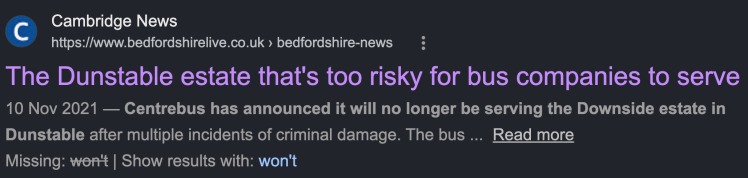
Above – don’t get me started on my ReachPLC issues with the above search result!
The problem for those working in the adult and youth skills and training is that the problem that affects their policy area’s overall performance is outside of their control and influence.
Bus Stops – who is responsible for their maintenance and upkeep following vandalism?
There’s a debate in Westminster Hall on Standards Bus Stops on Wednesday 09 September from 11am which may throw some light on what all too often is a very visible sign of ASB in neighbourhoods. One of the problems as the Cambridge Bus Users explain in this blogpost is responsibility for repairs.
It’s not that repairing a single bus stop makes things better, rather it’s more related to the maintenance of the built environment and more generally the wider presence of the state and public services in our neighbourhoods – something which in an ASB context can make it feel like the law is no longer being enforced and some are acting accordingly – for example in the case of the noise of illegally-modified engines that Cambridge Liberal Democrats are campaigning on,
Moments that matter, and participation boosts
I mentioned in recent blogposts about ‘the great scattering’ when people leave school, college, and/or university – and in this post on how institutions did not address it during my teenage years in the 1990s. Which is why it’s good to see the 2026-36 strategy mentioned in the Skills Committee papers addresses this.
“The most vulnerable points include movement from school to post-16 provision, transitions for young people with SEND or Education, Health and Care Plans, leaving alternative provision or care, and the period after an unsuccessful course, apprenticeship or job. Programmes can create an initial step, but progress can be lost when follow-up ends or ownership is unclear.”
Above – Theory of Change for youth participation – Item 9 Appendix A p5
This brings us back to the sense of belonging as well as raising wider questions for policy makers on the fragmentation of public service providers. Because under the current structures there’s no responsibility or incentive to follow-up what leavers go onto – although some have started following the private school tradition of ‘old boys networks’ – or rather that of university alumni societies. Inevitably the resources are not there to match what the private sector institutions can manage, so building up an equivalent will take much longer if public policy changes are not forthcoming.
The transitions matter for adults too – especially in the case of unemployment
Vicky Spratt for the iPaper on FB here explains the changing nature of the Job Centre on a recent visit to one in Blackpool. (Also featured in the £article here). I’d like to think the process is different to what I experienced coming out of the civil service 15 years ago, and with hindsight I would have done things differently. However, with the Tory-led austerity being done in the manner that it was (no I still haven’t forgiven them!) the number of people with similar skills sets in similar fields all being made unemployed in a short period of time was not a pleasant experience for the tens of thousands that experienced it.
Building on what already works for young people and extending it
Take what is now The King’s Trust and their 12 week development programme here.
Not long after graduating over 20 years ago I found myself underemployed while doing part-time study at Anglia Ruskin for what became a Post-Graduate Diploma in Contemporary History. (Effectively the history of the EU to 2002). Hence I spotted it somewhere and signed up for it because as I told the course leaders (one of whom was at school with my older brother!) that I was bored and needed a challenge that had nothing to do with academia. The result was embarking on something that over that three month period was far more challenging (but in a good way) than anything I had faced in my course over three years at university. Which I still find confusing to this day.
What would a similar 12 week programme for adults of different age ranges and backgrounds be like? What impact might it have in the longer term on community relations and participation more widely?
If you are interested in the longer term future of Cambridge, and on what happens at the local democracy meetings where decisions are made, feel free to:
- Follow me on BSky
- Spot me on LinkedIn
- Like my Facebook page
- Consider a small donation to help fund my continued research and reporting on local democracy in and around Cambridge


