
As mentioned in my earlier blogpost this application is outside the draft local plan proposals so expect heavy lobbying and expensive barristers at the Local Plan Examination in Public
TL/DR? Go and meet them in Shelford on:
- Sat 10 Oct 2026
Details at the bottom of https://cambridgesouth.co.uk/
To see the slides, go to here
If like me you prefer to download the file, click on the triple-horizontal dots on the bottom bar and the menu will pop up. Take your pick.

Above – from Pigeon and Lands Improvement land promoters
Great Shelford Parish Council, within which the proposals are in, has published a statement on its FB Page opposing the plans.
“The parish council agreed that it is strongly opposed to this proposed development. We consider it to be an existential threat to our village and the way of life of its residents. It is also a threat to Cambridge and its character as a small, compact city surrounded by individual necklace villages, each with their individual character.
“The proposed development will triple the size of Great Shelford, eliminate all the greenbelt on the north west of the village and destroy an area our residents enjoy frequently for walking, cycling and horse riding. It will also eliminate arable land at a time when growing our own food is becoming increasingly important.”
Above – Great Shelford Parish Council 06 October 2026
Given the size of the development, the proposals will inevitably be decided by the Planning Committee of the Greater Cambridge Development Corporation – but that does not mean the applicants will get an easier ride.
One action local residents could undertake is to contact their local MP via https://www.writetothem.com/ (in this case Pippa Heylings MP (LibDems – South Cambridgeshire) and ask her to contact the Minister for Housing and Planning asking if he can provide some ‘in principle guidance’ for planning applications submitted by developers on land that has not been designated for development in the current or draft local development plan.
Pigeon Land has got form promoting developments on land not designated in the current local plan as suitable for development.
They have an outstanding application that is being determined by South Cambridgeshire District Council’s Planning Committee next week (See here, item 5) where the Planning Officer’s recommendation is to refuse the application.
“With regards to criterion a of policy S/7, the provision of up to 138 dwellings outside the development framework [i.e. Local Plan and Neighbourhood Plan] is inappropriate in relation to the scale, density, and character of the village. The proposal is situated outside of the development framework and would not be in accordance with the development level associated with Hardwick.”
Above – Item 5, Officer’s Report p27, para 11.4
“The Council does not have an unmet need for housing and can presently demonstrate 7.82 years of housing land supply…Therefore, the proposal would not accord with point J of policy S5. It is worth noting that the site would not be in a suitable location nor scale to not put undue pressure on limited local facilities (S5(J(i)). Point ii of J is not applicable to this proposal.“
“
Above – Item 5, Officer’s Report p29, para 11.11
Great Shelford also has a Neighbourhood Plan with Stapleford.
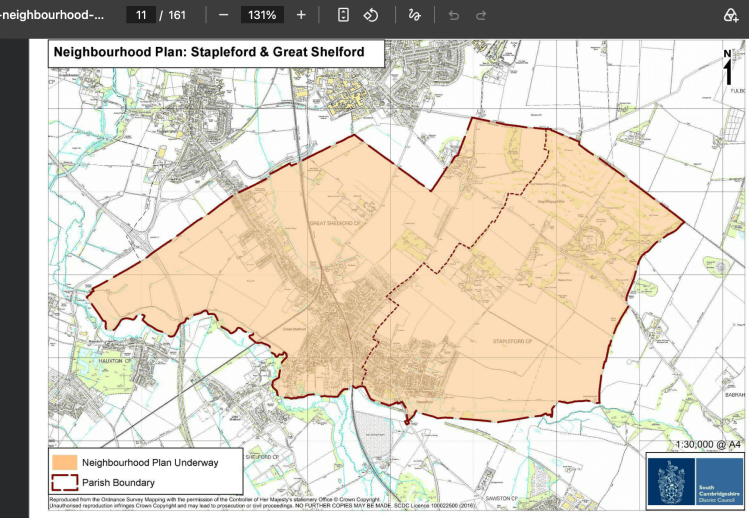
Above – The Stapleford and Great Shelford Neighbourhood Plan [PDF, 13.5MB] was made (adopted) on 2 October 2025.”
(The landing page here says the next review is … was due on 02 October 2026 so the GCSP may want to have a look at it!)
And finally…
The site sits within the Cambridge Green Belt both in the current, and in the draft local plan
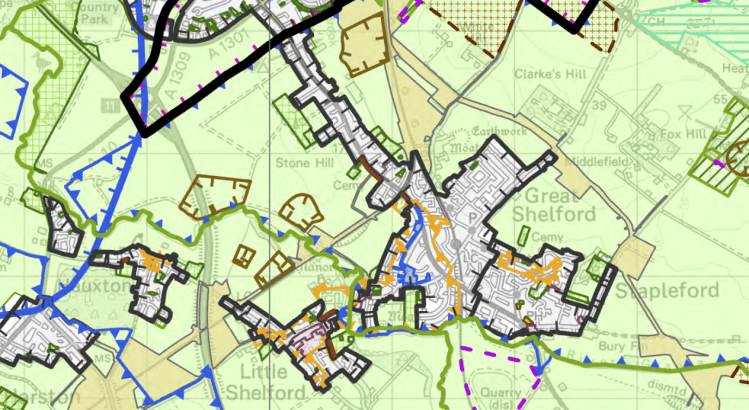
Above – detail of Proposed Submission Greater Cambridge Local Plan Policies Map (2026) 11.63 MB (which is the second document in the table in the document library here – the third one is a detailed map of the proposals for the city of Cambridge).
Note that the Green Belt guidance was updated…just over a week ago. See here
“Development in the Green Belt is inappropriate unless it falls within one of the categories in policy GB7.”
Above – GB6 in National Planning Policy Framework, Chapter 13: Protecting Green Belt land
And looking at the list of exemptions in GB7, I can’t see how *any* would apply to this site.
“So…basically it means they cannot build there, right?”
As we have seen in the past, ministers can and do overrule planning refusals on the recommendation of planning inspectors – and have also overruled recommendations of refusal from planning inspectors as we saw with the Honey Hill waterworks relocation plan – until the Chancellor effectively blocked the work by pulling the funding needed for the project after Anglian Water told ministers the costs had more than trebled.
That said, when the Cambridge Growth Company’s officers along with Peter Freeman were cross-examined by local councillors in both Cambridge City and South Cambridgeshire District, he made a number of firm commitments about the integrity of local plans, neighbourhood plans, and local plan-making processes.
On the 9th December 2025 the CGC (now CamDevCo) Chairman and senior officers appeared before Cambridge City Council councillors. You can read the summary provided by council officers from the section that follows the public question asked by some crazy fool (Me!) who turns up to council meetings for fun.
- “Residents require greater opportunities to question the Growth Company, its leadership, developers, and lobbyists.
- Research by academic Dr Cleo Valentine in neuro‑architecture highlights that current developments may negatively impact mental wellbeing.”
The first point corresponds with my conclusion about the need to improve communication between developers and residents in my previous blogpost.
As far as Great Shelford is concerned, the top two points of interest I picked out are:
“Planning issues – compliance with new local plan, hierarchy of development in new local plan, devolved planning powers
- [The Cambridge Growth Company] was reviewing its work and aligning with evidence as part of the Local Plan, avoiding duplication wherever possible. The CGC committed to respecting the proposed hierarchy of development in the new local plan.
- “There was no plan to interfere with neighbourhood plans, the focus was on major strategic sites.”
So the question here is whether the Greater Cambridge Development Corporation will consider the site to be a ‘strategic site’
“Hasn’t the list of strategic sites already been drawn up”
It has – it’s in the Greater Cambridge Local Plan Infrastructure Delivery Plan: Strategic Sites Appendix (2026) (1.96 MB).
And the land surrounding Great Shelford Rugby Club isn’t in there. Which probably means the land promoters will spend a fortune on an expensive planning KC to represent them to try to get the site included – similar to what we saw in 2016-17 Examination in Public hearings that I filmed for the Federation of Greater Cambridge Residents’ Associations
This was followed by cross-examination by South Cambridgeshire District Councillors.
You can read the full set of notes from the council officers here
“The CGC was in support of the Local Plan, and it was recognised that the Local Plan was the first phase to deliver growth within the local area. The CGC was looking to identify how this could be built on.”
Above – South Cambridgeshire District Council Overview & Scrutiny Cttee 29 Jan 2026, item 4
“So…at this stage the outlook isn’t good for the applicant/promoters, right?”
At this stage, no. I’d be laughing it out of the consultation venue.
***However***
Let’s remind ourselves of what the Minister for Housing and Planning Matthew Pennycook MP instructed Mr Freeman to do in his appointment letter of 31 October 2024
“When it comes to the growth strategy, development on a more dispersed geographical footprint is perfectly acceptable, but one or more contiguous urban extensions of the city must be core components of the vision the Growth Company brings forward, in order to maximise the benefits of agglomeration”
Above – Letter from the Minister to the Chair of the Cambridge Growth Company, 31 October 2024
Which means that if the proposals are to get built, there are a host of hoops and hurdles to deal with.
- The vision of the Greater Cambridge Development Corporation *will have to be signed off by the board* on which the leaders of all of the local councils *and* the Combined Authority Mayor will all have seats at.
- I can’t imagine such a major public document being prepared without a major public consultation
- The vision would have to indicate which *additional* parts of the Green Belt would be taken out and redesignated as development land
- Only then could a planning application be put forward with a high chance of being approved.
So long as the land remains in Green Belt, the developers would need to demonstrate an insufficient land supply. And as the planning application mentioned earlier demonstrates that South Cambridgeshire has a 7.83 year supply of land to 2031 (item 4, p32, para 11.25), there is still a very long way for them to go.
Which is also why there are some curious phrases in their document.
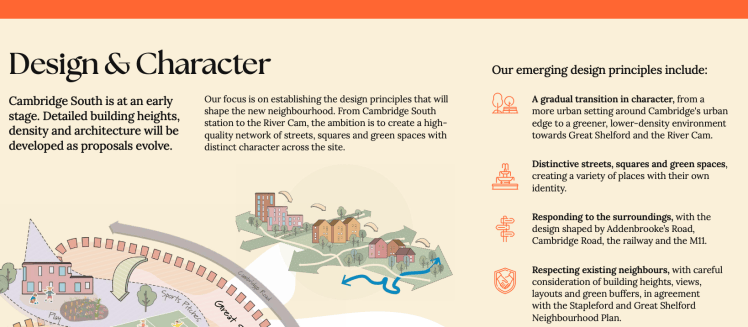
Above – Cambridge South slides p8
“Our emerging design principles include…”
…have they read p52 ono of the Stapleford and Great Shelford Neighbourhood Plan which builds on the local plan with further text on design principles?
Slides 13-15 talk about ‘community facilities’
Yet a development for 4,000 homes is likely to have a population of over 10,000 people. And Stapleford & Great Shelford together already have a population of nearly 7,000 people. So whatever community facilities they propose, the largest of them will need to serve a community approaching 20,000 people. Which is the size of a town.
So if the development does ultimately go ahead despite the protections, I’d expect some exemplary facilities, amenities, open spaces and more that would be in the top 1% of places to live in the country, with the developers and consultants taking hits on their profits from the development. How much are they prepared to forego?
Recommended reading – Rob Cowan on Essential Urban Design
…which you can buy from Hive here
I wrote about his splendid book on urban design way back in 2021. It’s one of those books that has lots of useful diagrams such as this one below on the different types of green spaces in a neighbourhood. It’s not just for professionals – it reads well for general readers and anyone interested in scrutinising big planning applications from a more informed (about the subject/profession) perspective.
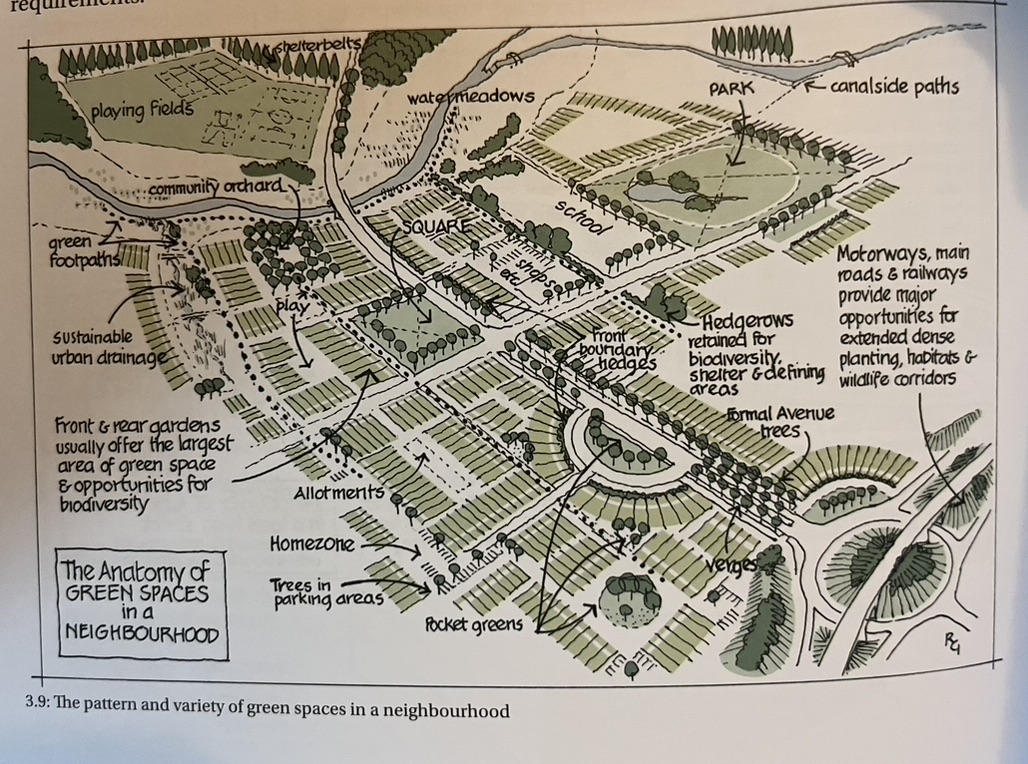
Above – Rob Cowan (2021) Essential Urban Design, fig 3.9
It’ll be interesting to see how this set of proposals turns out.
If you are interested in the longer term future of Cambridge, and on what happens at the local democracy meetings where decisions are made, feel free to:
- Follow me on BSky
- Spot me on LinkedIn
- Like my Facebook page
- Consider a small donation to help fund my continued research and reporting on local democracy in and around Cambridge


