
…and other types of public transport infrastructure. The report is titled Licence to build: Delivering urban transport infrastructure through devolution
There is also a fair amount of crossover from the industry body UKTram and their response to the Government’s Mass Transit Task Force
There is also an interesting report on apprenticeships by the CITB titled: Construction Apprenticeships: Challenge. Opportunities. Support. Autumn 2026 update. It highlights a host of recruitment and continuity issues – the drop-out rates being alarming.
Ministers should treat mass urban transit construction and provision as a sector rather than as discrete bespoke projects separate to everything else
The four themes the Centre for Cities report picked up were:
- Powers
- Planning
- Finance
- Capacity
In the grand scheme of things, a combination of limited powers, fragmented planning processes and institutional structures, financial backing dependent in Whitehall, and the lack of industry capacity vs other countries all stand out.
“How does this report compare with the Transport Select Committee in 2005?”
You can:
- Read what the Commons Transport Committee concluded on 23 March 2005
- Read the Government’s response of 12 October 2005
….and judge for yourselves.
One of the things I’m still not clear on is the big skills gaps that remain in industry. There are a host of reasons for this, but the lack of completion rates are striking.
“Too few employers offer apprenticeship opportunities. Only 17% of construction businesses currently employ an apprentice, while 81% say they are not at all likely to take one on.”
“Too many apprentices fail to complete their training. In England, only 58% successfully complete their apprenticeship by passing their End-Point Assessment. Improving achievement and progression would strengthen the skills pipeline without relying solely on more starts.”
Above – CITB Press Release 15 October 2026
When we dig into the data we find the gaps remain stubborn – such as starts vs achievement/completion for women.
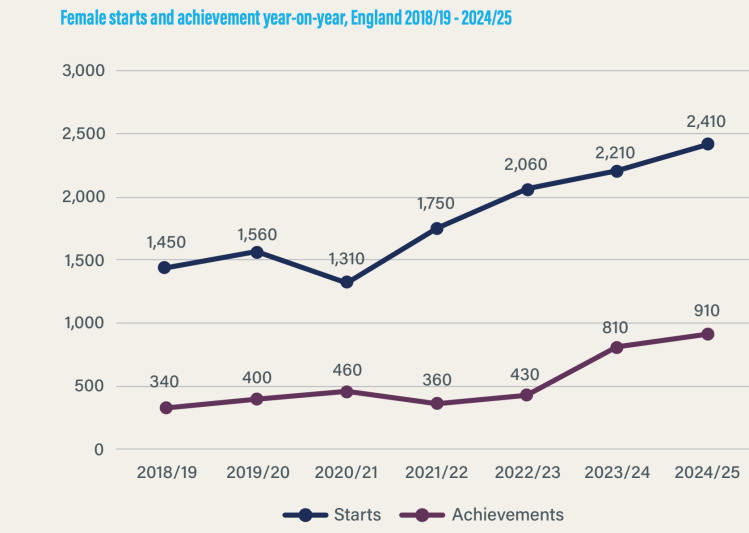
Above – Construction Apprenticeships: Challenge. Opportunities. Support. Autumn 2026 update, p15 / p8pdf
What’s interesting in the text is that some of the causes of non-completions are due to things outside of the control of the construction – issues that sit in other parts of central and local government.
The costs imposed by the privatised utility firms
The cost of utilities’ fees as a barrier was striking – and it’s not clear what public economic benefit was being served. It feels like such fees eventually end up servicing the debts of the firms that were appallingly managed by a succession of owners under the ‘light touch regulation’ regimes that both political think tanks and senior economists of the late 20th Century have a lot to answer for.
“Costs for moving utilities disproportionately fall on the scheme promoter, who must
bear 92.5 per cent of diversion costs. This accounted for almost a third of costs on the
earlier Birmingham City Centre metro extension.”
Above – Centre for Cities (2026) p13
“What might it be like if the utility companies did not behave (or were not structured to behave) like parasites on infrastructure projects?”
Only that’s what it feels like – privatised utility companies loaded up with debt that now requires servicing, both in the form of high bills and high fees for utility works that form part of such infrastructure works.
Also, Cambridge has got some very high profile case studies.
“The cost of the roundabout on Fendon Road, Cambridge – which gives priority to cyclists and pedestrians – has risen from an estimated £800,000 to £2.3m. Council officials blamed the rise on “unexpected utility work” and Covid-19.”
Above – BBC Cambridgeshire 02 July 2020 on the ‘Dutch Roundabout’ which I quite like as a cyclist having to use it every so often. I wouldn’t say it was worth £2.3million for it though.
“Doesn’t this say more about how our cities are governed, and what municipal authorities have control of and responsibility for?”
History tells us it doesn’t have to be this way. The introduction from Prof William Robson to Leicester’s guide is a wonderful summary of sound municipal local government:
“The services provided by the Municipality affect the lives and happiness of the community in a direct, vital and intimate way. Civilised life as we know it would be not only intolerable but impossible without the ceaseless activity of the local authorities in:
- maintaining the highways
- administrating the police forces
- providing education and public health services
- inspecting and building houses
- relieving destitution
- supplying gas, water, electricity and transport
- maintaining fire brigades
- providing public baths / swimming pools, libraries and recreation grounds.
“In short, for all the necessities and amenities of a municipal character which we have come to regard as indispensable elements in our complex and highly organised society”
W. A. Robson (1939) – quoted in Civic Affairs, City of Leicester
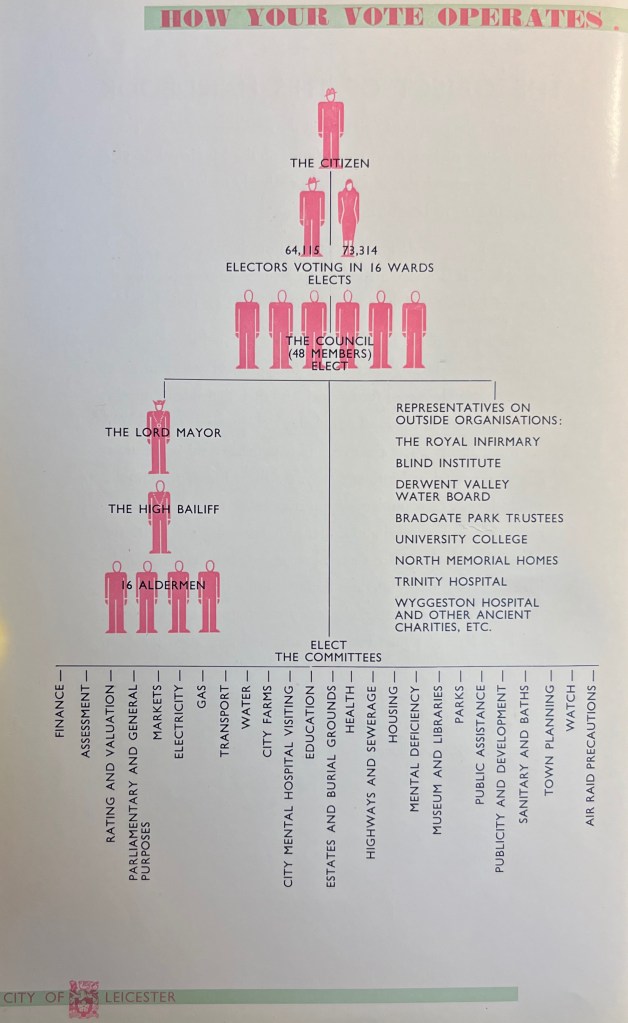

Now compare that with how Cambridge’s structures look today.
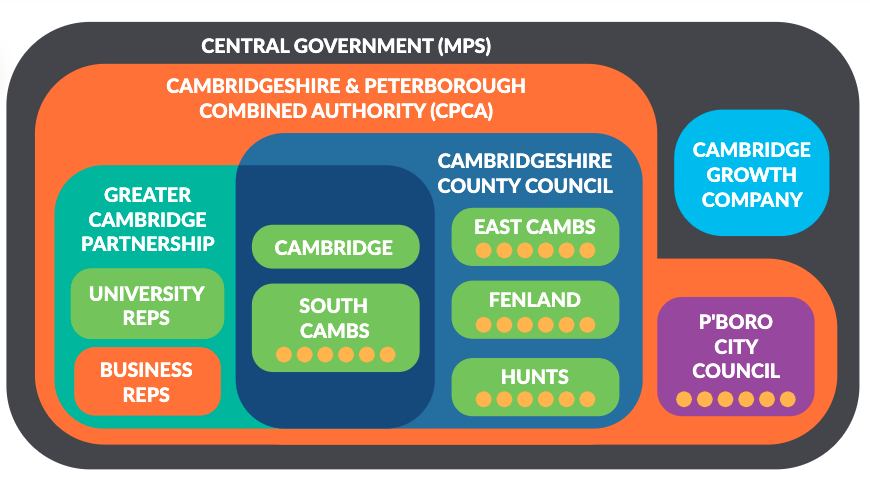
Above – complicated: the local governance structures of Cambridgeshire that successive government ministers created. Diagram by CamCycle
Note the above diagrams do not cover the utilities. The process of post-war nationalisation resulted in both private and municipal utility firms being taken over by the state (see ‘Public ownership of industries and services’ (2018) House of Commons Library, p17) which cites the creation of regional electricity boards as a case study, and also the article by Valentin and Steinfort (2023) on the living legacy of privatisation of utilities in the UK.
How ministers deal with these excess costs imposed by utility firms on infrastructure projects inevitably will be tied to what they do with utility firms (especially the struggling ones like Thames Water) regarding means of ownership.
“Looking at the Leicester example, why can’t councils set up their own renewables generators and use the electricity generated from that to power trams and light rail?”
Good question (other than the amount of land that might be needed for wind farms and solar farms to generate enough power to power the electric engines!) At the same time upgrades to the national grid might enable further growth of offshore windfarms and untapped tidal energy potential to cover those places where competition for land is intense.
The Chancellor’s Budget Statement – 28 October 2026
The day when BBC politics correspondents get very excited is looming – half the time the setup feels like ministers spend ages trying to bury the bad stuff and political reporters then try to find them as much bad stuff as possible before their competitors to ‘break’ their exclusive story. Hence Jill Rutter for the Institute for Government recommended some big changes in January 2017
“The end point is a quite simple vision: A Budget process that contains fewer measures,
which are better thought out – and can be implemented efficiently by HMRC without
imposing unreasonable burdens on taxpayers.”
Above – Jill Rutter (2017) for the Institute for Government, p5
I’ll leave it to you to decide how many of the recommendations in the summary have been taken on board in the decade that followed.
If you are interested in the longer term future of Cambridge, and on what happens at the local democracy meetings where decisions are made, feel free to:
- Consider a small donation to help fund my continued research and reporting on local democracy in and around Cambridge
- Follow me on BSky
- Spot me on LinkedIn
- Like my Facebook page


