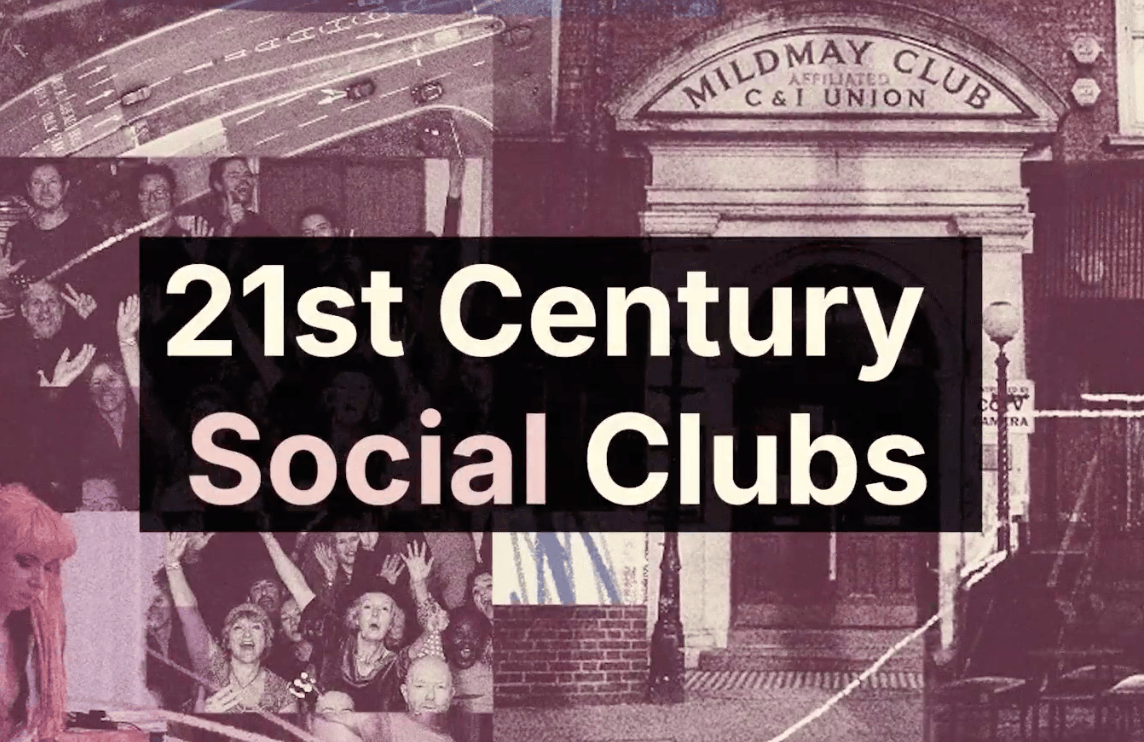
What are the lessons for a fast-growing Cambridge that we can pick up on?
You can:
- Read the Centre for London’s report on the future of social clubs
- Have a look at the Power to Change’s case studies for a Civic High Street
- Browse through the 21st Century Social Clubs project page
- Find out more through Stir to Action which is hosting the 21st Century Social Clubs project
A short video intro:
Above – “Compared with fifty years ago, only half of these institutions still exist in our neighbourhoods and on our high streets” Stir to Action 17 December 2025
Although not a social club, there’s a place close to where I live that I hope succeeds as a social venue – mindful of how pubs across the country have struggled to recover since the first lockdown.
The revamped Rock Pub on Cherry Hinton Road as a case study
The pub reopens on 21st October 2026 (Oh – that’s today!) following a revamp that has taken over a month, in part the result of the Greene King brewery chain moving many of its pubs to a franchising model. One of the things they are bringing back are music nights – with a number of acts lined up over the next few months. The pub used to be one of the familiar venues on the local band circuit in the 1990s.
One of the pubs in the same part of the city that has successfully diversified its offer is the Red Lion in Cherry Hinton, which amongst other things now has its own creative writing group. In the other direction from The Rock is the Cambridge Wine Merchants where I just missed their Petals and Pumpkin Paint Party – yeah, you try saying that fast after a large glass or three! They do splendidly good wine-tasting events that have a habit of selling out quickly. Furthermore they often include a stupendously expensive wine as part of their package – one that most of us would never dream of buying.
And then at the top of the road at The Rathmore. there is the Irish Music Society Cambridge Comhaltas which meets every Wednesday. I went along for one term but struggled to keep up learning tracks by ear (which is the tradition of the music) having been familiarised with reading music as a child. It’s something I still struggle with in group singing with my current group – where everything is also learnt by year without the music score in front of us as with the old We Are Sound/Dowsing Sound Collective.
Cambridgeshire’s Quality of Life Survey 2026 – findings on Loneliness
You can browse through the quality of life reports here. What was really striking was that back in 2024 Cambridgeshire’s levels of loneliness (percentage of people who agreed with the statement ‘I often feel lonely’) was at 31% – not far off what London is today. That the county has somehow managed to get it down to 24% is quite an achievement – and it would be good to know more about what the drop was attributed to.
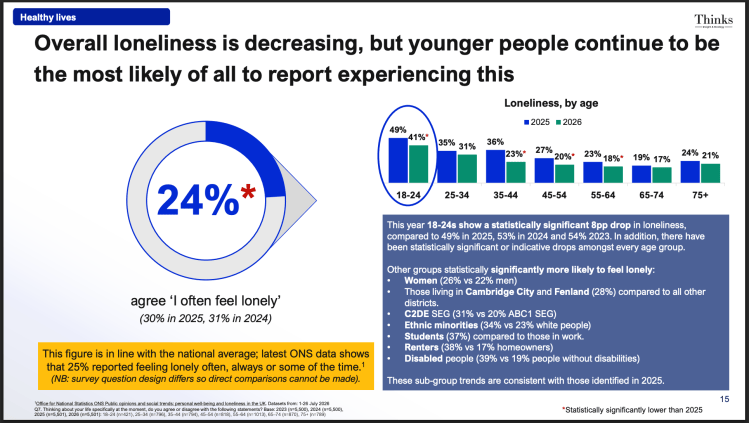
Above – Cambridgeshire County Council Quality of Life Survey (2026) p15.
On the drivers of loneliness:
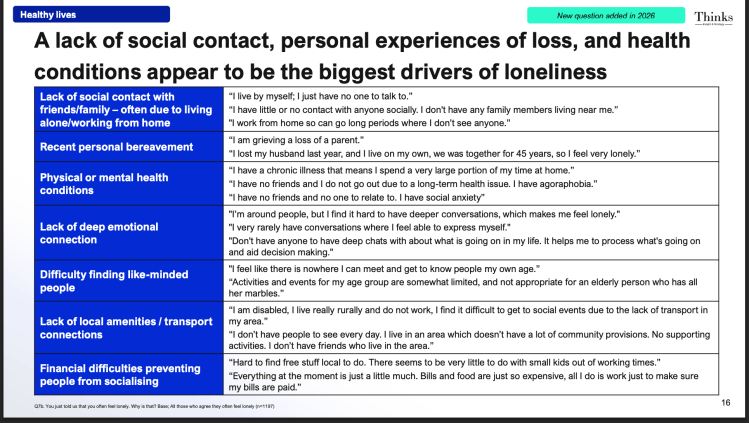
Above – Cambridgeshire County Council Quality of Life Survey (2026) p15.
What the report does not do is make connections between the different causes. It also does not identify important indirect actions and policies that might make a significant difference to people who find themselves feeling lonely on a regular basis.
The two big variables for me are:
- Level of disposable income a person has
- The ease of transport access – especially public transport (because you don’t have to worry about where to park the car)
There is pent-up demand for activities – and I still think the city is under-providing for our children and teenagers
The recent Indie night at The Junction was packed out with young people going by the photographs the promoters posted on IG here – noting that this was a first trial run. I had no idea which age group was the target audience – was it people who were old enough to remember the 1990s first time around (me) or younger generations wanting to dance to music from that era? (Or both?) Turned out it seemed to be the latter from the snaps. But hey, us 1990s teenagers lived in an era where Oasis covered Beatles songs, and so on.
There is also the additional prospect of linking up area-based social clubs with new youth club provision.
Something for others to run with?
Social clubs for adults in places with a noticeable population turnover and chronic inequalities
…and at a time of significant economic and social change. It’s similar to a time when an uncle in my extended family having moved from Ireland to London, told a 19-year-old me about the trials and tribulations of running the finances of a workingmen’s club at a time when many of the traditional working class jobs in manufacturing were declining. But it was still a huge undertaking for the committee he was on – their turnover being in six/seven figures.
The few clubs I can think of in Cambridge off the top of my head are:
- The NCI (New Chesterton Institute)
- The Cambridge Joint Services & Veterans Club
- The East Road Social Club – originally the Cambridge Workingmen’s Club
- Chesterton Workingmen’s Club
- The Salisbury Club on Mill Road
- The Rathmore Club
There are also work-based clubs too such as the Frank Lee Centre on the Cambridge Biomedical Campus, which has restrictions on who can be a member. (It was originally established for the staff at Addenbrooke’s). I’m not sure what is becoming of the old University Social Club for staff that was on the corner of Mill Lane by the Mill Pond.
I’m not going to pass comment on the above-mentioned institutions. Instead…
…given the recent and planned growth of Cambridge, I want to look at the London-based reports and see what ideas they may have. Such as the Centre for London report here. That report has a series of recommendations which cover:
- Financial Stabilty
- Operations & Capacity
- Planning & Redevelopment
The report also highlights the union of social clubs – The Club and Institute Union which dates back to 1862.
Going back to the video of the 21st Century Social Clubs’ vision…
The video says 21st Century Social Clubs should be spaces for things like:
- social connection
- lifelong learning
- arts and culture
- community cohesion
- local democracy
Which amongst other things means having premises that are large enough and viable enough to host some if not all of these. At the same time, there’s no point in trying to be prescriptive and trying to micromanage the process. Far better, for example to establish the the firm foundations and let people get on with deciding what they want instead of trying to get people to meet the requirements of a government tick-box list.
Centre for Democratic Business reports
The focus of the Centre for Democratic Business is listed in their website here and includes
- Grassroots arts and culture – Supporting creativity, performance, and cultural expression
- Social cohesion – Bringing people together across different generations and backgrounds
- Member democracy – Giving people voice and power to shape local issues
- Community ownership – Protecting and improving collectively owned assets
- Mutual support – Encouraging care, connection, and everyday solidarity
- Health and wellbeing – Enabling more active, social and healthy lives.
In its report of April 2025 titled Social Clubs, Community Power, and Political Participation, it listed key areas for action including:
- “Recognising clubs as democratic infrastructure — Treating social clubs as essential spaces for building trust, relationships, and civic capacity
- Supporting political participation — Using clubs as venues for political events, local consultations, and engagement with communities who feel distant from decision-making
- Partnership with public institutions — Encouraging local government and civil society organisations to work with clubs as partners in strengthening local democracy and service delivery
- Rebuilding civic pathways — Supporting clubs as places where people can develop confidence, skills, and experience in democratic participation
- Funding and development support — Providing financial backing and business development programmes to help clubs modernise, broaden membership, and remain sustainable
- Governance and training — Investing in specialist training to support the democratic and organisational role of membership-led institutions”
Above – Social Clubs, Community Power, and Political Participation (2025) Centre for Democratic Business
All of the above is easier said than done.
“Does the local plan-making process enable low-cost land to be set aside for social clubs and community ventures to establish themselves?”
Or rather, ‘how do you prevent new social clubs moving into new venues from being undermined from the start by disproportionate expenses related to the cost of the land and costs of borrowing?
I mentioned the case of the Cherry Hinton Hub in this previous blogpost where the size of the premises does not seem to be big enough to sustain the cafe – hence the recent update here.
With the growth of employment sites – in particular the sci-tech parks, there’s also a wider urban design challenge. Given the potential lucrative returns on investment, can some new social clubs be subsidised by the rents paid to the freeholders? And can those new institutions be located in a place where it is easy for local residents (Especially children and young people) to access the facilities there?
If you are interested in the longer term future of Cambridge, and on what happens at the local democracy meetings where decisions are made, feel free to:
- Follow me on BSky
- Spot me on LinkedIn
- Like my Facebook page
- Consider a small donation to help fund my continued research and reporting on local democracy in and around Cambridge


