The ***fourth*** transport strategy in just over 12 years has been published in its final form by the Combined Authority for the Transport Committee to debate next week. It then goes to the CPCA Board on 25th November for approval and if all is good, for submission to the Transport Secretary
Image: Can we get a Cambridge tramway or light rail system included on this t-shirt?
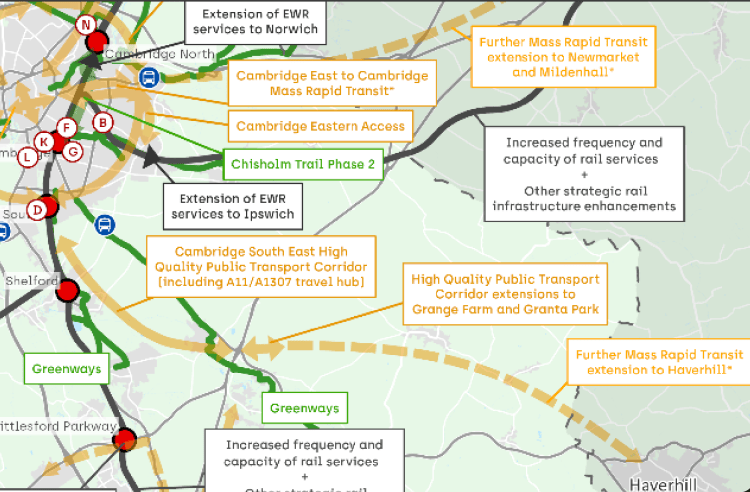
Above – detail of Figure 4.2: Connecting homes, disadvantaged areas and the wider region to the economic opportunity of Cambridge – map of key interventions. GCTS Item 8, App. A, p54 / p59pdf
You can:
- Have a look at the Transport Committee’s meeting papers (item 8 has the extensive transport strategy papers)
- Read the Transport Strategy for Cambridge City and South Cambridgeshire District from back in 2014 by the county council here – this is why the Greater Cambridge Partnership has continued to push with busways
- Browse the more distant transport history going back to SuperCam and CHUMMS
- Browse through the old CAM Metro consultation pages from 2020 on the Wayback Machine on a proposed tunnel under Cambridge
- Find out more about light rail and tramways being built elsewhere in Tramways and Urban Transit Magazine, which you get with LRTA membership (I am a member).
“Can’t everyone just hurry up and get on with it?”
I think that’s one of the reasons why ministers are trying to devolve much more to regional/sub-regional tiers of the state and trying to figure out a way that doesn’t involve Central Government having to rubber-stamp things that could/should be decided locally.
The one thing central government should be doing much more on is increasing capacity on in the areas where shortages will delay and make more expensive the construction of new infrastructure. In particular with skills and co-ordination/sequencing of construction works. Such as keeping tunnelling teams together so they can move from one major project to another in a seamless manner, rather than risking disbanding them.
What are the documents involved in this?
All of the ones listed as the supporting documents here: Greater Cambridge Transport Strategy (GCTS) 2026
- Appendix A – Greater Cambridge Transport Strategy – 152 pages
- Appendix B – Need for Intervention Report – 52 pages (note the challenge statements, there are 19 to become familiar with!)
- Appendix C – Stakeholder Report – 27 pages
- Appendix D – Connectivity Analysis Report – 122 pages
- Appendix E – Transport Modelling Options Report – 37 pages
- Appendix F – Capital Delivery Plan (full) – some BIG spreadsheets
- Appendix G -GCTS – Equality Impact Assessment – 66 pages
- Appendix H – Greater Cambridge Development Corporation – Mass Rapid Transit Programme Update – one page
Above – you can access each of the appendices in the list here
“What did the CamDevCo say?”
“Our immediate focus is to complete the Strategic Outline Case (SOC) which seeks to establish the strategic case for intervention and identify a short-list of potential network options. The programme will then progress to the Outline Business Case (OBC) stage”
“One useful thing they could all do is to have a high profile one-page diagram explaining what each reporting stage is and why they have to do it. Otherwise it’s a list full of acronyms for the public. SOC, SOBC, OBC, FBC etc. The guidance from the Department for Transport recently updated here is too long and too generic.
“What did the other documents say?”
The best thing to do is to read the executive summaries at the start, and the conclusions at the end. If there’s anything that grabs your attention, look for the detailed section that’s of interest.
Note there’s also an institutional cultural issue here of using bland, confusing acronyms
You’ll see terms such as:
- HQPT – High Quality Public Transport (Buses)
- MRT – Mass Rapid Transit (Buses)
- Corridors (Roads for buses to travel down)
Despite the CPCA Mayors clear manifesto commitment, the term ‘light rail’ barely appears.
Which indicates the continuing power struggle between politicians and those (IMHO) wedded to past strategies that still have not resolved the ‘last mile’ congestion in Cambridge, nor have they protected bus passengers from the impact of cuts. Just ask the teenagers trying to get to college in term time.
“You’re just as wedded to trams and light rail”
Based on my experiences staying in cities in continental Europe that have them, and seeing how they work splendidly.
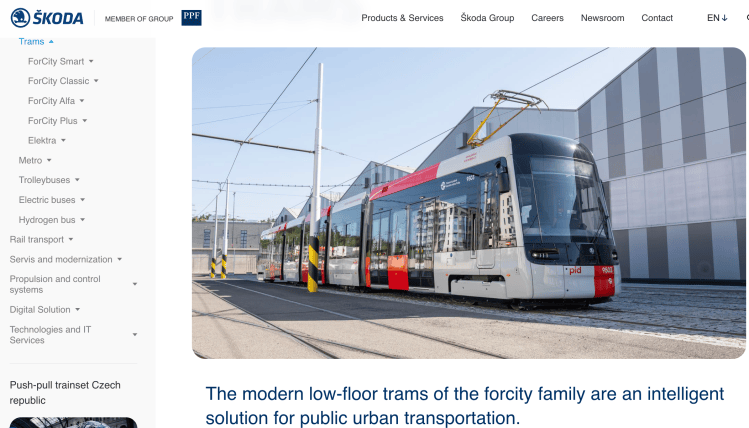
Above – by SKODA in Czechia/Czech Republic. Which of these would you choose for a rapidly-expanding Cambridge region?
This is the sort of manufacturing facility that ministers should be encouraging the establishment of in the UK – along with local supply chains and training colleges.
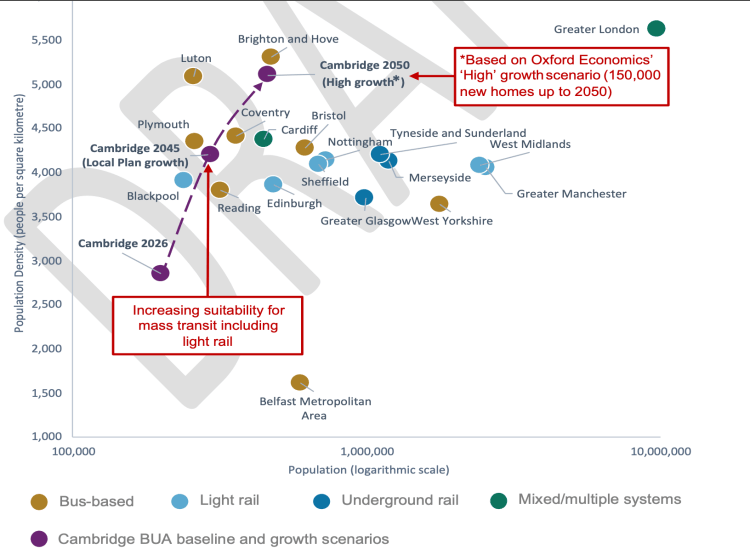
Greater Cambridge Transport Strategy – Need for Intervention p35 / p40pdf
Note the logarithmic scale of the population on the X-axis in the graph above. That high growth scenario of 150,000 new homes by 2050 adds to the 60,000 homes approximately in [Greater] Cambridge at present. Given that it cites the Oxford Economics growth scenario study published by the Government here, and given that the study cites ‘Greater Cambridge’, I’m assuming that the above chart means the same, and not the City of Cambridge as per its current mid-1930s-era-made boundaries.
Further education access
The diagram in the Need for Intervention document covers areas experiencing multiple deprivation and areas where car ownership is lower than average. I have picked out the travel time it takes for teenagers and students to get to places of further education. The map shows the limitations of a ‘Greater Cambridge’ approach because of the fact that a critical mass of teenagers and young people live outside of the county and have very long commutes. Whether Essex and Hertfordshire should be building and funding their own equivalents of Hills Road Sixth Form College, or whether towns like Haverhill and Royston should be inside a new ‘Greater Cambridge Unitary’ show that what has been proposed in the past hasn’t made things any better for teenagers over the years.
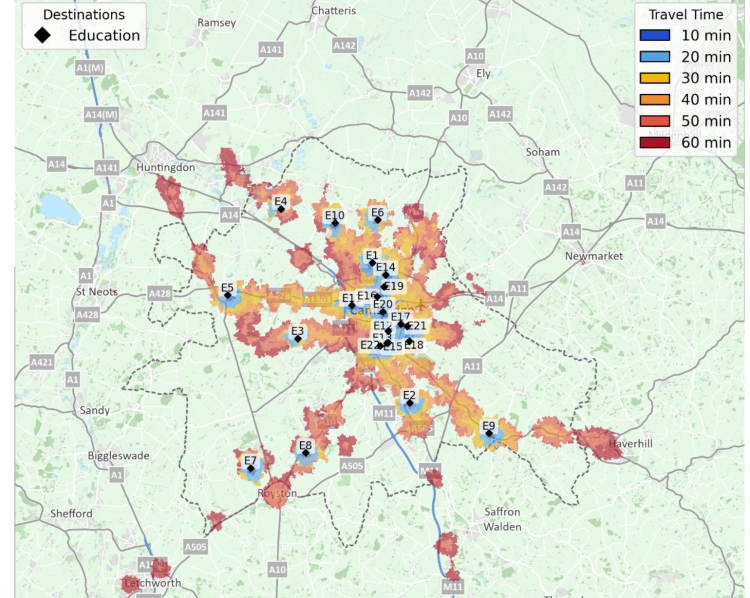
Greater Cambridge Transport Strategy – Need for Intervention p22 / p27pdf
Compare the above with the Lichfields study for the Cambridge Biomedical Campus
I wrote about the above in 2024 – the map may look familiar.
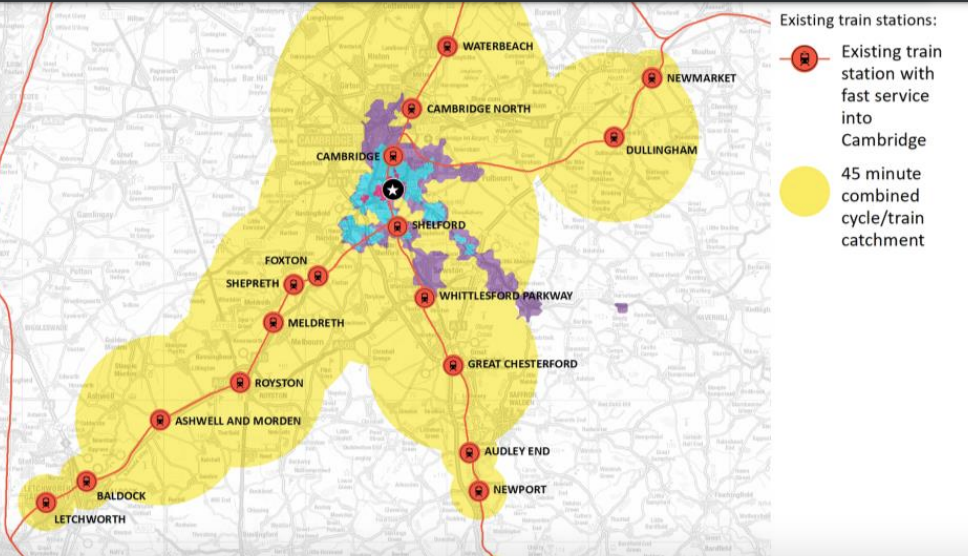
Above – Lichfields (2024) for CBC Ltd, p26
In the grand scheme of things, our current situation has been caused by the lack of a co-ordinated plan combined with austerity, privatisation, and the fragmentation of public services.
“[Queen Edith’s ward has] over half of the sixth-form students from the whole of Cambridgeshire, studying at six schools and colleges”
Queen Edith’s Magazine, Autumn 2020
And that’s before we account for the students coming in from over the county boundary. Back in 2023 one student who had just finished her A-levels at Hills Road SFC (where I was in the late 1990s as well) told me of the overcrowding situation from a student’s perspective – one seldom mentioned let alone addressed by the political institutions or the pro-growth lobby groups. And if they have been discussing it, then their collective failures on making a substantial positive impact speaks volumes. Where is the failure? The failure to acknowledge and take on the problems the teenagers are facing? Or the failure of their existing actions that were meant to take on and resolve those problems?
The word ‘Interchange’ appears over 100 times in the Transport Strategy document (item 8, Appendix A) alone. But Cambridge does not have any examples of a world class transport interchange
Brookgate had the opportunity to build one at Cambridge Station but chose not to. And Cambridge North station is plagued by cycle thefts and bus services that are all too unreliable, especially at rush hour and late at night. Which then makes me wonder whether they have thought through the dependencies thoroughly enough. (See the big spreadsheet at Item 8 Appendix F which identifies a few).
If the decision-makers wanted to make a real positive difference to some of their proposals, they could:
- Recruit a significant number of people who live in low income communities and who are dependent on public transport to improve their proposals
- Run the sessions in their communities so it’s easy for participants to get to – and ensure senior managers who otherwise would not go to those parts of the city/county are there and there on a regular basis
- Pay the participants for their time and work – and work with the DWP to ensure that they don’t get their benefits cut/get financially penalised for what is not permanent/full time employment. (The hassle involved with stop-starting, adding to the burdens of people who can least cope with them must be avoided).
Why the special case? Because as a result of participating you get the positive impact of the temporarily increased incomes, and the increased collective knowledge within those communities of how decisions are made, both of which can have a knock-on positive effect in areas where other big developments and projects are proposed, such as in Abbey Ward and in North Cambridge.
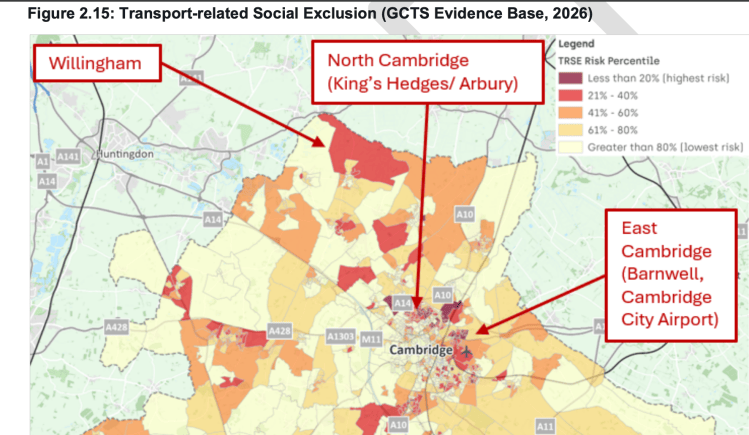
Above – detail of Transport-related Social Exclusion in Greater Cambridge Transport Strategy – Need for Intervention p23 / p28pdf.
The image above shows that the decision-makers already know which areas to target – they have that information.
I’ll finish here for now as some of the documents are so large they need their own blogpost and further scrutiny – and not just from me.
If you are interested in the longer term future of Cambridge, and on what happens at the local democracy meetings where decisions are made, feel free to:
- Follow me on BSky
- Spot me on LinkedIn
- Like my Facebook page
- Consider a small donation to help fund my continued research and reporting on local democracy in and around Cambridge.


