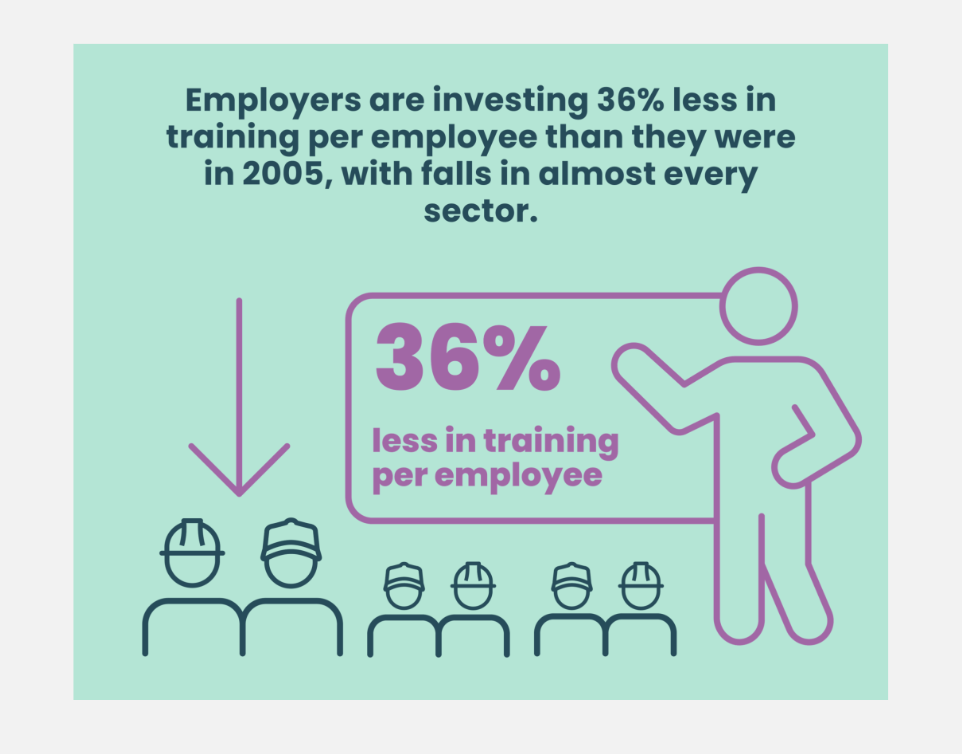
‘…while employers invest one third less training per employee than in 2005.’ says the 2026 Adult Participation in Learning Survey published by the Learning and Work Institute
You can read their report here
The footnotes also link back to previous reports – ones that indicate investment in their own workers by employers has fallen even further.
“Employers are also investing less, 26% less per employee compared to 2005 – with graduates three times more likely to get training at work than non-graduates.”
Above – The great skills divide (2024) L&W
For those of you in office-based jobs or in professions that have CPD frameworks, one of the benefits you’ll be aware of is the ability to network. This is not the same as whether we like to network or not. (I used to, but since the onset of CFS/ME I no longer have the headspace for it – not least because turning up to a place already fatigued makes ‘masking’ that much more harder, to say nothing of the Post-Exertional Malaise that crushes me during the week after). Think of the opportunities that you’ve had as a result of the informal contacts you’ve made – and then compare it to someone I used to go to school with who I bumped into last year who feels he’s stuck in ‘low level admin’ with no options to retrain or upskill.
“Adults’ interest in learning is undimmed – but class inequalities mean three million lost learners”
One of the press releases from the Learning and Work Institute focused on the class divide. That divide was put to me in stark terms by the same person above when we were talking about our own experiences of school and further education, and having crashed and burned for different reasons. “Yes, but you made it.” he told me – something I’ve pondered on ever since. (And something I moaned more about in a piece about ‘being educated to be ignorant’ by the system of the 1990s).
At least back then there was in principle at least, the option for adults to return to study for academic subjects at tertiary education colleges – as the British Newspaper Archive shows us below.
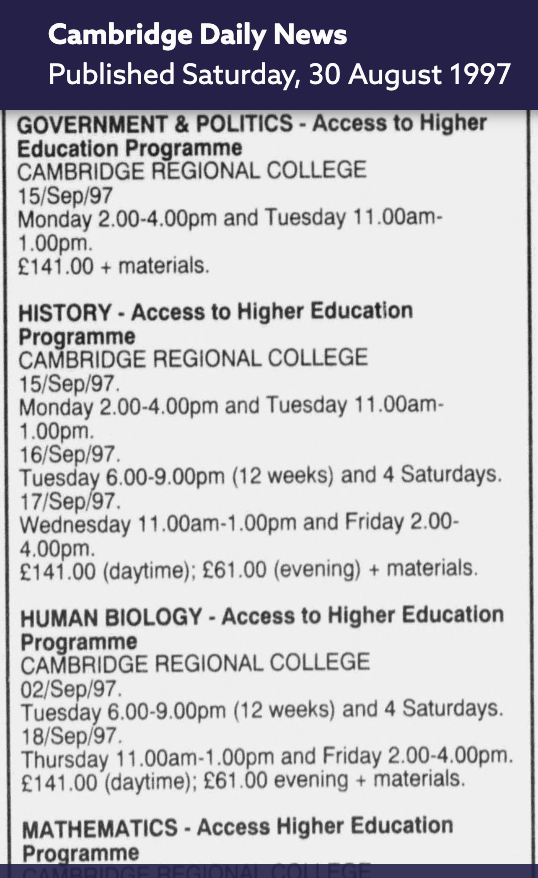
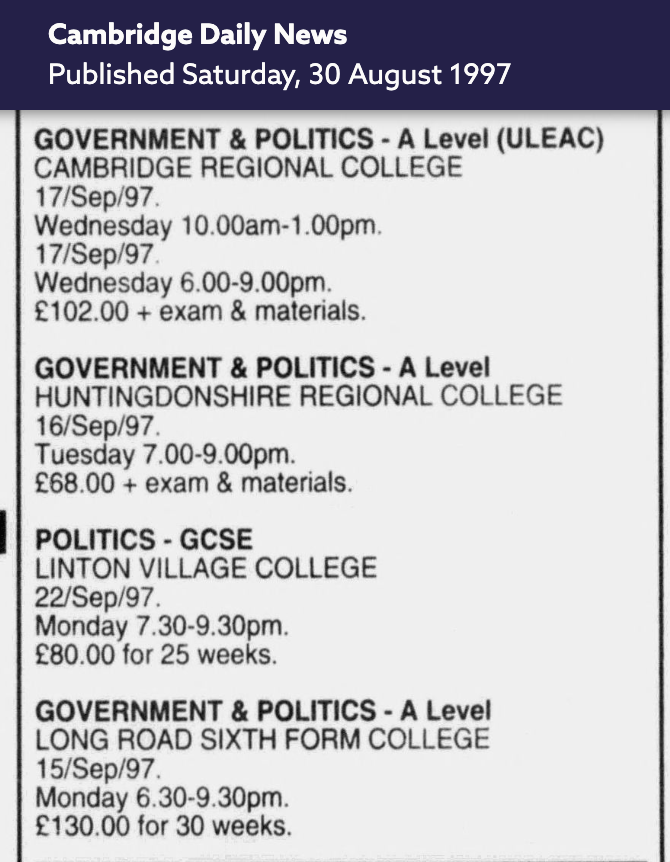
Above – the Further Education guide in the Cambridge Evening News of Sat 30 August 1997 shows that at Cambridge Regional College, (both 16-19 and adult students) could choose to study A-levels either during the day or evening. Even Linton Village College offered a GCSE in politics. (Can anyone find a copy of a GCSE politics textbook anywhere from that era?)
In the mid-2000s a change of Government Policy meant that the A-levels offer was cut from Cambridge Regional College, which focused entirely on vocational qualifications. You can browse CRC’s website here or go to their open day on Sat 14 November 2026 to compare what they offer today with what they were offering 30 years ago. My point being that given the social and political culture of the time, segregating vocational from academic in such hard institutional lines can’t have been good for social integration.
Long Road Sixth Form College used to have an excellent evening class programme in the 1990s
Sadly it was removed many years ago – for what reasons I do not know. Furthermore, the relatively-recently built CAST next door to it, built for 14-19 year olds as a science academy.
“CAST students learn in state-of-the-art laboratories and facilities, supported by our close partnerships with leading science, engineering and technology organisations. Our curriculum is designed around career-focused pathways, guiding students into sectors such as Life Sciences, STEM, and Applied Sciences.”
Above – Cambridge Academy for Science and Technology – About us
“Why on earth are there no evening classes for the lifelong learning sector given that the Combined Authority refuses to make moves on a separate lifelong learning college for adults?”
The CPCA indicated in response to a public question I put to their skills committee that their focus is on ‘Further Education Cold Spots’ – in particular East Cambridgeshire district, and St Neots.
“Antony Carpen, a resident who runs the Cambridge Town Owl blog, urged Cambridgeshire and Peterborough Combined Authority to enter into discussions to “explore the possibility” of building a new lifelong learning college near the planned Cambridge East station.”
[In response, Cllr Lucy Nethsingha, Chair of the CPCA Skills Committee said]
“Improving take up of adult skills is more about taking out mobile provision to find people where they are rather than building new sites. I would also say that if we were going to build new sites, Cambridge is already extremely well provided with education provision.”
Above – Eoin McCaul for Cambs Live, 17 June 2026
Given the position of central government at the time, if I was in Cllr Nethsingha’s position chances are I’d have given a similar response – possibly even stating that the CPCA lacks the independent funding, the legal powers, and the political influence to persuade ministers to do the things that I have been calling for. There’s also more on the Cold Spots research in the Grant Thornton papers (item 6) from the Skills Committee of 29 July 2024.
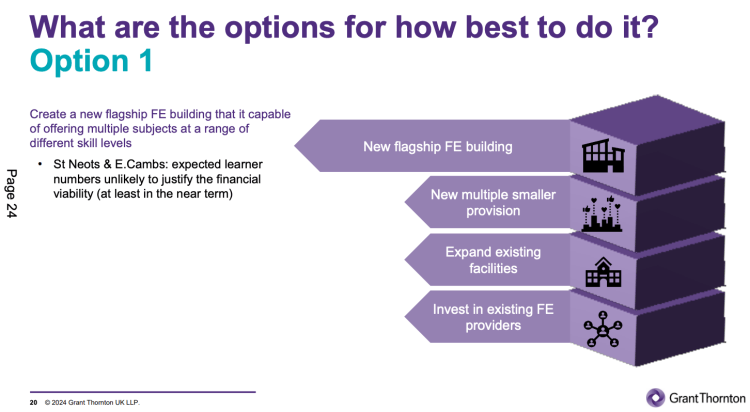
Above – Slide 24 of Item 6 Cold Spots presentation paper
Since then, Andy Burnham has taken over as Prime Minister, The Budget has been published and some significant policy changes on how local government and strategic authorities (of which the CPCA is one), plus further developments including the establishment of the Greater Cambridge Development Corporation (along with the welcome announcement regarding a new stadium for Cambridge United Football Club) means that in the space of just over four months, the big picture has changed somewhat.
Counting the cost: The UK’s Employability Skills Crisis
Back in September the City and Guilds published its own report saying that the UK had a skills crisis – and putting it in the title. And the findings are damning. On employers and successive governments.
“Two in five 18-24-year-olds feel they did not get enough practical, real-world experience through school, university or training, with limited resources and lack of access to coaching factoring into their lack of confidence. Others report that these skills were not prioritised in school.”
“NEETs who want to develop their skills are far more likely to engage with their friends or peers (37%) rather than seeking support from career coaching or employability programmes (10%) or a careers service within school or college (8%). This suggests these services are perceived as being unhelpful, that there is currently a lack of signposting, or both.”
Which then makes me wonder about the role and function of potential large lifelong learning institutions (in the context of adults in their 20s) and also of places and institutions that don’t look or feel like school that might be a more suitable place to engage – for example sporting institutions.
[Premier] League announces ambition to support 250,000 young people at risk of becoming NEET
“Football clubs can reach people in communities who may otherwise miss out on support,” said Premier League Chief Policy and Social Impact Officer Clare Sumner. “Through a nationwide network of club charities, the Premier League uses the appeal of football to build relationships, develop skills and help engagement with school and other opportunities.”
Above – Premier League press release 09 October 2026
And it doesn’t have to be just football clubs. What other places that are ‘not school’ and which don’t feel like school might also be suitable? I’m not going to try and list any here – they will be different from place to place.
“What does a crisis ***really*** look like?”
Here’s Ernest Bevin in 1940 shortly after he was appointed Minister of Labour as he mobilised the economy and society for the war effort in May of that year – despite him and Churchill being lifelong adversaries up to that point.
Note that I am not calling for Bevin-style powers to be brought in to deal with the current crises (including the climate emergency).
Yet.
In July Mr Bevin made another speech
Above – Bevin 15 July 1940 in London, Paramount Newsreel via Reuters Historical News Collection
Adult education, adult skills, and lifelong learning were huge priorities for Bevin who also had substantial powers to conscript not only people but also property for the purposes of the war effort.
“The Minister of Labour will be given power to direct any person to perform any services required of him. That does not necessarily mean services in munitions or factories. It does not apply only to workmen. It applies to everybody. No one can tell what these days may bring forth, or who may be required to dig defences or do anything else, but everybody alike must be under this control.”
“Let me deal with a few points about control over property. Some establishments will be controlled altogether right away. Others may be controlled later. They will, in effect, be working on Government account.”
One of the results? Within six months Bevin had more than doubled the number of Government Training Centres to increase the supply of skilled workpeople – men and women.
…as the Minister for Labour and National Service wrote in this syndicated piece in November 1940.
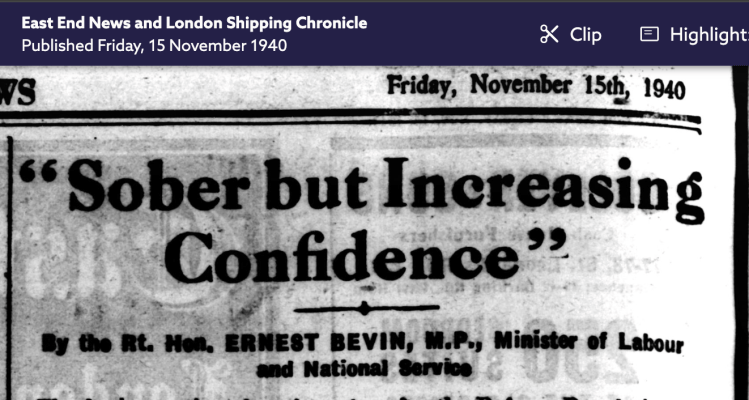
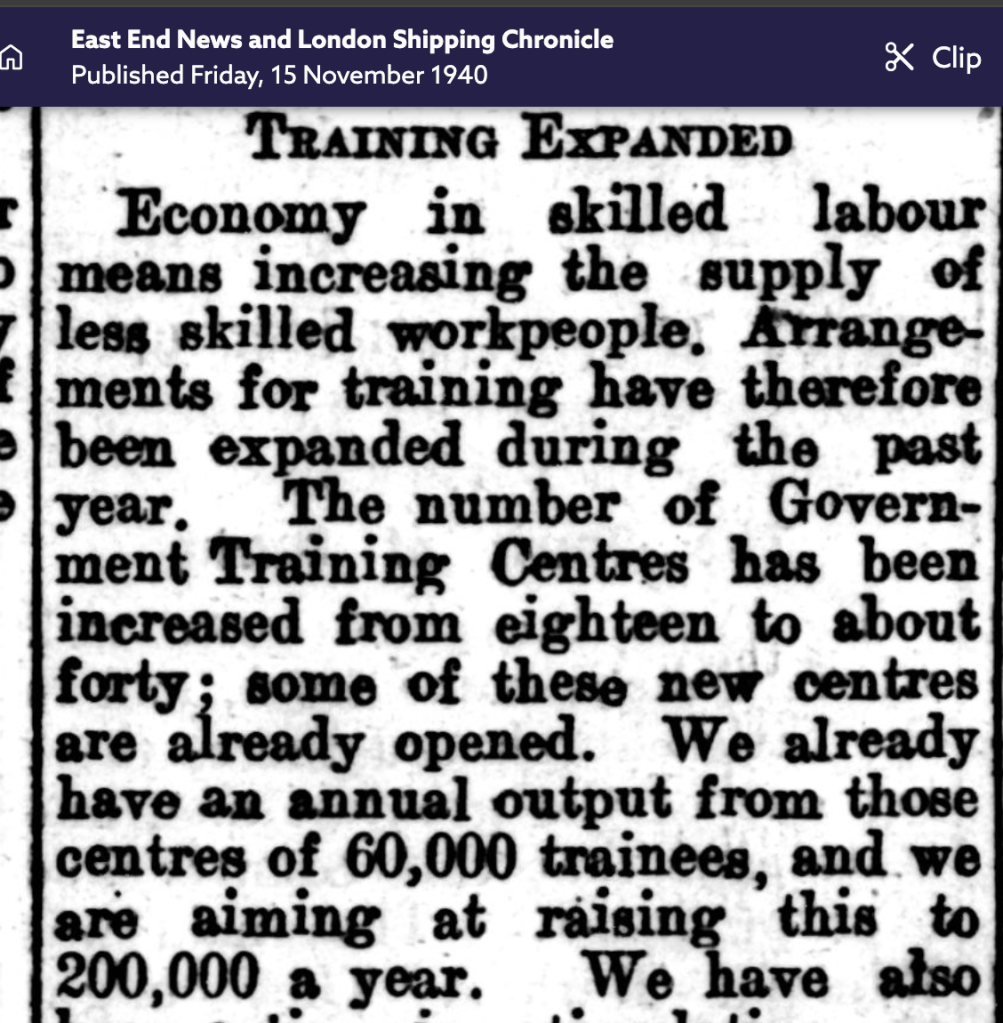
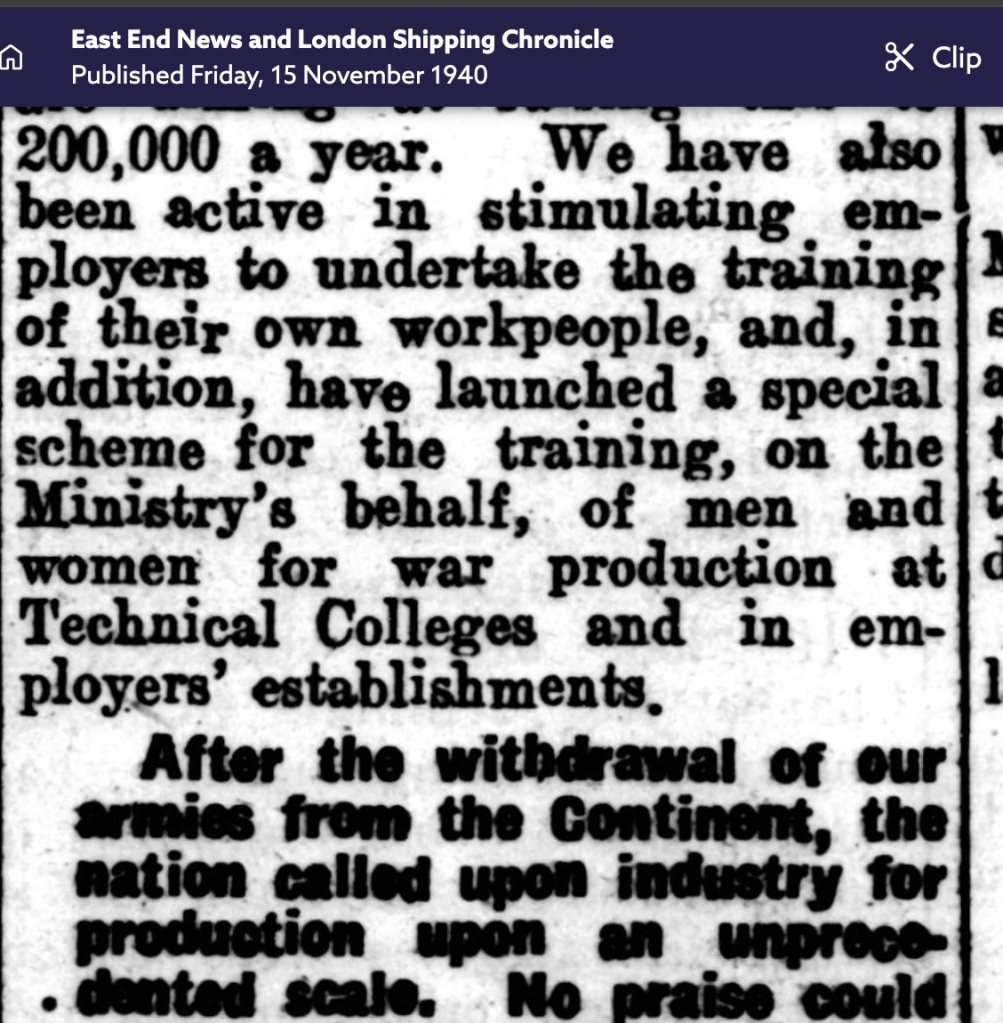
Above – East End News 15 Nov 1940 in the British Newspaper Archive
Part of the recruitment challenge was dealt with by a mass advertising campaign to go with the legislation – Bevin devolving many of his powers to local boards made up of employers and trade union officers alike, choosing only to use the powers of compulsion as a last resort.

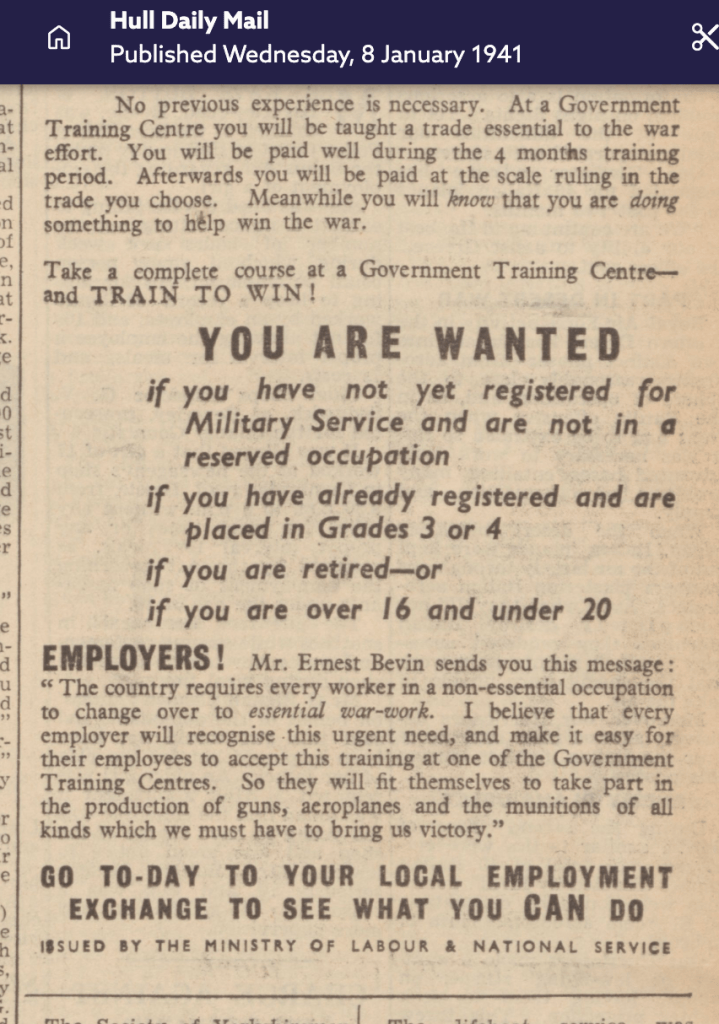
Above – Hull Daily Mail 09 January 1941 in the British Newspaper Archive
While not calling for Bevin-style powers to deal with the multiple crises that we have at present (note we have a disinformation crisis which Demos highlighted in their report earlier), it might be an idea for Mr Burnham and colleagues to speed up the development and construction of the lifelong learning and training facilities now – especially on anything to do with the Green economy, climate emergency mitigation, and disaster response, so that when the next major emergency kicks in, the institutional and organisational capacity will be there to take on the applicants.
Because we saw what happened in 2020 when ministers failed to prepare. And none of us want to see a repeat of that.
If you are interested in the longer term future of Cambridge, and on what happens at the local democracy meetings where decisions are made, feel free to:
- Follow me on BSky
- Spot me on LinkedIn
- Like my Facebook page
- Consider a small donation to help fund my continued research and reporting on local democracy in and around Cambridge


