
This comment from officers came as City Council leader Cllr Katie Thornburrow slammed decades of underinvestment Cambridge’s Guildhall, Corn Exchange, and Market Square. Officers made clear just how serious the problems are at what are two of the largest non-university indoor spaces in the city centre.
You can:
- Read the meeting papers for the Performance, Assets and Strategy Overview and Scrutiny Committee meeting of 03 November 2026
- Watch Ben Binns, Assistant Director of Development at Cambridge City Council speak about his concerns about the Cambridge Corn Exchange.
- Watch Mr Binns highlight the serious issues that the Guildhall has.
- Listen to the set of questions councillors want to put to Cabinet (summary after over 3 hours!).
- Read the Guildhall’s asset condition report by Sir Robert McAlpine for Cambridge City Council. (If that doesn’t work, see Appendix 3 in this list)
The councillors’ preferences
- Option – Full scheme with ‘value engineering’. Six councillors in favour, and two against.
- Option – refurbish and rent out – councillors agreed it was viable but didn’t particularly like it “I think this would be a tragic loss of civic function in the centre of Cambridge” – Cllr Tim Griffin (Lab – Coleridge). This was clarified as renting out everything but the council chamber and the large hall, but holding the freehold.
- Option to ‘kick the can down the road’ for the Unitary Council to decide – no one in favour
- Option to sell the guildhall, Seven opposed
Mr Binns also confirmed that the overall maintenance bills of the buildings (Guildhall and Corn Exchange) were inevitably rising, and that for the Corn Exchange the heritage requirements mean that it is impossible to reach Net Zero under the current regulations.
“It is the observation of the Sir Robert McAlpine project team that the Guildhall is a deteriorating asset with a visible worsening of the building occurring during the currency of the Cambridge Civic Quarter Pre-Construction Services phase of the Cambridge Civic Quarter project.”
Above – Sir Robert McAlpine for Cambridge City Council, p2
‘Tough Choices’
I wrote about the choices that councillors face last week here. Only in the huge volume of information I missed the bits that Mr Binns highlighted on the state of the Guildhall. (hence the importance of the scrutiny committee). This was also picked up by councillors.
Presentations to the councillors
You can watch the introduction from Cllr Katie Thornburrow (Lab – Petersfield), Leader of Cambridge City Council, followed by the presentation from officers.
You can watch the debate from councillors from 43m here
Cllr Thornburrow introduced the debate stating:
“This project is a one-in-a-century opportunity to reimagine our Guildhall, Corn Exchange, and Market Square in the heart of our civic quarter”
“These three landmarks are owned by everyone in Cambridge – as councillors we are only their stewards. Selling the guildhall not an option.
- Vastly improved market square ready to support traders & evening activities
- A Corn Exchange that sounds great doesn’t leak
- A Guildhall transformed into an accessible low carbon community space, with a welcoming civic cafe, flexible rooms, enhanced venues for weddings and conferences, and a dedicated home for democratic debate.
“.We owe this to those who had the vision to build what we see today, to those who enjoy it, and to those who will come after us…This means being honest about the decades of underinvestment all three have suffered”
A reminder of the options
These are from the meeting papers which I discussed in my earlier blogpost. Cllr Thornburrow urged councillors not to vote for selling the Guildhall – especially given the state of the current market.
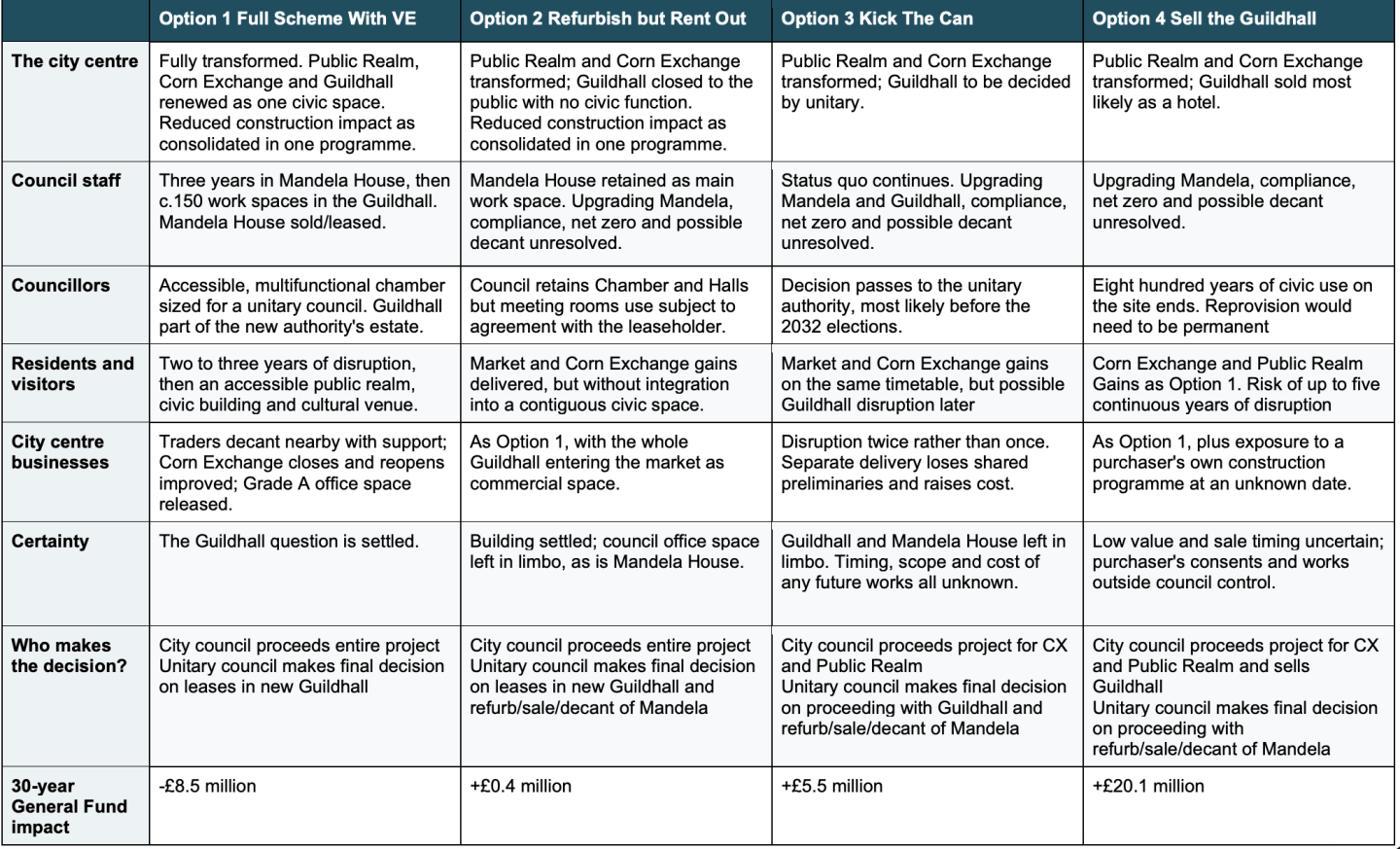
Above – Table in Item 5, Civic Quarter Update Report, p26
“The committee’s views on these issues will go to Cabinet on 16 November”
Above – Officer’s Report, Item 5, p2
“There have been civic functions on this site for around 800 years but there hasn’t been significant investment in the city centre more generally for many decades. The important strategic context to set this in is the significant growth the Government expects in the coming decades. This city might be several times bigger in future generations.”
Lynn Miles – Director of Economy and Place, Cambridge City Council – presentation to councillors.
“Essentially the bones of the Guildhall are in trouble” – Ben Binns (Asst Director of Development, Cambridge City Council)
This was a striking remark from Mr Binns, highlighting something that I can’t recall being mentioned in the consultation events.

Above – the steel frame of the Guildhall under construction in the 1930s (with the Market Square used as a car park at a time when there were few restrictions on motorists) Capturing Cambridge/Museum of Cambridge
Cllr Hugh Clough (Greens – Newnham) was particularly concerned that the consultation events did not highlight the extremely worrying state of the Guildhall.
“What I’m trying to understand is… …it feels like we need to get this information out lest it impacts the costs on the table… It’s clear this has been going on for years. Why did this come out just before the 11th hour, and what potential costs are we looking at? …I went to all of the meetings and *none* of this was hinted at.”
Above – Cllr Clough (Greens – Newnham) to Cambridge City Council
The explanation from officers was that Sir Robert McAlpine had hired office space and their experts working in the building spotted things that staff and the public would not have spotted.
Mr Binns for the Council said that the current scope will ‘absolutely’ cover the serious issues raised *provided* there is a maintenance strategy. Quite understandably Cllr Clough had issues with that explanation – asking what additional costs they could be liable for following the more detailed/intrusive surveys.
“There will be things that we don’t know – but we are managing the risks. We can’t ask for a better contractor – they worked on Big Ben and the V&A.”
Above – Ben Binns
“Every single building needs a renovation after 50-70 years. This is standard for buildings of that age.”
Above – Cllr Katie Thornburrow
Cllr Clough re-iterated his concerns following the responses.
On the future of the Corn Exchange
One of the biggest concerns councillors had was the impact of ticket price rises – with rises to £50 for headling/touring events becoming the norm.
Cllr Beth Gardiner-Smith questions the revenue estimates for the Corn Exchange
- Expected rise in income from higher ticket prices
- Expected rise in the *number* of shows (from 180 to 240 shows)
- Expecting 70% of capacity sold
- Expecting a higher bar spend
Cllr Gardiner-Smith also noted that the assumptions were also higher compared with equivalent venues.
Mr Binns responded to the ticket prices here – and said this was the result of detailed analysis from UK and global datasets (citing Ticketmaster data). He also stated that ticket prices are determined by the producers of the show, not the venues.
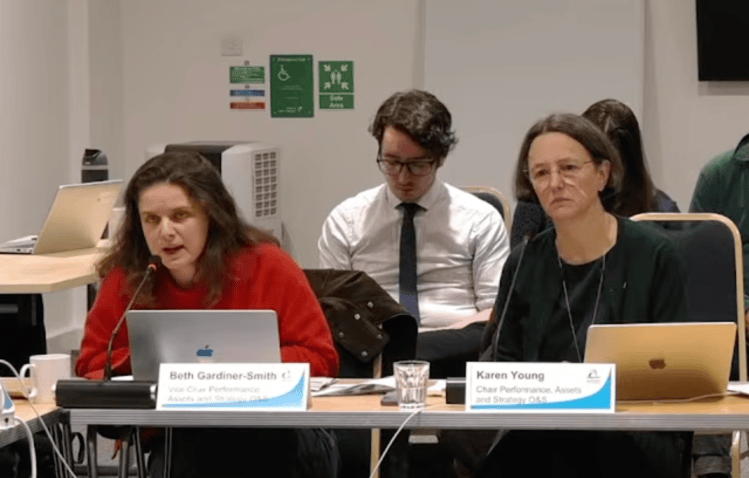
“I note what you say it’s dictated by producers. People across Cambridge are priced out of events at the Corn Exchange. It’s a public venue for a purpose, and all part of a purpose that we are creating a public realm and a civic space. We want events to remain affordable.
Above – Cllr Gardiner-Smith pushing back on the rising prices (have a listen here).
Cllr Gardiner-Smith wasn’t the only councillor to raise the issue of high ticket prices.
“I’m worried about ticket prices – and accessibility to the arts for Cambridge residents”
Cllr Sarah Nicmanis (Greens – Coleridge)
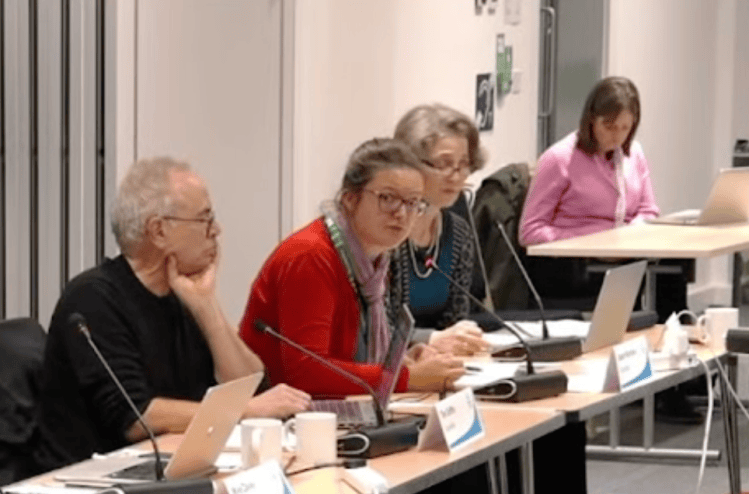
Above – Cllr Sarah Nicmanis (Greens – Coleridge, in the red) next to Cllr Tim Griffin (Lab – Coleridge)
“I’m hearing a lot of concern about people not being priced out – I’m seeing lots of nods. This will be fed back to the Cabinet.”
Cllr Karen Young (LibDems – Queen Edith’s) – Chair of the Committee
It’s the city council’s Cabinet that will decide what the council’s policy should be – though it’s more than likely that it will have to be ratified by the Full Council.
Does this help make the case for a new large concert hall for Cambridge?
After all, it’s in the Combined Authority Mayor’s Growth Plan. (Or was in the final draft in December 2025 – see item 10 Appendix A here)
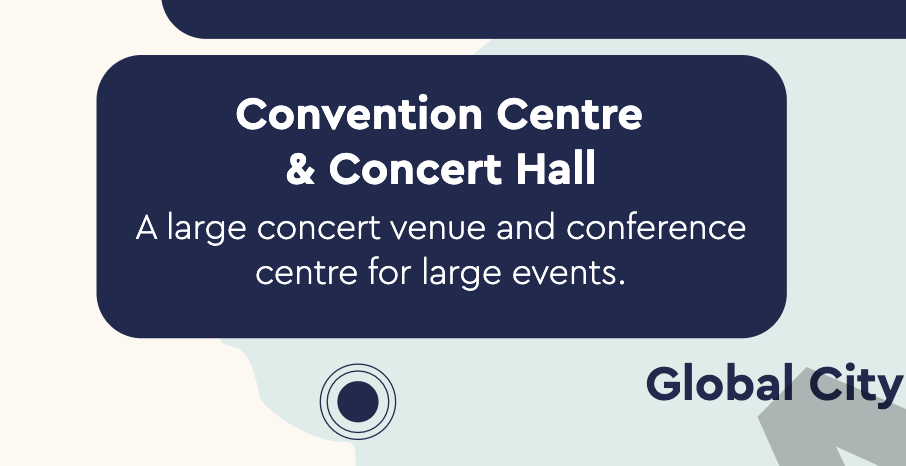
Above – detail of Item 10, Appendix A, slide 65 from the Mayor’s draft local growth plan December 2025
“What would happen to the Corn Exchange?”
Back in 2021 I suggested turning it into an incubator hub and premium business address auctioning short term leases to the highest bidders (on the grounds that the private sector would pay big sums to get such a high profile location on their business cards), and raising the existing floor level up to the top (thus filling the void below) so as to keep the large indoor area floor space. It would be much closer to the ceiling but for most of the events it would serve, this should not be a problem.
A lot of things have changed since 2021, so that point becomes a tiny little footnote in civic history – if that!
One thing that’s missing in all of this is co-ordination between what the city council needs to do with the Civic Quarter mindful of the growing urgency to start work given the poor state of repair of both buildings. How does all of this sit with:
- What the Unitary Council may want to do
- What the Greater Cambridge Development Corporation may recommend on future civic and entertainment facilities for Cambridge 2050
- The co-ordination between the local council and the Combined Authority
I’d like to think that those conversations have been had and are ongoing.
If you are interested in the longer term future of Cambridge, and on what happens at the local democracy meetings where decisions are made, feel free to:
- Follow me on BSky
- Spot me on LinkedIn
- Like my Facebook page
- Consider a small donation to help fund my continued research and reporting on local democracy in and around Cambridge


