Phil Rodgers spotted the calls that city councillors have to make themselves – or pass onto their unitary council successors. At the same time, everything could change (again) with The Chancellor’s Budget Speech in less than 36 hours time.
The problem?
“Since October 2025, building and borrowing costs have risen sharply”
“After £13.7m of proposed savings, the full scheme including all preparatory work would cost £95.7m. With a tight council budget and local government reorganisation ahead, the chosen scheme must not put unnecessary pressure on other services or council finances.”
Which is why the officer’s paper is being put to councillors for their views – but *not* for a formal decision
You can:
- read the meeting papers here
- read the civic quarter additional papers here
- read the background from the city council on the civic quarter
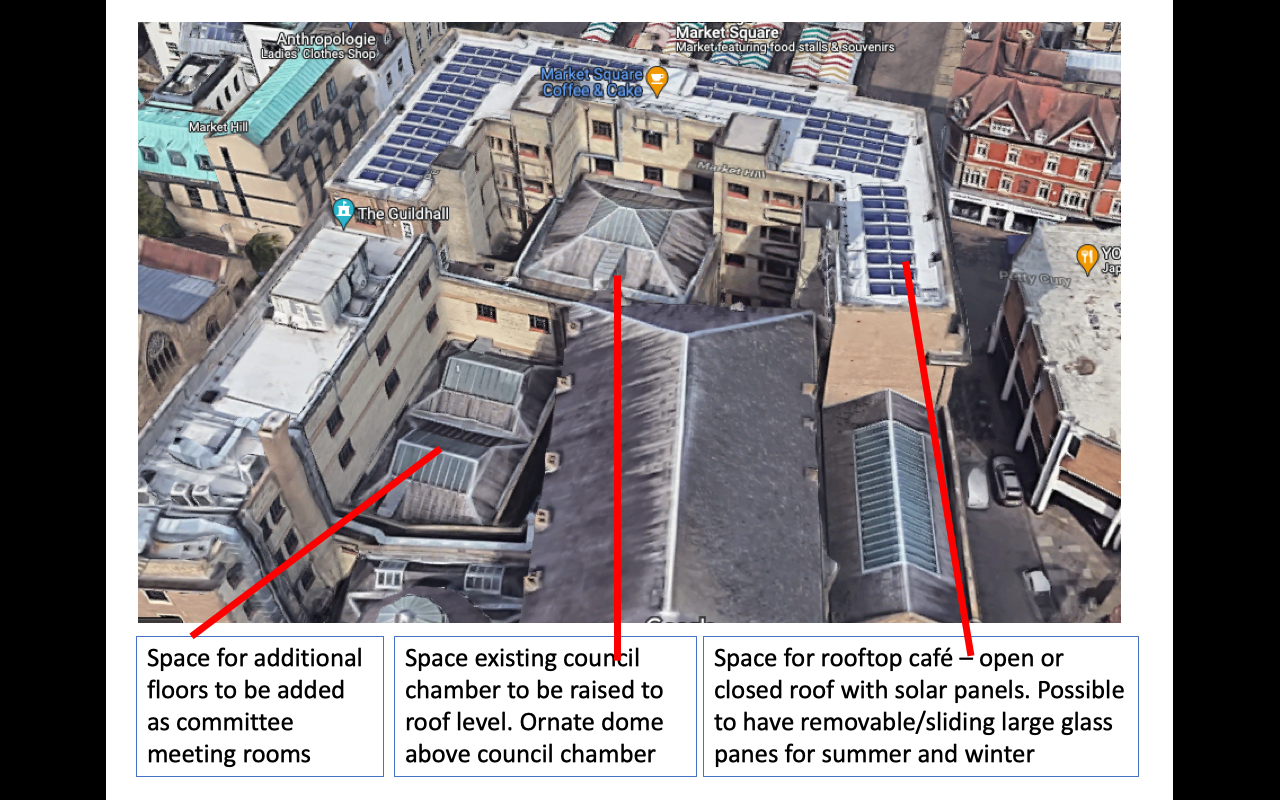
- read my outline concept that got completely ignored by the council back in 2024
I wasn’t the only one not happy with the proposals.
I featured Mr Holbrook’s alternative in a blogpost back in November 2024 which included a shared entrance for both Corn Exchange and Guildhall (the large hall’s stage entrance is opposite the Corn Exchange’s main entrance).
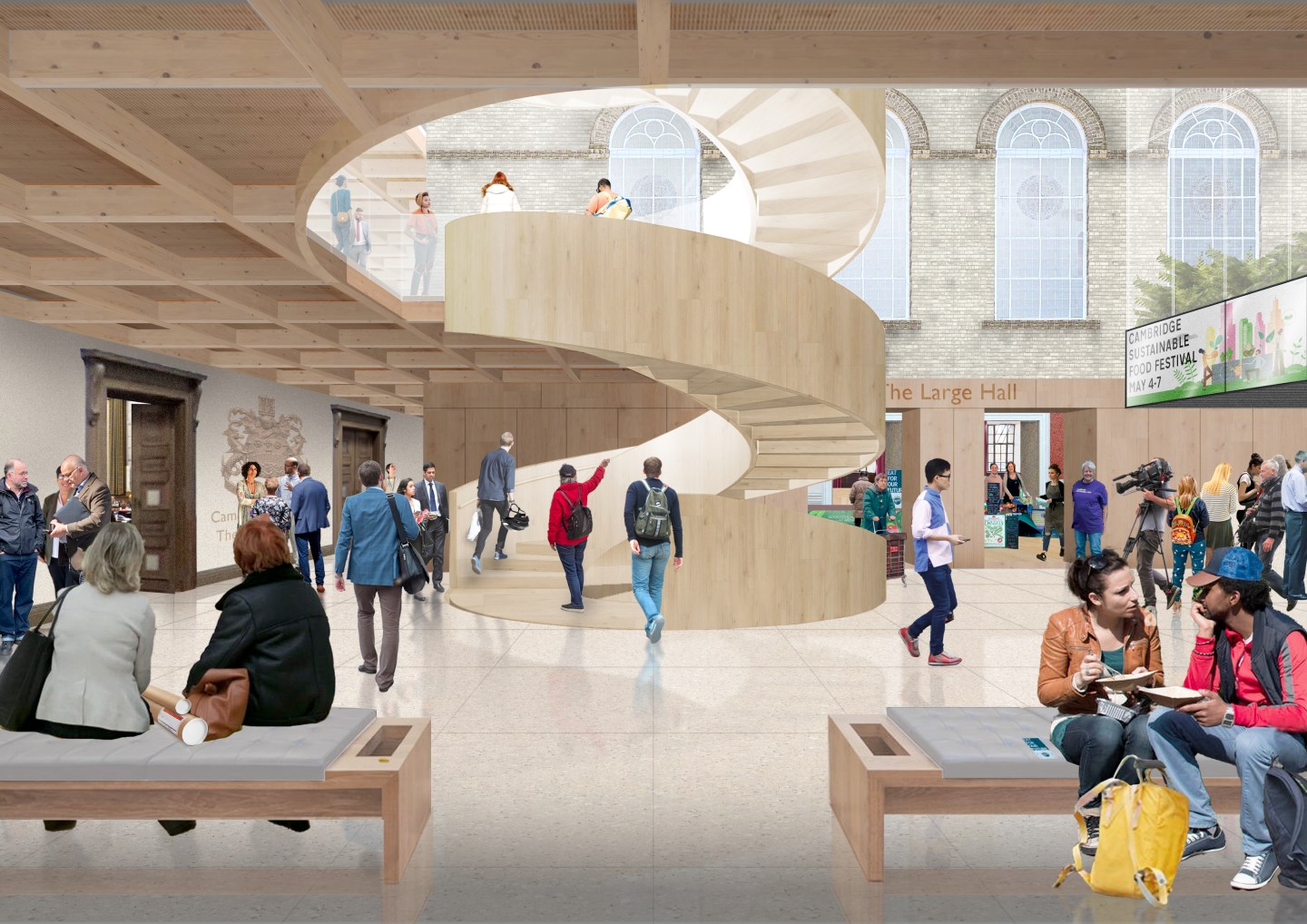
Above – ‘I want that one!’ – by 5th Studio, November 2024
“What were your proposals again?”
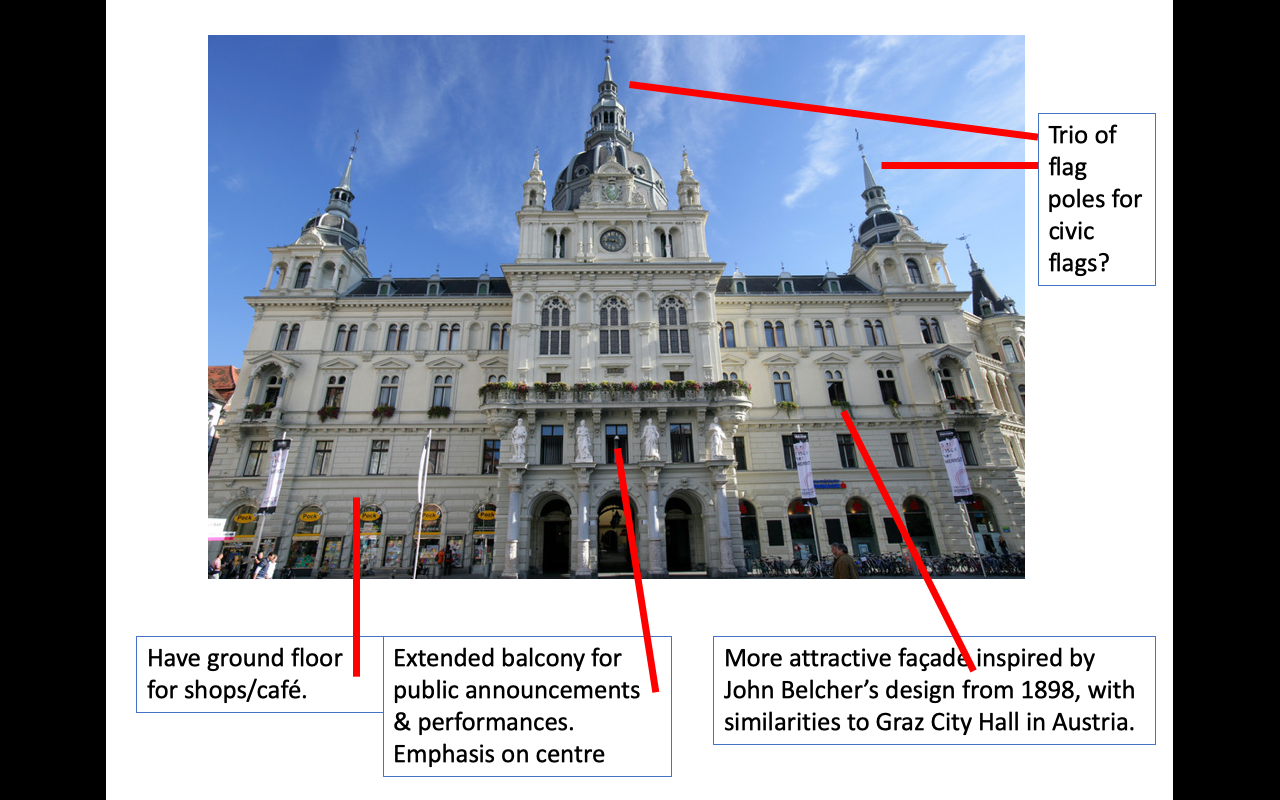
Basically make the front of the guildhall look much more aesthetically pleasing and in a brighter colour rather than the dark bulky mass that Charles Cowles-Voysey imposed on the town as was.
When it comes to falling out over guildhall designs, Cambridge has got history. 175 years of it.
When I discovered how to use AI to convert etchings and prints from old architectural newspapers I put a few through them to see what would come out the other end. This is what the Peck & Stephens proposal from 1860 might have looked like had it been built.

This reflects the ‘ornate twin towers’ theme that I think a second urban centre should adopt for large civic and public ‘anchor’ buildings.

Above – we got a bulky design because opponents of the original design could not agree on an alternative. Cartoon by Sid Moon for the Cambridge Daily News in the Cambridgeshire Collection featured in Lost Cambridge 28 July 2017
“So, what are councillors facing?”
This:
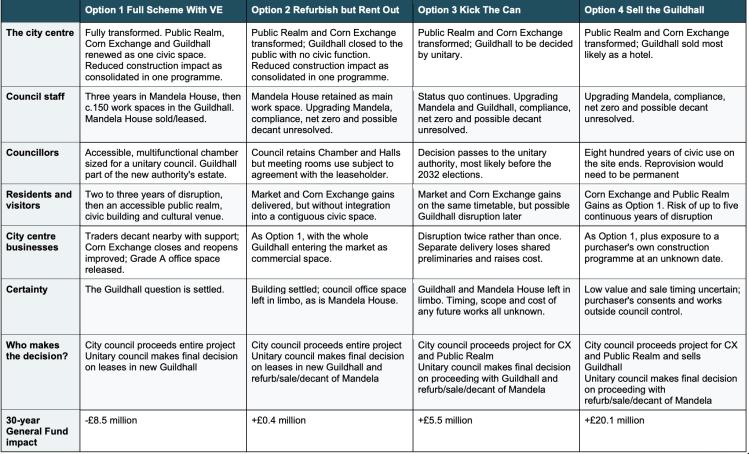
Above – Table in Item 5, Civic Quarter Update Report, p26
The impact on the finances are:
- Carry on as normal: A further loss of £8.5million
- Guildhall ceases to be a public building and is let out to private sector – saves £400,000
- Leave the guildhall to be decided by the incoming Unitary council but carry on with public realm and Corn Exchange – saves £5.5million but leaves a big problem for the incoming unitary council
- Sell the guildhall, carry on with Corn Exchange and public realm improvements.
“What do you think they should do?”
Wait and see what they are going to get from The Budget – and also from the development corporation too. There are far too many uncertainties at the moment for very big decisions to be taken by the current city council knowing it will cease to exist in the next few years.
The missed opportunity for a co-ordinated plan for civic buildings
This was a missed opportunity because of the decision by Cambridgeshire Conservatives to move out of Cambridge and into a small pokey little complex at Alconbury that no one could get to by public transport. Fewer public questions to deal with that way. Unexpectedly they lost political control of the county council shortly after the move at the county elections in 2021, and then got crushed at the county council elections in 2025. In the meantime the developers who negotiated a long lease for old Shire Hall came up with their proposals for an apart-hotel that I moaned about here.
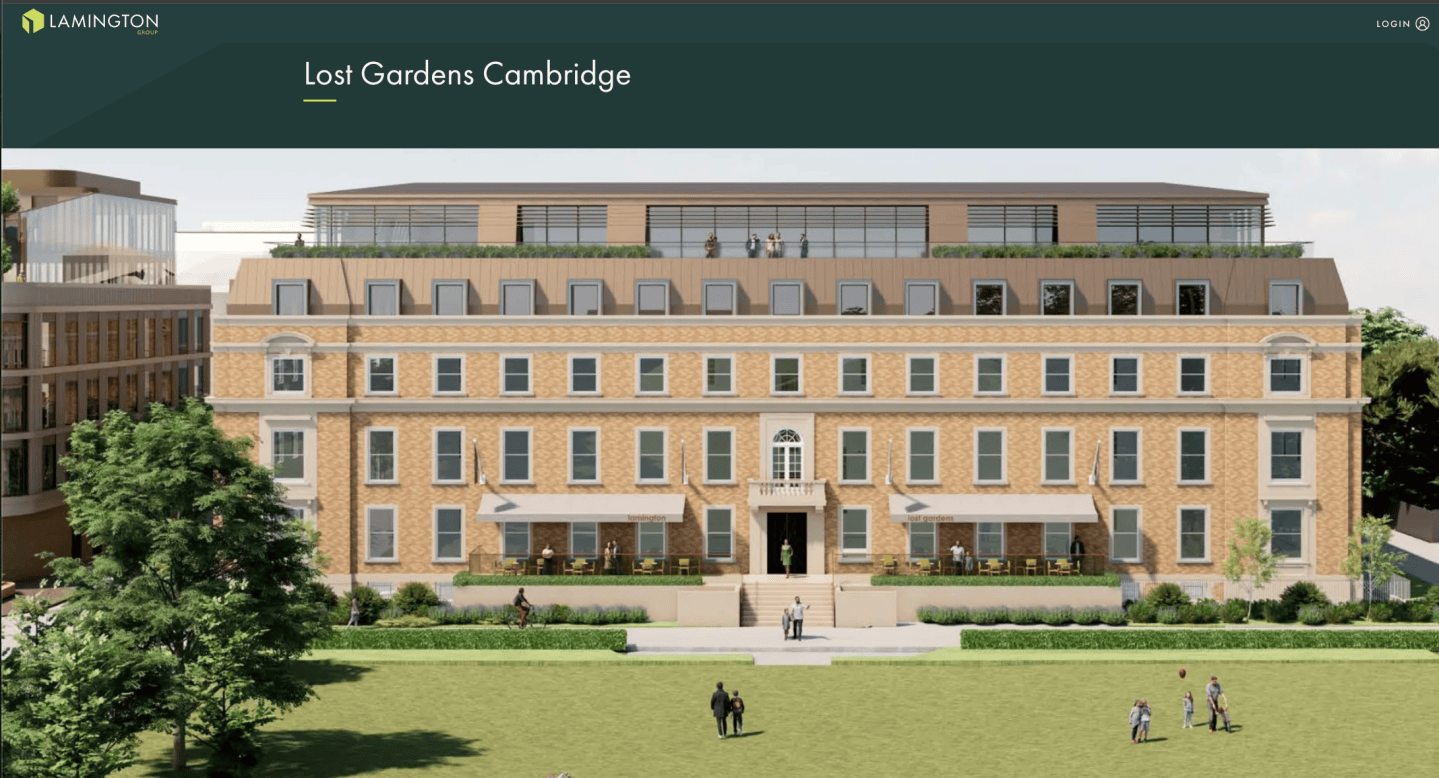
Above – from the developer’s landing page here. The new top floor looks even more bland and boring than the 1930s-era Shire Hall that was made out of the old bricks from County Gaol that used to be there. (It was also the site of the last public hanging in Cambridge in 1864 where the hangman held a press conference before he did his final deed)
Note this was a time when there was significant public pressure to abolish capital punishment – pressure that led to the ending of public executions in England not long after. (It would be another century before the penalty was abolished for murder – further legislation was needed to get rid of the penalty for the rest).
The opportunity that was missed was turning the Castle Hill site into a heritage-themed site. I think a new extension for the Museum of Cambridge should have been included in the plans. One of the options that has been suggested for the Cambridge Guildhall is to have a new Museum of Cambridge there – one that tells the story of the city.
Given the desire from the business sectors to be located so close to King’s College Chapel, I can’t help but feel that the Corn Exchange could be converted into both a business hub and incubator – with building divided into three floors so that the top floor functions as a very large event space with an inevitably lower ceiling due to the raised floor.
A new urban centre for a growing Cambridge
As events have moved on over the decade-and-a-half that I’ve been blogging for, (anyone who was there at the start still around?!?) the case for a second urban centre that is a meaningful distance away from the historical centre, becomes stronger and stronger. I’m not the first person to propose this – John Parry Lewis did the same in the mid-1970s.

Above – from the Cambridge Sub-Regional Plan that I’ve digitised here from my own library.
Note his phasing which had the plans been adopted, would have taken place over 25 years – taking the city to 200,000 people by the Year 2000. Note how he also proposed the new urban centre *as a sub-regional centre* – i.e. larger than the district centre currently proposed in the draft local plan.
My take is that if ministers are going to insist on such high growth targets for Cambridge, then they need to:
- Designate where a new urban centre is going to be
- Designate what functions it will undertake that are perhaps no longer possible in the historic centre, for example a) public administration and local democracy, b) city and sub-regional retail, c) large arts, leisure, and entertainment
- Designate what anchor buildings will enable the second urban centre to withstand the shocks that crushed the Grafton Centre as a second urban centre
- Make the transport connections ‘politician-proof’ – i.e. make it all but impossible for major service cuts to be brought in – noting that privatised Stagecoach were able to cut bus services from South Cambridge to The Grafton’s bespoke bus station without intervention from councillors or ministers. With the inevitable result.
Hence my repeated call for a new civic square to be enclosed by:
- A new large ornate city hall radiating civic pride
- A new large concert hall (Happy for this to be separate from a proposal to turn one of the huge aircraft hangars on the airport site into a new indoor arena holding 5,000+ people)
- A new large lifelong learning college – solving multiple problems from the skills shortages in adults that The Guardian picked up on recently, to combating loneliness in society
- A new railway station [Cambridge East] and light rail transport hub with suburban and regional connections
Using civic centres to design out poverty – a recap
With the above in mind, I was reminded by this blogpost from December 2025 which highlighted a forgotten report titled The Missing Links – Connecting Disadvantaged Neighbourhoods to New Economic Opportunities. Two recommendations that stand out:
“Working Neighbourhoods Transport Grants (WNTGs) – a new grants programme that would provide five years of targeted funding to 250 disadvantaged neighbourhoods. Allocated via Mayoral or Local Transport Authorities, the grants would support Community Transport Organisations to deliver flexible, employment-focused transport services such as work shuttles, late-night buses, rural minibuses, or community car clubs. This would ensure reliable, affordable access to jobs, while also supporting the development of social capital among residents.
“Nightingale Skills Centres. A new network of Nightingale Skills Centres – small, satellite training sites of Further and Higher Education providers, located directly in disadvantaged neighbourhoods – to make skills provision accessible where travel to formal training sites is difficult. Based out of community spaces or vacant high street units, they would focus on delivering foundational qualifications up to NVQ3 and work with local employers to align training with job opportunities.
Above – The Missing Links (2025) pp5-6
Such centres could function as feeder centres to a large lifelong learning college as and when learners in the smaller towns and villages find out about the wider range of options and progress onto further/higher levels of training or study – knowing that as a sub-regional transport hub there’s a greater chance that the public transport and active travel access has been designed in.
But hey – that’s a very long term vision, one I probably won’t be around for to see to fruition.
If you are interested in the longer term future of Cambridge, and on what happens at the local democracy meetings where decisions are made, feel free to:
- Follow me on BSky
- Spot me on LinkedIn
- Like my Facebook page
- Consider a small donation to help fund my continued research and reporting on local democracy in and around Cambridge


