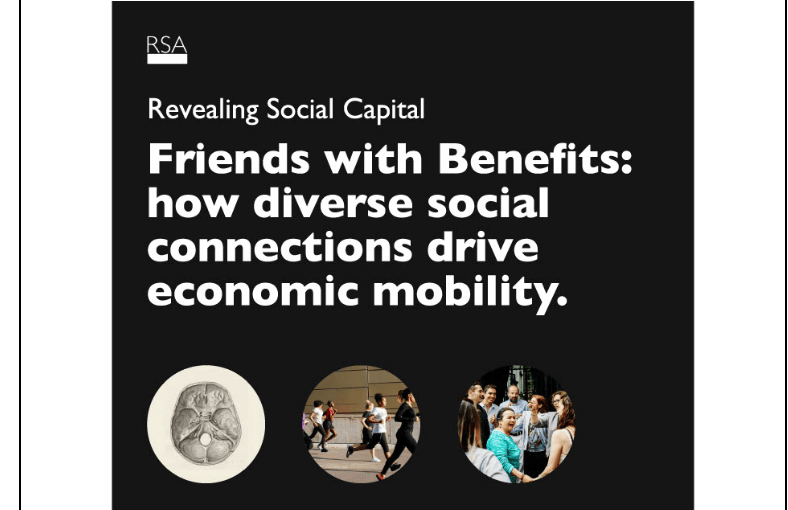
The RSA published a report in December 2025 that inevitably fell off the radar because a number of people were looking forward to seeing what in-depth analysis of F-Book and IG data showed about social interactions across class boundaries. Amongst other things.
You can:
- Read the RSA reports here
- Browse through the earlier report by the RSA and also by the Bennett School of Public Policy
- Browse through the wellbeing and social inclusion paper for the draft local plan
- Find out about a new campaign on 21st Century Social Clubs
- See more on what’s happening in Cambridge of late
“Proximity alone does not create bonds. Shared activities do. Our research across 20+ neighbourhoods revealed that placing diverse economic groups together fails without meaningful interaction. Inclusive workplace cultures and community activities with universal appeal create opportunities for people from different backgrounds to connect.”
Above – How to connect communities to create opportunities (2025) BIT
“We surveyed 3,770 adult Facebook users in the UK to understand how social connections relate to self-reported wellbeing. Respondents with more friends (particularly more high-income friends) and tighter-knit networks report better wellbeing across multiple measures: greater life satisfaction, less isolation, higher trust and stronger social support”
Above – How to connect communities to create opportunities (2025) BIT, p12
“‘Pride in Place’ Neighbourhood boards and Community Wealth Funds should develop micro-grants and ‘backbone support’ to support local capacity for civic and social engagement as well as social infrastructure.”
Above – RSA (2025) p12
Cambridge City Council’s small grants
You can find out more about their grants here, applications for next year’s round opening in November 2026. You can also see how well the previous years’ reports covered their projects. It’s essential that this evaluation feeds back in.
Using a small city council grant to hire a hall that councillors awarded funding to in order to improve its catering facilities
The hall is the old Cherry Hinton Free Church on Hartington Grove – the original hall around the back of the slightly later interwar redbrick building that became the United Reformed Church, and today the Greek Orthodox Church of St Athanasios
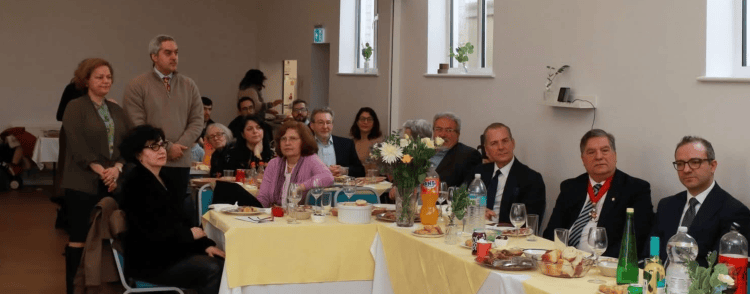
Above – Photo from St Athanasios FB page with former local councillor and former Mayor of Cambridge George Pippas second from the right with the medal and red ribbon.
You can also see where the hall and church is within the wider neighbourhood on GMaps here, with Cherry Hinton Road effectively forming the ward boundary between Queen Edith’s and Coleridge on Cambridge City Council.
There are at least a couple more windows further to the right of the photo, with the hatch to the kitchen lit up at the back of the photo. This was one of the main expenses that the council funded (hence why I think current and potential community groups could make more use of it). This was also the same hall that the Cambridge Liberal Democrats used in the snap 2017 General Election as a temporary campaign headquarters. I filmed this interview prior to the refurbishment with the then party president and former county councillor, Baroness Sal Brinton, who you can still see contributing in the Lords today.
Making more use of community facilities in the absence of permanent community development officers
I’m not proposing forming a large London-scale social club that were featured in a recent report. The relatively low housing/population density along with the increasing turnover and massive house price/salary ratio imbalances makes this hard to achieve. Essentially there are a number of potential new groups and initiatives that could be hosted at the same time in the same venue funded by a community grant from the council to pay for the hall hire and refreshments – along the model of the Queen Edith’s Community Cafe at Nightingale Pavillion on the 2nd Sunday of the month, every month.
- Where Friends Grow (Cambridge) aimed at 20s & 30s
- Empty Chairs – expanding on the one in Cambridge Lewis hosts on the last Thursday of the month
- The Junction’s Creative Cafe on the first Tuesday of the month, “Open to everyone, but particularly welcoming adults experiencing mental health challenges.”
- The ADHD Cambridge Group (Whose meetings always clash with music rehearsals!)
- People, Planet, Pint, – which normally meets at the Salisbury Arms
- Coleridge Community Forum – providing a space for councillors to meet local residents (and for the latter to raise any local issues in a non-confrontational space, as what happens at the Queen Ediths’ Community Cafes)
- Rebel Badge Club – have the gatherings as a place for people to organise shared activities to enable people to complete the requirements of the various badges (like scouts and guides/cubs and brownies but for adults).
It only needs to last for a couple of hours for each event (Say 2-4pm) and then people can either head home or go to either Cambridge Wine Merchants over the road or the recently re-opened Rock Pub down the road – the new landlady Caz having organised a host of events that either haven’t been seen for years (live music) or haven’t been tried before – such as the group watch-a-long/Watch Party of Traitors.
“Anything else from the RSA reports?”
The failure of the BBC and ITV’s big media city investments to integrate with established Working Class communities.
“MediaCityUK exemplifies this challenge. The BBC and ITV hub built on Salford’s former
docks placed media professionals right beside Ordsall’s established working-class
community, yet the two groups barely interact.”
Above – How to connect communities to create opportunities (2025) BIT, p19
They have a host of interesting case studies too.
“We propose regional civic service programmes with three key features: easy enrolment for all young people, small cross-class teams tackling local projects, and delivery by community organisations rather than central government.”
“Most friendships form in neighbourhoods, making local services and social infrastructure critical for building relationships from proximity. Community facilities like Family Hubs create the most mixing when they offer activities that appeal across different backgrounds“
Above – How to connect communities to create opportunities (2025) BIT, p22
Getting to a participating society
I wrote more about this in an earlier blogpost here. In the more longer term, getting a critical mass of people to participate in community action including scrutinising the decisions being made about the future of our city is what I’d like to see. That might facilitated in the form of a localised list of discussion topics that become informal weekly meetups – especially when there are big public consultations on that cannot be fully covered in a single gathering.
It’s a huge ask and it’s not something I’ve got the capacity to do myself. But we have to start somewhere. Anyway, let’s see what The Budget brings in just over 12 hours time.
If you are interested in the longer term future of Cambridge, and on what happens at the local democracy meetings where decisions are made, feel free to:
- Follow me on BSky
- Spot me on LinkedIn
- Like my Facebook page
- Consider a small donation to help fund my continued research and reporting on local democracy in and around Cambridge.


