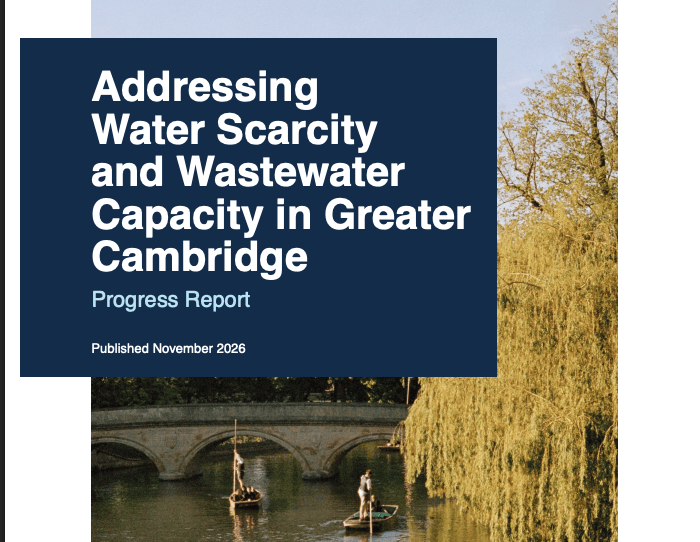
The Government published a report just in time for everyone to ponder it over the weekend – the main takeaway being the further investment into the Cambridge Water Works at Milton (which should mean that Honey Hill is saved)
You can read the report here, and also read the press release from the Greater Cambridge Development Corporation here.
Other headlines in the executive summary include:
- “Short-term action to reduce water demand and unlock growth
- Local collaboration to test new ways of improving water resilience.
- Supporting growth through planned water supply infrastructure.
- Progress to resolve wastewater capacity issues“
“That sounds awfully bland”
The only specifics in the executive summary are:
- the Grafham Water pipeline
- the long-planned Fens reservoir at Chatteris,
- increasing the capacity of the existing Cambridge Waste Water Treatment Plan. (I’ve always known it as the Cambridge Water Works – it’s easier that way). Feasibility studies have shown that “the site can accommodate planned growth and future projections to support the government’s long-term aim.” (p28)
On the final point, that means Anglian Water really should be made to do something about the Milton Pong, which on a bad day is an overwhelmingly pungent stink that I dread thinking about!
Much of the rest of the actions – mainly pilot work, are in the detail
“Such as?”
Building new storage facilities to collect and hold water in the winter months.
“Increasing storage would allow surplus winter water to be captured for use during drier
periods, improving resilience while reducing pressure on the environment. The findings are
informing intervention priorities and regional planning through Water Resources East.“
Above – Cambridge Water Scarcity Progress Report (2026) p19
This relates to a scheme that Cambridgeshire County Council is leading on – mindful that Cambridgeshire is predominantly an agricultural county.
“A new £1.32 million grant scheme is now open to help farms and growers across Cambridgeshire make better use of water and reduce pressure on local supplies. The Water Resilience Grant Scheme is funded by the Ministry of Housing, Communities & Local Government (MHCLG), with Cambridgeshire County Council as the lead authority. Funding is available for practical improvements, including”
- rainwater harvesting
- on‑farm water storage
- more efficient irrigation systems
Above – Cambridgeshire County Council Agricultural Water Resilience Grant Scheme
Round 2 of the Agricultural Water Resilience Grant Scheme deadline – 29 November 2026
You can read the announcement here (Round 1 was launched back in July) which is the second tranche of the £1.32m of funding, the criteria including:
- “Location: Projects must be located within Cambridgeshire
- Open to: Agricultural and horticultural businesses operating within Cambridgeshire
- Grant value: £2,000–£50,000
- Funding contribution: Up to 50% of eligible project costs, paid after costs have been incurred and claimed
- Match funding required: 50%
- Total funding available across all rounds: £1.3 million
- Funding remaining for round 2: Approximately £580,000
£50,000 – that won’t go far, will it?
It’ll make a difference for small farmers – have a look at the case study from FPS Environmental which includes a large water storage tank and soakaway which reduces the surface-level runoff of rainwater coming from the barn.
It’s ‘Infrastructure First’, chaps!
Which may mean some property types have to reappraise their investment portfolios as ministers double-down on capturing more of the financial gains to pay for the infrastrucure – something that hasn’t really happened in previous rounds as Dr Andy Williams of the Oxford Cambridge Supercluster mentioned in a talk in Queen Edith’s ward back in 2023.
“One of the things Dr Williams mentioned was the failure of previous governments to build the necessary infrastructure needed for previous expansions. Cambridge South railway station has been long called for over the decades”
The Government’s report of today states the following”
“The [Greater Cambridge] Development Corporation will embed an infrastructure-first approach to delivery, bringing together planning, investment and delivery to ensure that critical infrastructure – including water supply and wastewater capacity – is in place to support growth at the right time and scale”
Above – Cambridge Water Scarcity Progress Report (2026) p30
“Is there anything on retrofitting existing buildings?”
Yes – but nowhere near enough and far from the scale that the city needs if Ministers are to get the growth they want. The report states:
- “2,048 social homes across South Cambridgeshire District Council and Cambridge City Council have been retrofitted, with further homes to be retrofittedin the coming months
- “Water recycling systems are being installed at three swimming pools in Cambridge City from Autumn 2026 – this is expected to save up to 90% of the water used for cleaning filters, which is normally wasted, equating to savings of 8.6Ml/year.”
- “Cambridgeshire County Council will launch a programme to install water-saving devices in approximately 100 schools.”
Above – Cambridge Water Scarcity Progress Report (2026) p30
What it does not cover is the street-by-street programmes that for private homes can involve very intrusive and disruptive work – as I filmed in the Greville Road case study in Coleridge in July 2025 which I wrote about here.
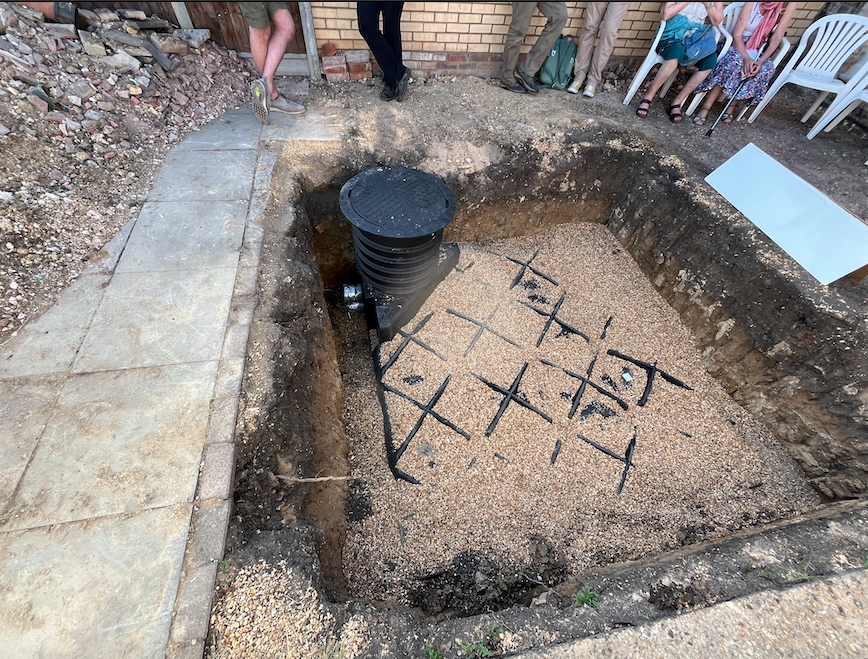
Above – the top of the fitted reservoir in the Cambridge exemplar house which in this case is a 1,000 litre tank if I recall correctly, with the filter on top of it. The plastic top is designed to enable inspection. You can watch the video of Richard Lester of Rainwater Harvesting explain how it works here.
Demand reduction – Cambridge Water’s Targets
The report states as follows:
Cambridge Water’s demand management deliverables
- 1,740 smart-capable meters were installed in 2025/26.
- Over 14,500 further meters planned by 2030
- Over 90% of properties expected to be metered.
- Around 16Ml/d demand reduction expected by 2032.
Above – Cambridge Water Scarcity Progress Report (2026) p14
Which is a target-and-a-half. (16 million litres per day saved by 2032 in the face of lots more houses and labs coming on stream).
Eddington gets a mention
One of my least favourite developments (I’ll stop there!!!) has a rainwater harvesting scheme.
“This work is intended to address barriers that currently limit the operation of development scale water reuse schemes and support greater adoption of water-efficient infrastructure in new developments.”
The problem is that the rules need changing. As the Guardian reported:
“Recycling system in Cambridgeshire that could save thousands of litres a day is deemed not in line with rules”
Above – Guardian 19 August 2026
Which was just over 3 months ago. Ministers at Defra better get their skates on and change the rules if they haven’t already.
Reducing runoff in the Upper Cam valley (i.e. before the River Cam gets to Cambridge)
One of the case studies here is about reducing surface water runoff and increasing percolation – oh this is GCSE / A-level geography all over again! (Note to policy people: Get this content into worksheets for schools and exam boards).
“We are focused on designing, constructing, and monitoring runoff attenuation and infiltration features (RAIFs) [in the Cam and Wensum catchments] to improve aquifer recharge, enhance base flows, and increase water availability.”
Above – Water Resources East, Cam and Wensum trials
There are a host of other things the report covers, and the local groups covering water campaigning in/around Cambridge in more detail include:
- Cam Catchment Partnership
- Cam Valley Forum
- Cambridge PPF
- Friends of the Cam
- Friends of the Earth Cambridge
- Water Sensitive Cambridge
Alternatively, ask your local councillors for more information – especially if it involves what local government is doing.
If you are interested in the longer term future of Cambridge, and on what happens at the local democracy meetings where decisions are made, feel free to:
- Follow me on BSky
- Spot me on LinkedIn
- Like my Facebook page
- Consider a small donation to help fund my continued research and reporting on local democracy in and around Cambridge


