The final words of the Cambridge Citizens’ Founding Assembly video from the standing-room-only event at The Guildhall on 25 November 2026
You can watch the short video clip:
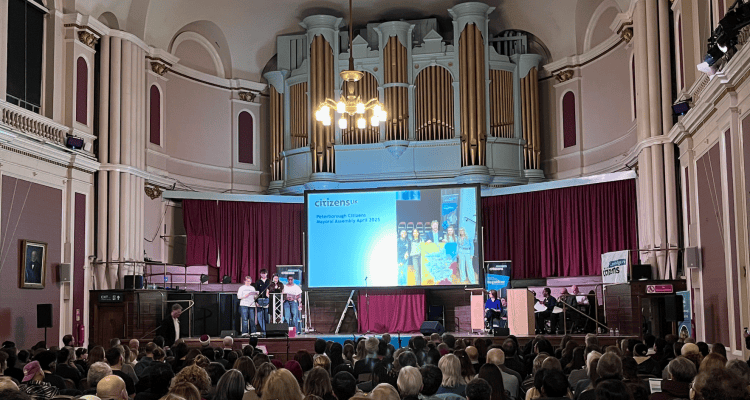
Above – standing room only at the Guildhall’s large assembly hall (opened in 1862) with the pipes of the broken organ in the background and the slightly shabby-looking oil paintings of splendid chaps (and Queen Victoria) helping make the case for a revamp
This blogpost follows on from my previous one on the event publicity here
About the Citizens UK Charity
“We bring together everyday people and local organisations to build a better, fairer society. Together, we make change on the issues that matter, from campaigning for zebra crossings on dangerous roads, to reforming the immigration system, to the Living Wage campaign.
The Cambridge Chapter of Citizens’ UK launches after four years of groundwork
The pre-founding assembly dates back to November 2023, over three years ago. I wrote about that event here which took place at Long Road Sixth Form College.
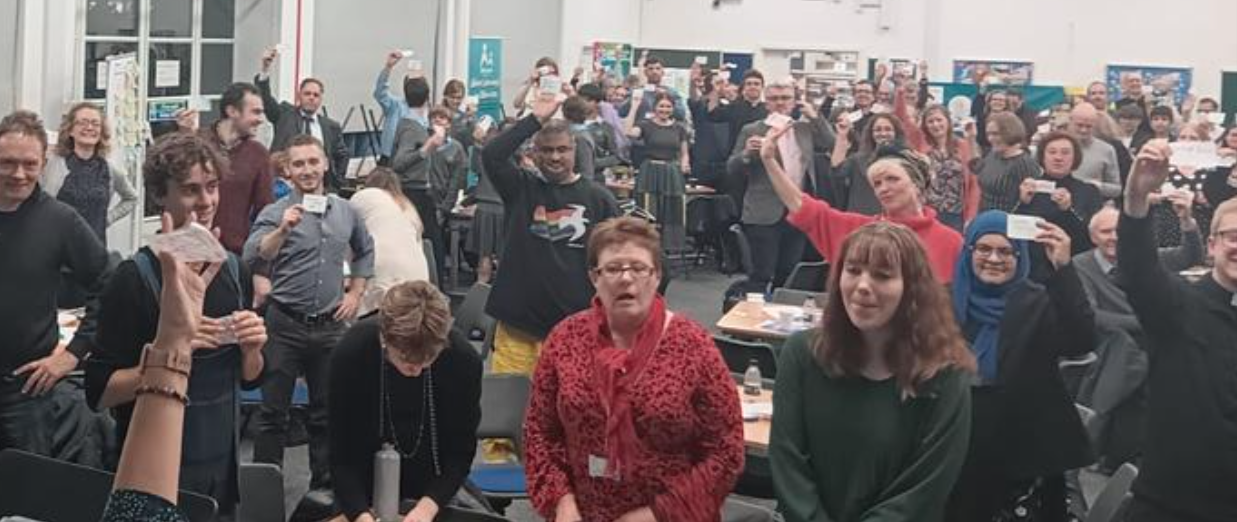
Above – from one of a trio of photos here by the organisers. (Can you spot me and Hilary Cox Condron?)
In the time between those two gatherings, local volunteers and groups have hosted a series of ‘Weaving Trust’ events – the most recent of which you can read about here. And as anyone familiar with community work, you have to stick around for the long haul – echoing the words of Michael Sheen in his Raymond Williams lecture/masterclass in 2017. It’s not something you can simply rock up to and expect everything to fall into place.
Children and young teenagers hold the politicians to account.
The first commitment the students of Long Road Sixth Form College extracted from Combined Authority Mayor Paul Bristow was on the popular Tiger Bus Pass
Above – they also put the pledge up on a big screen so there was no running away from it!
(Was it pre-arranged or was it spontaneous? I’ll leave that one to you to decide!)
“If you don’t improve the cyclelanes we’ll get the little’uns to sing a Coldplay song”
The students from Long Road Sixth Form College, Cambridge led the conversations on bus services, and St Bede’s, Cambridge led the conversation on improved active travel (in particular potholes in cycle lanes). Understandable given the modes of transport the different cohorts are dependent on – mindful that both institutions are in the south of the city.
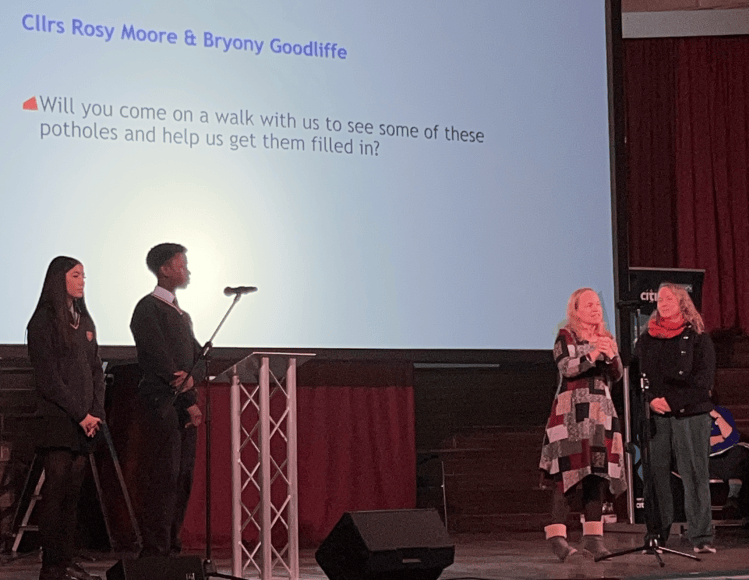
Above: ‘Walk this way’ – St Bede’s students question Cllr Bryony Goodliffe (Labour – Cherry Hinton Division on Cambridgeshire County Council) and Cllr Rosy Moore (Labour – Coleridge, on Cambridge City Council)
It was left to Rosy to introduce the students to the joys of two-tier local government in Cambridge – i.e. who is and who is not responsible for potholes on the city’s roads. In a few years time the problems of two-tier governance for local issues should be confined to the history books – with only one unitary council to complain to. Unless potholes become the responsibility of the Combined, and soon to be rebranded ‘Strategic’ authority of Cambridgeshire and Peterborough.
“Did the Assembly make an impact?”
Yes – and not in the way events normally have an impact. And this was because a critical mass of the participants were under 18 – which mean that many of them came along with family and friends. i.e. the sort of people who don’t turn up to council meetings on cold weekday nights in November. A reminder of Cambridge City Council’s full council meeting on Thursday 26 November (which may well have happened by the time you read this!)
It was part school concert, part charity pledge event, part political debate interspersed with the noise and chaos associated with anything involving people under the age of 11. Which is as it should be.
On the part of young people’s issues at the full council meeting, one of the motions in the general debate involves asking the city council to pass a motion that includes:
“To launch a Cambridge More Ball Games campaign, modelled on London Sport’s campaign, to remove “No Ball Games” signs from Council owned land, including parks, open spaces and housing estates by December 2027”
Above – Cllr Beth Gardiner-Smith (Labour – Romsey) – item 11b
The Cambridge Chapter of Citizens’ UK to commence big listening campaign in 2027
The timeline was confirmed at their founding assembly at a packed assembly hall at the Guildhall in Cambridge on 25 November 2026. The audience included the Combined Authority Mayor Paul Bristow, Mayor of Cambridge Maria Cleminson, and Karen Clarke, the Head of Strategic Engagement for the Greater Cambridge Development Corporation.
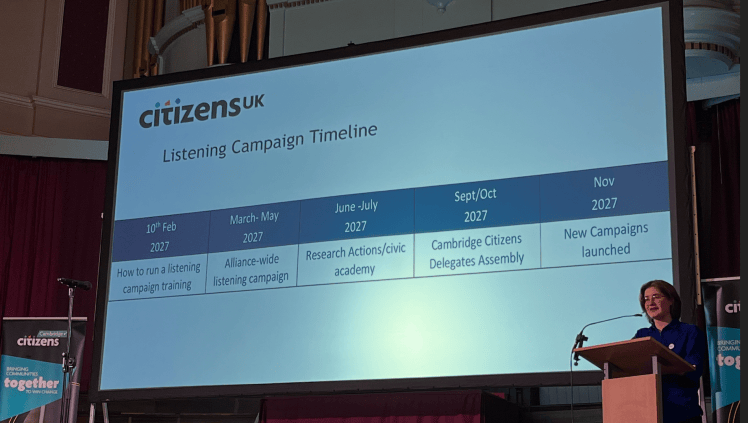
Above – the proposed Listening Campaign timeline
The current institutional members are listed below:
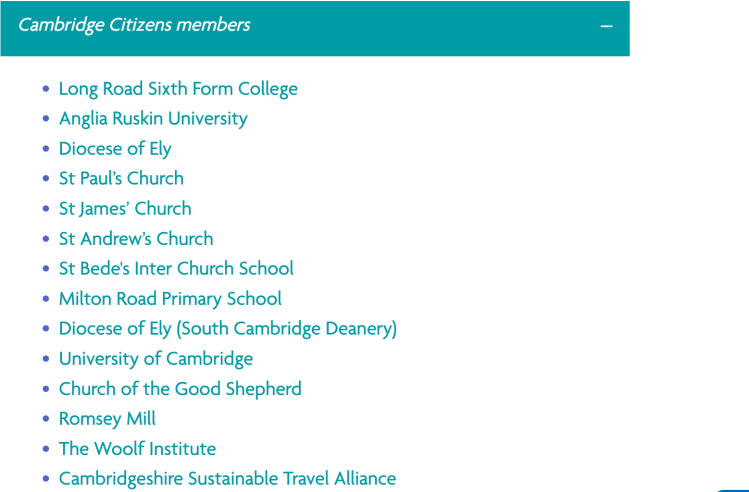
Above – Cambridge Citizens’ member organisations
There were some additional member organisations that also were announced as members during the evening.
Can the Listening Campaign act as a gateway towards much more sustained engagement and longer term conversations on the future of the city?
This includes decisions on issues being transferred to the Greater Cambridge Development Corporation and the creation of both the unitary council and the Strategic Authority (the latter being what the Combined Authority will evolve into following the English Devolution and Community Empowerment Act 2026).
That will need to involve some sort of citizenship education not just for children but for adults too. My previous blogpost on Votes at 16 covers this. That does not mean doing an in-depth politics course. The GCSE Citizenship textbooks past and present do a pretty good job of covering what is a huge amount of material. And even that will be too much for most people.
For those of you wondering what a GCSE Citizenship book covers…
…have a look at the headings below from the textbook by Jenny Wales
The chapters speak volumes on setting strong foundations *before* getting into the existence of political institutions. It starts with where the children and teenagers are: The communities where they live.


Above – I featured the above-two pages in a blogpost from 2023 calling on the Combined Authority to commission GCSE citizenship & democracy evening classes.
With no discretionary funding for local priorities, the Combined Authority remains restricted on spending only what the Government a) provides it with funding for, and b) staying within the bounds of the terms and conditions of that funding. If ministers have not provided any funding and policy direction, nothing happens.
For anyone who wants to see changes in lifelong learning provision, their options include:
- Contacting their MP to ask them to lobby ministers (https://www.writetothem.com/)
- Getting involved with lifelong learning campaigns such as the WEA at https://www.wea.org.uk/
Succession planning for the children and teenagers – especially those that stay in / return to Cambridge as adults.
As the primary school children were singing their final song, I wondered which would happen the soonest:
- Cambridge getting a new large concert hall (mindful of how awful the acoustics are in the large assembly hall!), or
- the children reaching their 20s?
Something to ponder given Cambridge’s record on infrastructure investment.
If you are interested in the longer term future of Cambridge, and on what happens at the local democracy meetings where decisions are made, feel free to:
- Consider a small donation to help fund my continued research and reporting on local democracy in and around Cambridge
- Follow me on BSky
- Spot me on LinkedIn
- Like my Facebook page


