
It was a session at the UK property gathering UKREiiF 2026 on 19 May, sponsored by British Land (which means they also got a panel seat for the debate) – mindful of the news about Cambridge Science Park which I last wrote about in late 2025 here
I can think of a number of reasons why this remains a fantasy despite the best efforts of institutions and their representatives that stand to gain financially from something like this. The top two include:
- The broken governance structures – current and proposed, keep nearly all of the meaningful decision-making powers locked up in London
- The Green Party in Cambridge – which is the most hostile towards the current growth plans, made substantial gains at the city council elections to the extent that they are now the official opposition on Cambridge City Council (i.e. there are democratic legitimacy issues that won’t go away anytime soon).
In a nutshell the institutional structures and governance systems are unable to solve the problems that local residents are raising – ones that they fed back via the ballot box. And the shockwaves from those local election results were strong enough to persuade the Health Secretary Wes Streeting to resign citing lost confidence in the Prime Minister, and for the Mayor of Greater Manchester to contest a by-election as Labour’s candidate in order that he might challenge the Prime Minister for his job.
The Civic Future – a challenge by Cllr Alisha Lewis (LibDems – Cheltenham Borough Council)
In another superb blogpost by Cllr Lewis, we find out the differences that can be made when we take the time to engage, listen, and work with people and communities. Much of what Cllr Lewis wrote resonates with what Michael Sheen said about community action in his Raymond Williams Lecture back in 2017. Too few people and institutions are interested in the long term engagement.
The current approach of the past few decades has delivered what Cllr Lewis highlights as being a gift to TeamNigel on one side, and perhaps The Green Party to the other. (Mindful that Cllr Lewis is a Liberal Democrat – her sister party in Cambridge now relegated to third party status at Cambridge Guildhall by the electorate).
“There are two serious positions on immigration in Britain. You can make the case for fewer people — restrict the offer, reduce the numbers, accept the limits of what we can currently provide. Or you can make the case for radical growth — build the homes, fund the NHS, expand the economy until the offer is real for everyone, and then extend it to as many people as you can genuinely serve.”
Above – Cllr Alisha Lewis (LibDems – Cheltenham Borough Council) 19 May 2026
In Cambridge we have already experienced the significant population growth in my lifetime. The population of the city is 50% greater now than it was when I started secondary school here in the early 1990s. I have watched how infrastructure and public service investment has not kept pace with that growth – which is why too many parts of our city are not experiencing or sharing the economic gains.
So long as local residents continue to experience shortages in essential public services – especially doctors and dentists, it’s hard to see how things will improve on that front without the structural changes that might enable local or regional tiers of the state to fund construction of say a new school of dentistry or medical school at a regional university. (Peterborough would be an ideal candidate for both as the largest settlement in the Combined Authority area – one that could and should be incorporated into wider transport infrastructure improvement so as to enable commuting students along the GNER line).
The proposed Greater Cambridge Unitary Council won’t have the powers it needs to raise revenues from the overheating and chronically unequal local economy.
Firms in Cambridge paid over £120million to HM Treasury for the financial year 2023-24. Of that revenue, Cambridge City Council was allocated £11.2 million (so less than 10%), and Cambridgeshire County Council just £12.9 million – which had to cover the rest of the county including Fenland and Huntingdonshire.

Above – Cllr Mike Davey at Cambridge Guildhall, 06 Dec 2023
Such is the limited collective knowledge of all things civics, politics and government that few residents are probably aware that business rates revenues effectively function as a national tax, redistributed nationwide, not a local tax with revenues spent locally. As with adult social care, local government finance has been stuck in the Too difficult to deal with pile by successive governments. (Former Home Secretary Charles Clarke wrote a book about policy issues in the ‘Too Difficult Box’ in 2014).
Are there alternatives? Yes, but this is not the post for such things. Back in 2022 I wrote this post looking at options on a local income tax or a land value tax, looking at publications from the 1990s from both the IFS and also the JRF. With the significant cuts to local government funding from the Coalition and later Conservative Majority
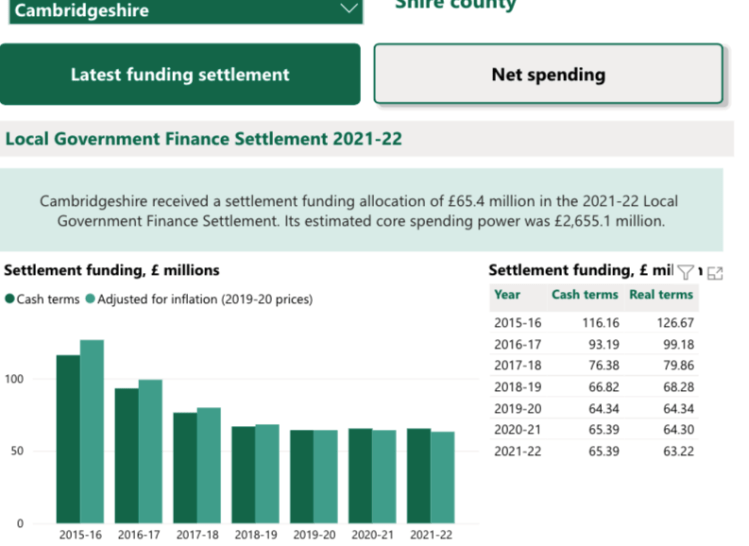
Above – Data for the cuts to Cambridgeshire County Council from the House of Commons database here
The Cambridge economic sub-region also has challenges
At the Suffolk County Council elections the county electorate returned a TeamNigel majority with 41 of the 70 seats, with The Green Party as the new official opposition with 13 seats. The normally dominant Conservatives were utterly destroyed, left with only nine seats (having won 55 at the previous county council elections).
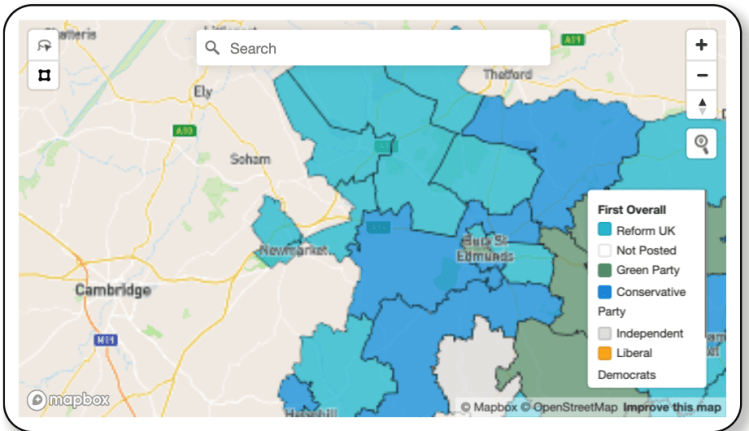
Above – from Suffolk County Council, detail of their county seats on the Cambridgeshire border
Given the results of South Cambridgeshire District Council’s full council election, all ministers need to do is pay for new and upgraded rail links east of Cambridge and watch for the Cambridge overspill effect and the housing market to do its thing! (I jest! I wouldn’t wish Cambridge’s broken housing market on anyone).
The picture in Essex wasn’t much better for the Conservatives as TeamNigel won control there, Saffron Walden town returning a Residents For Uttlesford county councillor. This in part reflects the party political splits over the proposed expansion of Stansted Airport which resulted in the Uttlesford Conservatives being crushed at the 2019 local elections – something they still have not recovered from despite returning the Leader of the Opposition as their local MP in 2024 (who by Saffron Walden’s standards surprisingly came within 3,000 votes of losing to Labour).
And in Huntingdonshire…
It’s likely that the Liberal Democrats will make a pitch to lead the council again – having gained more seats but not enough for a majority.
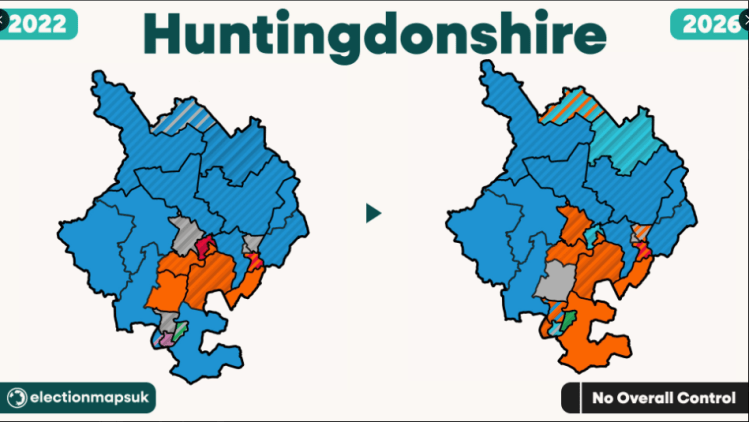
Above – Huntingdonshire’s changes from ElectionMaps.
Again, transport connections to Cambridge appear to account for some of the election results, the southern wards being closest to the main roads that lead to Cambridge with the more isolated rural areas sticking with the Conservatives. Residents of Huntingdonshire will find out what their final council will look like on Thursday. The fate of the historical county remains to be seen with the restructure.
And from the previous year in Hertfordshire county
Cambridge’s economic sub-region
If we look at bus commuting patterns for Cambridge’s sub-region using 2011 data, we get something like this below:

Above – Cambridge & Peterborough’s bus travel to work area commuting patterns 2011 – from the ONS here
The patterns are even more interesting when you filter the data by variables such as age and income. I had a look in more detail here. What that blogpost also highlights is how dominating the London economy is – and how extensive commuting patterns into the capital are.
“No one has ever asked me whether I want our city to explode – an additional 51,800 homes and 66,600 jobs”
Above – quoting a Mr Willan from the Cambridge Independent Press, 01-08 March 2023. It was one of two letters sent in to the editor nearly three years ago that listed a series of things that Cambridge needed sorting out. Not having much of a life I responded to each individual point. Not so much to the writer but rather to identify who was ultimately responsible for the issues and where the blockages in the system were.
Does everything need to be in Cambridge?
In September 2025 I wrote about how ministers could designate county towns such as Bedford and Northampton as ‘landing sites’ for Cambridge spin-outs – ensuring the fast rail connections are built to underpin this. At the same time I plotted out what a quad of fast rail-connected settlements – Cambridge, Luton (only 10 miles from Hitchin junction!), Peterborough, and Northampton might be like.
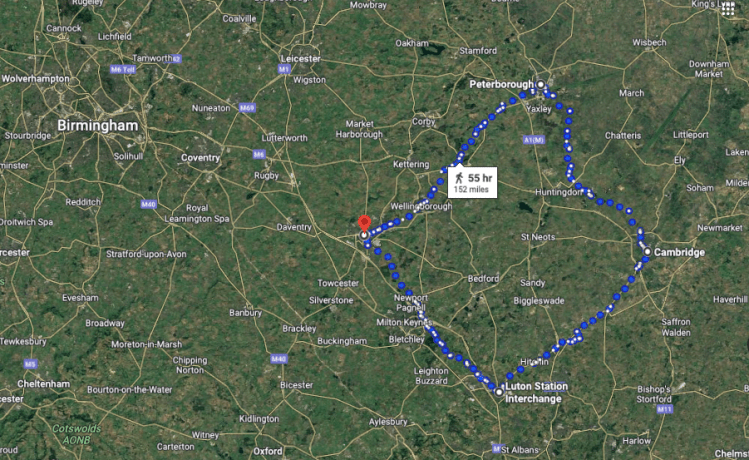
Above – from G-Maps where Northampton, Peterborough, Cambridge, and Luton make for a nice ‘quad’ – with potential extensions westward towards Rugby, Coventry, and Birmingham.
Cllr Alisha Lewis calls for a radical response
Cllr Lewis is damning on the reluctance of what I can only call ‘progressive politics’ of not wanting to have the difficult conversations that left the door wide-open for the likes of TeamNigel and his wealthy backers to step in. Looking at the TV footage of the protests in London last weekend, you might be forgiven for thinking that one side is obsessed with immigration while the other side is obsessed with the seemingly endless wars in the Middle East. I find it striking how few public policy debates explore what meaningful changes to UK foreign policy – co-ordinated with other countries, might have a positive impact on both.
Cllr Lewis highlights two things:
“When I speak to people on the left about immigration, the paralysis is total and it takes two forms that compound each other…. [some have the] inability to admit anything has gone wrong”
and
“You cannot take someone somewhere new if you haven’t acknowledged where they’re standing. You cannot persuade someone who doesn’t believe you’ve heard them.”
If we apply both of the above to the people and institutions participating in the property event UKREiiF 2026 there will be lots of people talking up the merits of the growth of Cambridge but very few of them will be talking seriously and meaningfully about the negative externalities of that growth, let alone the solutions needed to deal with them and the institutional structures and systems – and the people, to make it happen. Let’s take a newsworthy example: Cambridge Science Park
“Innovation at Cambridge Science Park has already changed how billions of people live their lives, from groundbreaking cancer drugs to Bluetooth technology. Now our masterplan scales that success to deliver threefold economic growth and up to 20,000 new jobs.
Above – press release from Cambridge Science Park 18 May 2026
“20,000 new jobs *on top of the existing housing crisis*?!?”
Which makes it all the more maddening that Cambridgeshire County Councils transport officers along with Transport Ministers in Tony Blair’s government went for a guided bus instead of re-opening the Cambridge-Huntingdon railway line that CAST IRON campaigned for. Because had they done what CAST IRON had called for (The busway eventually costing far, far more than budgeted for)
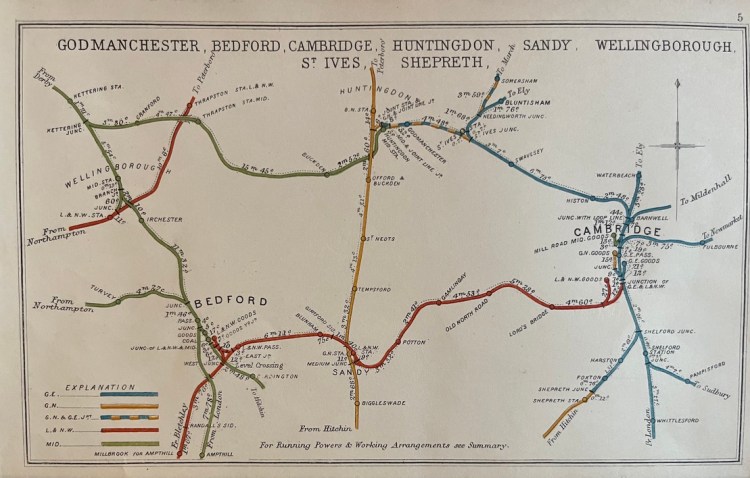
Above – an old railway map showing the old west-of-Cambridge rail links to Bedford and Huntingdon respectively
Think of what a suburban stopping service from Huntingdon to Haverhill (and onto Sudbury) might have done for road traffic congestion.
Are the promoters of Cambridge Growth being honest about the shortcomings of our city?
I’ll continue this in an additional blogpost – looking more at what Cllr Alisha Lewis has written. Because those involved in promoting and gaining from Cambridge’s growth not only need to be more clear about what those negative externalities of that growth are, but play a far greater role in dealing with those problems. Not simply relying on a hollowed-out state to do it for them.
If you are interested in the longer term future of Cambridge, and on what happens at the local democracy meetings where decisions are made, feel free to:
- Consider a small donation to help fund my continued research and reporting on local democracy in and around Cambridge
- Follow me on BSky
- Spot me on LinkedIn
- Like my Facebook page

 The Cambridge Town Owl