We ask: “Will city become the country’s first anarcho-syndicalist commune where councillors take it in turns to be ‘executive officer for the week’?”
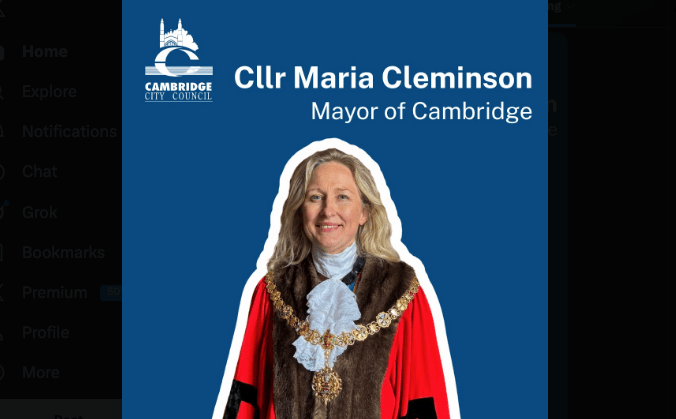
Pictured: New Mayor Maria Cleminson – Mayor of Cambridge 2026/27
You can:
- See the summary from BBC Cambridgeshire here
- See the full exchanges from councillors *after* the first vote and just before the second attempt/vote. By Cambridge City Council.
- Wonder what the Oxford-Cambridge Supercluster people make of this given their workshop at UKREiiF on making Cambridge the most innovative city in Europe. (I said it was a fantasy in my previous post)
For those of you interested, Cllr Mike Davey (Labour – Petersfield) name-checked his earliest predecessor Major Dermot Freyer – the first Labour councillor for that part of Cambridge (then St Matthew’s Ward). I wrote a little about Cllr Freyer here in LostCambridge.
“So who is in charge of us?”
No one is.
“Then who is responsible for us?”
We all are!
That’s paraphrasing an exchange I heard during the Cambridge Students’ occupation of Senate House 2010 between police officers and students. (Some of the videos of the occupation from over 15 years ago are still up – have any of the participants gone onto more famous things?!?)
“So, what happens now?”
There’s a minute chance we could become an autonomous collective as explained by former Cambridge student Michael Palin – also explaining to anyone interested about the people who live in the castle on Castle Hill, Cambridge. [There is no castle on Castle Hill – the ancient colleges ran off with the stone and kept written records of it].
“No – really, what happens now?”
They’ve got between now and Monday 01 June 2026 to sort things out – see the meeting papers here.
“Will they?”
Hard to tell from here. However, the leader of the now third largest party on Cambridge City Council, former council leader from 2014 Cllr Tim Bick (LibDems – Market) put out a video statement explaining from his perspective what happened.
[UPDATED TO ADD]: Since posting, both Labour and The Greens have published statements on the recent Full Council meeting:
Feel free to read/listen to what the three parties have posted and come to your own conclusions.
In the meantime, back to the original post!
Cambridge Greens have been celebrating the elevation of new councillor Maria Cleminson (Greens – Abbey) as the new Mayor of Cambridge for the municipal year 2026-27 – the first Green Party councillor ever to hold that ceremonial office.
Senior Green Party Councillor Elliot Tong (Greens – Abbey on both city and county councils) stated his personal position on the political leadership of the city council:
Above – Cllr Elliot Tong 22 May 2026
“Does Cambridge City Council need a council leader?”
Yes – It is a requirement of the Localism Act 2011 and the Council’s Constitution.
Which means that not having one means things could get very messy indeed.
The problem for Cambridge Labour might stem from a directive from Labour’s National Executive Committee.
Above – former Labour Councillor Dave Baigent (Ind/YP – Romsey) querying reports that Labour Party councillors are banned from negotiating and agreeing power-sharing deals with The Green Party.
Phil Rodgers also picked up on this – referring specifically to Brent in London.
Again at the time of posting, I’ve not seen any official comment from Cambridge Labour.
“What happens if….?”
In the grand scheme of things the city council has under two years of its existence left before the new ‘Greater Cambridge’ unitary council takes over. This time next year should be the elections for the ‘shadow council’ but there’s still a lot of negotiating to do – not least on the formal geographical boundaries.
If Cambridge Labour sticks by the edict from its NEC then…
- The Greens and LibDems could roll over and let Labour get on with things as a minority council. (But as the offices of Council Leader and Executive Councillors have significant powers, this is not something the two opposition parties were prepared to accept)
- The Greens and LibDems could negotiate an agreement between themselves on how Cambridge City Council should be governed, decide on leadership and committee roles between them, and vote it through. (They have the numbers to make this happen).
It’s hard to tell what is most likely to happen. Either way…
…it does not look or feel like Cambridge Labour is in control of its own destiny.
It was striking how during the election campaign most of the social media images published by Labour and all of the campaigners that I saw locally were either serving councillors or election candidates. In previous elections the local party had a significant number of local and student volunteers. Both were conspicuous by their absence this time around.
Additionally, it was clear that the shambles in Westminster were having a huge negative impact on the standing of Labour generally. This reflected in the focus by Cambridge Labour on their record in office – in particular on house building which in principle should have been enough for them to hold onto more seats than they did. The problem is that Cambridge is part of the international housing market and no amount of house building will quench that demand, as former Cllr Sam Davies wrote in November 2022. For those of you not familiar with South Cambridge’s local housing-related issues, have a look at the archive of Sam Davies’ posts here.
It’s hard to tell from here what the personal relationships between Labour and the opposition parties are like. Furthermore it’s hard to know at the moment what the group dynamics are for the massively-expanded Cambridge Green group are, which now make up the official opposition at The Guildhall.
In terms of the ‘big picture’ I assumed that Labour and the LibDems would come to some sort of an agreement about maintaining Political stability in the Guildhall for the final two years given the almost total dominance of the Liberal Democrats in South Cambridgeshire District – the proposed merger partner. This reflects the overall support for the growth in principle both parties have maintained (even if they have disagreed on particular policies within it), versus The Greens’ position which opposes growth in principle – mainly on the grounds of environmental stability and the water crisis.
But if Labour’s NEC stand their ground as reported with a blanket ban on local parties negotiating with opponents, then the national party is imposing an ‘all or nothing’ choice on local councillors. Given the Liberal Democrats’ dominance in South Cambridgeshire, it’s unlikely that the new unitary council will elect a Labour majority for its first term. Which means that if things continue as they are, Labour could find themselves in opposition in and around Cambridge for a very long time to come.
Food for thought?
If you are interested in the longer term future of Cambridge, and on what happens at the local democracy meetings where decisions are made, feel free to:
- Consider a small donation to help fund my continued research and reporting on local democracy in and around Cambridge
- Follow me on BSky
- Spot me on LinkedIn
- Like my Facebook page


