Three reports published in recent days plus a stack load of papers from the Cambridgeshire and Peterborough Combined Authority paint an unstable picture
The three sets of reports:
- Cambridge Ahead’s Cambridge Economic Overview 2026
- How Resilient is Cambridge? By Resilience Web Cambridge
- Young People and Work – Interim Report (AKA ‘Lost Generation’)
- CPCA – State of the Region (see papers at item 7)
The headlines from the ‘CamEO’ report contrast with the headlines in the Resilient Cambridge report.
“CamEO26 reveals Cambridge business sentiment is markedly more positive than national sentiment, and recent market signals suggest green shoots of higher growth are emerging.”
Above – Cambridge Ahead, landing page for the CamEO 2026 report
This contrasts with Resilient Cambridge
“Many issues are interconnected, and it’s important to identify how they exacerbate each other. In some cases systems are poorly designed, with single points of failure, or choke points that make them fragile to shocks and slow to respond to change. Often taking the most resilient action is difficult or expensive, meaning for example, that potential resources are treated as waste.”
Above – Resilient Cambridge (2026) Full Report, p1.
“The NEET rate has barely crept below 10% in 25 years. What should have been treated as an urgent national crisis has been absorbed into the background noise of public life.”
Above – Young People and Work (28 May 2026) Foreword
Going through the summary of the Resilient Cambridge report, I couldn’t help but notice the huge task ahead on resilience combined with 1million young people struggling to find work in the report launched by former Labour Health Secretary Alan Milburn.
Which chimes with another period of social history when just before his abdication Edward VIII visited South Wales in late 1936. Have a watch of the British Pathe report below:
The uncrowned King was quoted as saying:
“These works brought all these people here. Something should be done to get them at work again.”
Which the newspapers interpreted as:

Above: “SOMETHING MUST BE DONE” – Northern Whig 20 Nov 1936 in the British Newspaper Archive
…which sounded dangerously political to the ministers at the time. How does that compare with the current Prince of Wales and the work his new foundation is doing on homelessness?
Many other publications in 1936 ran with the mis-quotation – understandable perhaps given the huge impact of the Great Depression. And that was before war arrived on these shores.
A quarter of a century of NEETs – young adults Not in Education, Employment, or Training.
The quotation in the foreword in Lord Milburn’s report takes us back to 2001 and:
- the aftermath of the Dot-Com boom and bust,
- What was left of Cool Britannia, and
- the middle of the [internationalist green-left] anti-globalisation protests.
Go back to before the 1997 general election and you’ll find a grim picture for teenagers despite today’s nostalgia. One of the public policy responses was the New Deal for Young People – a new employment scheme funded by the much-lauded Windfall Tax on the excess profits of ‘fat cat’ directors of privatised utilities. This was followed up by the New Deal for Communities of which the current Pride in Place programme is a sort-of successor to it.
Policy recommendations from Cambridge Ahead – are they starting to sound a little repetitive?
This is a reminder of why contemporary history matters. The longer that ministers refuse to do something in the face of chronic policy failures, the harder it is for them to justify inaction or maintaining of the status quo. Furthermore, it helps keep policy recommendations from expensively-commissioned reports (both in cash and volunteer hours) at the forefront. For example a tourism tax for Cambridge is back in the news with speculation on whether the Mayor of the Combined Authority will approve it for Cambridge if ministers go ahead with their proposals. (They are still analysing the consultation responses at the time of posting).
Back in 2023, Cambridge Ahead’s Young Advisory Council made the case for a tourist tax for Cambridge
“We add our voice to the call to the Government to pass [legislation on tourism taxation] in order that cities such as Cambridge are better able to maintain their visitor and resident offering.”
Above – Cambridge: A City of Quarters (2023) p49/51pdf
The members of Cambridge Ahead need to widen the conversation from simply asking ministers to do things that simply involve turning on the spending taps
“There is a perception that governance complexity – particularly the makeup of Cambridge’s local government, and multiple public bodies with interests in planning and transport – is creating confusion and slowing decision-making.”
Above – p45 Cambridge Ahead (2026).
I featured this in my previous blogpost on the 45m science towers proposed for the Cambridge Science Park – the scale of the densification of the site will transform the northern edge of the city. Such is the scale of this development alone that I cannot see it going ahead without a substantial light rail component.
My point here is that Cambridge Ahead’s members could be making the space for a much wider, more inclusive debate on what our new local and regional governance structures should look like, and how new systems should function. We can take a history lesson from the city of Leicester and its local governance structure in 1939. It published a guide for its residents a decade after women were given equal voting rights to men – hence a good idea to educate the city about democracy and local public services. (Especially given the chaps over in continental Europe who wanted to do away with such things at the time!)
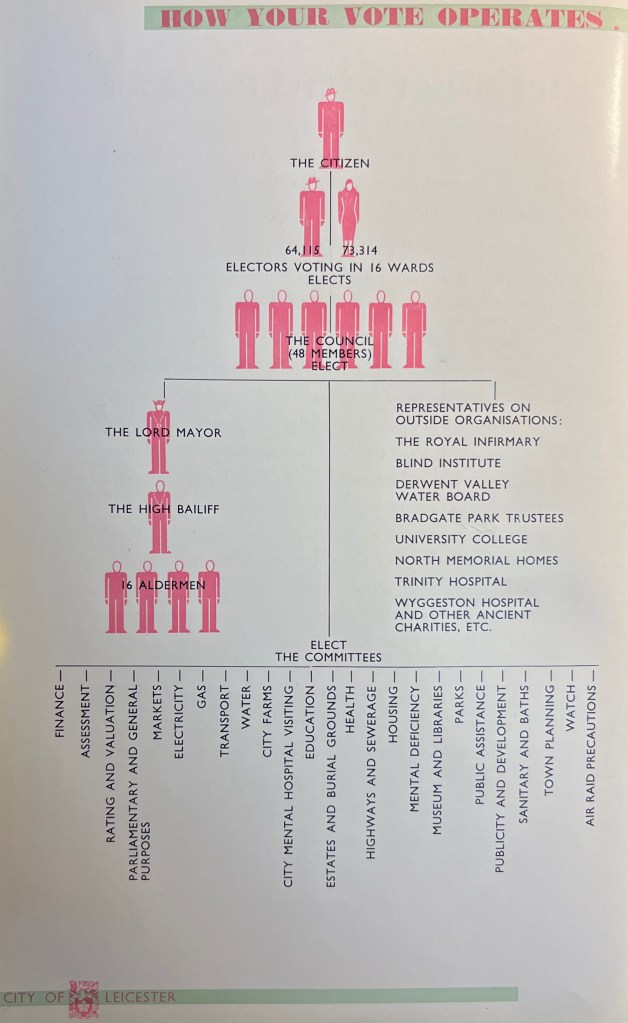
Above – Civic Affairs, the City of Leicester (1939) p5
I also featured the above in a blogpost from a similar guide published by Birmingham in 1928 here. I digitised both books so you can compare how much greater the powers and responsibilities of local municipal government were 90+ years ago compared to today.
Part of the problem is cultural
I imagine that Cambridge’s institutions – not just the ancient colleges or the University of Cambridge itself, enjoy having the ear of ministers. Even more so if those ministers are their former students. Who wants to worry about the concerns from backbench councillors of small district councillors when you can share high table with ‘The Minister’! It’s easy to overlook how different the experiences of students going to Oxford and Cambridge have with the tutorial system against those that do not.
“With some students receiving as little as two hours a week of contact time, many undergraduates feel they receive poor “value for money” for their tuition fees, according to a study on student perceptions by the Quality Assurance Agency for Higher Education.”
Above – Jack Grove in Times Higher Education 18 Nov 2013
One of the reasons I never forgave my first university which I graduated from back in 2002 was in part due to the few contact hours and the lack of ‘intensity’ of the course in the era of up-front tuition fees. Amongst other institutional failings in particular on housing.
When I compared my workload to that of undergraduate and postgraduate friends and acquaintances at Cambridge University in the early-mid 2000s I was astonished to find that the amount of written work/assessed essays I had to do for a term was what they had to do in about a week or two. The difference in intensity was significant. Given the housing costs, costs of living, and tuition fee debts on top of student loans that students have to pay back today, I probably wouldn’t bother today.
All of the above is a very long way of saying that I can understand why the former students who experienced a very intensive but enjoyable time at the universities of Oxford or Cambridge might be more than willing in their professional lives to maintain contact with the institutions. If on the other hand you’ve only had a handful of contact hours a week, and have to travel across the city by declining public transport from either very expensive purpose-built student accommodation or poorly-maintained housing that local councils don’t have the resources to take enforcement action over (meaning you end up spending little time on campus or ‘on site’), I can understand why having graduated you might feel you have little incentive to stay in touch.
Within Cambridge – and Cambridge University in particular, members of Unite the Union have taken industrial action, with the Union’s General Secretary Sharon Graham having visited them recently.
“Cambridge University is sitting on billions of pounds but the workers who keep it running are struggling to keep their heads above water due to the incredibly high cost of living in the city.
“Oxford University has introduced a local pay supplement to ensure workers can afford to live; Cambridge needs to as well. Unite will not back down until that happens.”
Above – General Secretary Sharon Graham of Unite the Union, Cambridge, 11 May 2026
A reminder of the chronic inequalities in and around Cambridge.
It remains to be seen whether any future local government institution will have the powers and influence to deal with those inequalities in any meaningful way that has an impact on the ground.
If you are interested in the longer term future of Cambridge, and on what happens at the local democracy meetings where decisions are made, feel free to:
- Follow me on BSky
- Spot me on LinkedIn
- Like my Facebook page
- Consider a small donation to help fund my continued research and reporting on local democracy in and around Cambridge


