You can read the 2026 evaluation programme from the Department for Transport here
I didn’t go looking for it – I think I was looking for something else and it just popped up.
“Baseline and post-opening evaluation studies are conducted for selected major rail programmes, with priority given to those with the highest levels of investment, such as:
- TransPennine Route Upgrade,
- those with the greatest potential for learning, such as
- the re-opening of the Northumberland line, which provided new connectivity, and
- the opening of a new station at Cambridge South, which serves the Life Sciences cluster and new areas of housing development.
“Transformational impacts of stations DfT investment in rail stations aims to improve connectivity and support local growth.
“DfT has commissioned a research study on the transformational impacts of investment in rail stations for local economies, with the aim of improving the existing evidence base on the impacts of stations. Four case study stations are included in the study: Birmingham New Street, Cambridge North, Reading and Wakefield Westgate. These stations were selected to cover a range of investment contexts, both in terms of the nature of the station and its location.“
Above – Evaluation Programme 2026 by the DfT, p16
Which is nice. Because one of the things this will enable is for the public to compare what the predicted passenger use was at the early planning stages vs what they turned out to be in reality.
The evaluations matter because of the discussions about building new stations and upgrading rail lines
One place to look is with the railway histories of the lines we used to have. Back in 1989 local residents in Huntingdon and St Ives made the case for re-opening the railway line between the historic home of Oliver Cromwell (do visit the Cromwell Museum) and Cambridge. It was written up in the Cambridge Evening News and I have transcribed the news report which also included the estimated cost from an independent study. At 1987 prices? Just £4million.

Above – Branch lines around Huntingdon (Kettering to Cambridge) (1991)
I have seen the future – **and it is rapid-transit-shaped**
Well, that was the plan in 1959 from the Light Railway Transport League – now the LRTA
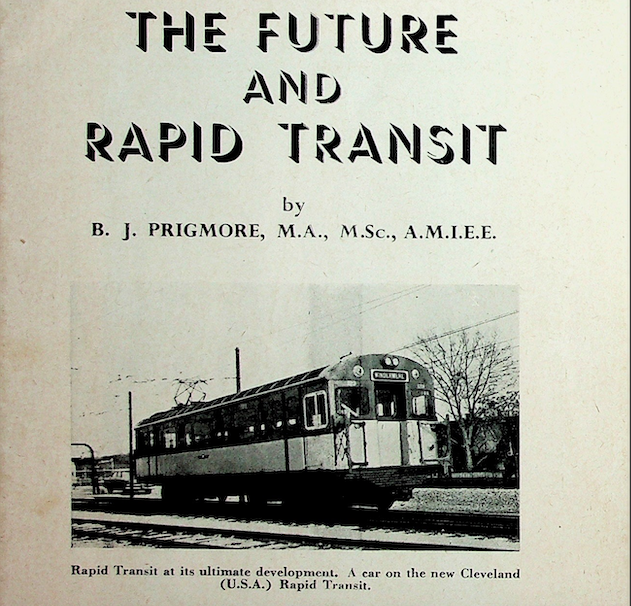
Above – The future and rapid transit (1959) by the LRTL digitised here
I concede that faded pamphlet images are hardly going to persuade a 21st Century public to embrace trams. But the words within such publications contain more than a few lessons:
“If public transport in major cities is to survive in a healthy condition it must sell time more efficiently so that the public will use it in preference to private transport simply because it happens to be quicker. Under present conditions one good way to do this effectively is to make increasing use of systems of transport which employ a private right of way. This trend may be observed in many principal cities throughout the world”
Above – the preface of The Future and Rapid Transit, by the old LRTL
In this epoch of over-centralisation, genuine civic pride is hard to come by. The privatisation of the buses by the Thatcher Government is still something successive governments have been too timid to undo. The recent legislation on bus franchising is hardly an example of a government in haste to undo the damage – and it took Dr Nik Johnson the whole of his mayoralty of the Cambridgeshire and Peterborough Combined Authority (2021-25) just to do the paperwork and consultations. Not surprisingly you don’t see much of the civic pride in our underpaid bus drivers in and around Cambridge. Hence why I would like to see more people encouraged to join local Cambridge bus campaigners.
On civic pride in public transport
You only have to browse through the old caps and badges for sale of the old municipal tramway companies to see how many towns and cities ran their own electric tramways, and look at the ornate designs to see the civic pride they had.

Above – because Cambridge didn’t get an electrified tramway despite the best efforts of locals pre-WWI we don’t have a huge back catalogue of municipal bling. (Trust me – I’ve looked)
Other future visions of transport
I’m still gutted we did not get the Cambridge Monorail in the 1970s – Ministers pulled the funding. At the time the Institute of Mechanical Engineers had their meeting in 1965 to discuss what the Year 2000 might be like, monorail technology might have been seen as much more feasible.

Above: “He said I’ve been to the Year 2000” – Transport in the Year 2000 by the Institute of Mechanical Engineers. How does it read today?
How does it also compare with what the Communist Party were proposing in 1944? Note at the time they had a handful of MPs. And ‘Cambridge Spies’ aside, there were a number of active communists who spent their childhoods in Cambridge including John Cornford and Raj Palme Dutt – the latter whose father, a local medical doctor and later Cambridge Town Council’s medical officer, was something of a working class hero on Mill Road.
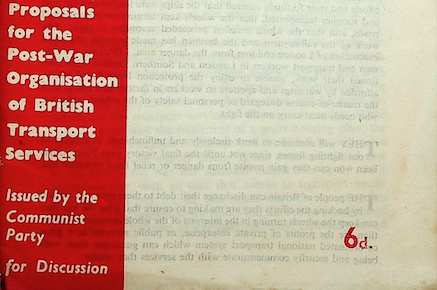
Above – Transport for the People (1944) CPGB
“Buses and Trams. Road passenger services are in the vast majority of cases short distance services, urban or inter-urban. The kind of service to be given is therefore chiefly a matter to be decided by the people in the areas concerned, though minimum wages and conditions in a publicly-owned service would be settled nationally… High standards of public service, together with improved wages and conditions for the staffs, will be the principle consideration. The general introduction of the 40-hour 5-day week will certainly be one of the first acts of the new administration, and improved standards of welfare facilities will also be laid. down nationally.”
Above – Transport for the People (1944) p19
Note the modern day contrast is the recent bus drivers’ strike in Cambridge in Jan 2026
Integrated public transport – can the evolving structure of local government deliver?
Some of you will be familiar with the lesson Cambridge’s Hungarian twin city Szeged teaches us with integrated public transport.
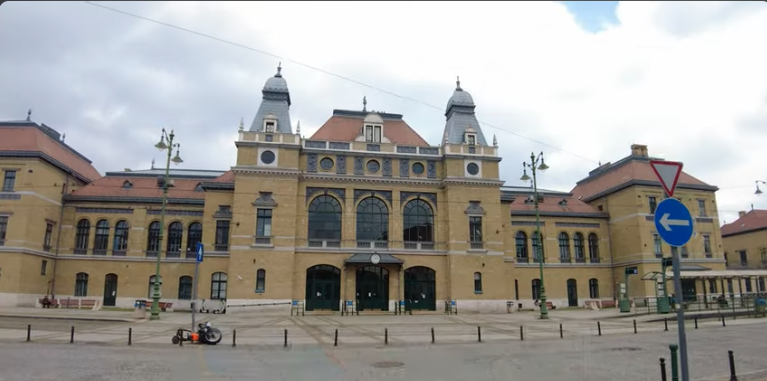
Above – Szeged Railway Station by Railway Networks – and a textbook example of integrated public transport.
The failure of Cambridge Station to have similar speaks volumes about how far our city (and country) has to go before we catch up with continental Europe. I still see the station redevelopment as a huge missed opportunity. It will be interesting to see if the evaluation for Cambridge North and Cambridge South come up with any recommendations for Cambridge East on what to avoid – mindful that this will be the third ‘blank slate’ that developers in Cambridge will have to get it right. And for anyone who wants to praise Cambridge North, the consultant representing the developers of the bland hotel at Cambridge North Station described the design as ‘acceptable’ to Cambridge City Council’s Planning Committee in November 2017.
I put it to those working on the future of Cambridge that everyone should be aiming for far, far better than ‘acceptable’
Otherwise all of that marketing about Cambridge wanting to become the ‘most innovative city in Europe’ or being ‘the best small city in the world’ is meaningless.
If you are interested in the longer term future of Cambridge, and on what happens at the local democracy meetings where decisions are made, feel free to:
- Consider a small donation to help fund my continued research and reporting on local democracy in and around Cambridge
- Follow me on BSky
- Spot me on LinkedIn
- Like my Facebook page


