
The grim news from Belfast has unleashed a wave of disinformation and inflammatory posts across social media. Why have successive governments been so impotent and passive in the face of such a threat to social wellbeing and national security?
But to start off on a more positive note, I spotted this post on IG from one of the flag protest marches with a Black JD wearing a union jack waistcoat and playing the anti-apartheid anthem from the 1980s by Eddy Grant: “Gimme Hope Jo’Anna” which got to number 7 in the UK Top 40. (in an era where you had to sell ***Lots*** of vinyl records and cassette tapes just to get into the top 40. At the time it was *huge*. Which reflected in the number of people who were not only dancing but clearly knew the chorus too! Have a watch here.

Above – filmed by Silvia on IG here
The song is a crash course of late 1980s South African history.
Above – Gimme Hope Jo’Anna by Eddy Grant
The version with lyrics is here, and ‘Jo’Anna’ is a representation of the regime’s centre in Johannesburg – in a similar way that we use the term ‘Whitehall’ to mean ‘The Government’.
The reason why this is important is because the short-medium term objective has to involve persuading people to move away from extremist movements, and in the longer term to address the huge injustices in our society as we face the climate emergency. That’s why Michael Sheen’s delivery of the Raymond Williams Lecture in 2017 was ever so powerful – especially on community action and community resilience.
You can watch Michael Sheen’s lecture in full here – his vocal delivery is world class
“You have to learn how to listen.
It’s not just a question of standing there with a clipboard and asking questions with the right look on your face.
You have to show up.
And stay around.
You have to let go of your assumptions and your biases and your agendas and your prejudices.
It’s really hard.
Speak to the people who are on the frontline of working in communities.
The ones doing the really tough work of giving support where it is desperately needed.
Where their resources are getting smaller all the time but the need for what they’re doing is getting greater every day.
Ask them about listening.
Because they’re really good at it.
But they’re also the ones who’ll say that they’re not being listened to.“
Above – excerpt from Michael Sheen (2017) Raymond Williams Lecture, which I blogged about here
Full Fact Report 2026
You can read the report and the summary here. Full Fact are a charity that campaigns and works against misinformation and disinformation.
“Our team of independent fact checkers, technologists, researchers and policy specialists tackle the harm caused by misinformation in the following ways:
- We fact check claims in public debate which are of public interest.
- We ask people to correct the record where possible
- We build world-leading AI tools which allow small teams to workat internet scale
- We campaign for system changes to make bad information rarer and less harmful
- We advocate for high standards in public debate.
Above – Full Fact Report 2026, p3
It’s a thankless task. You can read their latest fact-checking updates here. In particular they go after harmful content containing damaging mis/disinformation and provides comprehensive responses as to how and why the viral posts are false.
The problem as things stand is:
- Governments are the sources of too much disinformation
- The big tech operators don’t appear to be interested in the problem – some of them are actively involved.
One of the most recent ones involving AI-generated video content has hit the headlines recently
Full Fact’s recommendations
See from Page 10 in the report. The headings are:
- Secure the information ecosystem
- Strengthen public resilience
- Modernise laws and institutions
- Increase commercial transparency and accountability
Additionally, Full Fact commissioned research to see where the public is:
“The poll found that 80% of people are concerned about political misinformation. Only 3% find it very easy to tell whether a video is genuine or AI-generated, and the same proportion feel very confident in their ability to distinguish between genuine and fake political information online. At the same time, 66% of people think the government is doing too little to address AI-generated misinformation, and only 9%think it is doing the right amount.”
The bit that I am interested in is strengthening public resilience. The problem is the report misses out one of the key mechanisms that could deliver this: Adult Education and Lifelong Learning.
Within the strengthening public resilience heading it recommends three actions:
- Embed media literacy across the curriculum. Support the integration of media and information literacy across the curriculum at all stages, including an understanding of AI-mediated information, with the provision of teacher training, guidance and high-quality teaching resources.
- Fund long-term media literacy delivery capacity. Provide long-term, ring-fenced funding to support the delivery of media literacy, including workforce capacity, teacher training and professional development, with mechanisms that enable sustainable delivery at scale.
- Introduce a statutory duty to provide media literacy. Introduce a statutory duty on large online service providers to provide effective, evidence-based media literacy measures, embedded in product and system design, with clear standards and a code of practice, overseen by Ofcom.
Lifelong learning is only mentioned twice – and almost as if in passing
Given the ‘at scale’ response that the report’s authors call for, and given the resources that the Government could extract from the big tech firms that make their fortunes from social media there is potentially a huge funding stream that could be tapped into that could provide a much-needed boost to the enfeebled adult education and lifelong learning sector. But that also requires a change of mindset from ministers at the DWP and Department for Education.
“A community learning centre in every town”
…was what the then Chair of the Education Select Committee called for as part of the report recommending to ministers an adult skills revolution to foster new culture of lifelong learning.
Cambridge of all places should be one city that is red hot on adult education and skills. But we’re not. We don’t even have an adult education college supported by local government. And the Combined Authority under successive mayors have shown little interest in building one – citing (understandably) that they can only provide what ministers allow them to.
We have been here before as a nation.
During World War 2, the Army realised that the fight wasn’t just about might, but minds.
“The Citizen Soldier must know what he is fighting for, and must love what he knows.”
The British Army Bureau of Current Affairs, 1942 – Troop Morale and Education
It’s paraphrasing a quotation by the former MP for Cambridge Oliver Cromwell, mindful that conscription meant that the armed forces were not made up of a small number of professional full-time elite individuals, but a nation under arms and an economy run for the purpose of the prosecution of the war.
The output of the ABCA was massive
…and not only that, it kept going for several years after the war ended as national service was maintained. Hundreds of such pamphlets are still available on sale second hand. Today we have nothing like it.
Over the years I’ve collected a number of civics-related pamphlets from the early-mid 20th Century and have digitised them here.
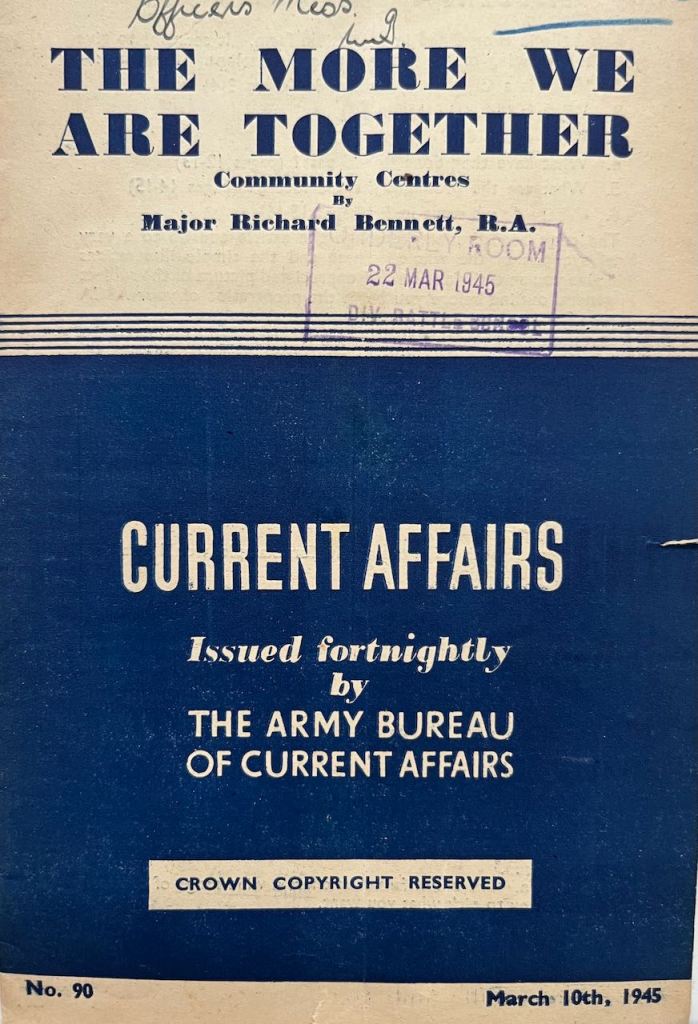

Above-left: The more we are together (1945) from ABCA, and Above-right: the back cover of Democracy in the Dock (1945) by Nelson, listing the many other subjects in their discussion series, many of which I think would make for interesting topics for today.
I wrote more about the above in a blogpost in November 2025 here. What lessons can today’s policy-makers learn about strengthening the general public individually and collectively?
The Marshall Plan for Civic Life – by Demos
You can read the paper here which identifies four concepts:
- Everyday Democracy,
- Public Service Reform,
- the Citizen Economy, and
- Resilient Information Ecosystems.
…the last of the four being very much what the Full Fact Report 2026 is about. The article by James Plunkett summarises some of the approaches and desired outcomes here.
“We will explore what an overall funding architecture for civic life, equivalent to the Marshall Plan, could look like — curating and building on the best evidence to date to describe a rationale, philosophy, and framework for investing in civic renewal. The framework is not just a practical structure for funding, but an underpinning logic about how all actors — state, citizens, private sector and civil society — can collaborate on national renewal.”
Above – James Plunkett (2026) A Marshall Plan for Civic Life
Which for Cambridge brings us back to that too difficult to deal with question of:
*** How should our city, county, and economic sub-region be governed, and how can powerful and influential decision-makers be held accountable by the people?***
It’s still work in progress.
If you are interested in the longer term future of Cambridge, and on what happens at the local democracy meetings where decisions are made, feel free to:
- Consider a small donation to help fund my continued research and reporting on local democracy in and around Cambridge
- Follow me on BSky
- Spot me on LinkedIn
- Like my Facebook page


