
The use of the terms HQPT and MRT only serve to make the general public cynical about the forms of public transport systems that highways engineering professionals are preparing for an expanded Cambridge – mindful of their shortcomings with the first guided busway
“What are we banning this time?”
Acronyms that confuse the public by making them believe what they are getting is better than promised. I complained about it here.
In that blogpost, I wrote:
“Figures in the world of business and commerce – in particular the Cambridgeshire Chambers of, have told me repeatedly that *wealthy people will not use a bus. They will however use a tram or light rail*.“
NEW MEETING PAPERS
The Combined Authority’s Transport Committee meets this time next week. See the following:
- The meeting papers
- The draft Transport Strategy – the fourth in less than 12 years, all the result of broken central government policies for Cambridge.
- Submit a public question to the Transport Committee – guidance
- The CPCA Mayor’s long-awaited announcement on bus franchising
- Contact your local councillors or MP to take up a transport-related concern that you have – one that ideally involves them asking a question to someone in power on your behalf. [Eg “Please could you ask the minister to publish the Government’s light rail policy”]
- Cambridge Area Bus Users – please join them, especially if you are a reasonably frequent bus user and/or someone who would like to use buses more instead of driving, but are unable to do so because of things like lack of reliability to buses not serving the routes that you need
- The Light Rail Transit Association – because we need to start campaigning collectively
I’ve said it before and I’ll say it again: Cambridge does not have the capacity to absorb the number of buses that the current transport and growth plans are proposing.
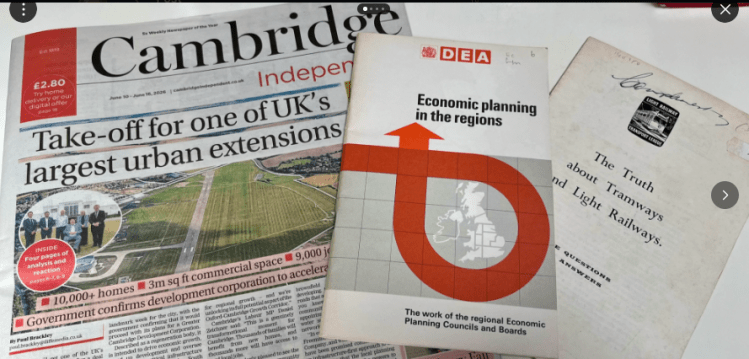
Above – today’s reading including:
- This week’s Cambridge Independent on the airport and development corporation (see my recent blogposts for more).
- The Department for Economic Affairs (which inspired ‘Yes Minister’) – the short-lived attempt by Harold Wilson to bypass HM Treasury – the latter being where all good things in the public sector go to perish
- The truth about Tramways and Light Railways from 1960 when so many places were scrapping these electrified modes of transport for fume-belching diesel-powered alternatives.A more up-to-date version is more likely to be in the latest editions of the LRTA Magazine.
- The Motor Car and Politics (1896-1970)
The medium term strategy
Here’s the diagram
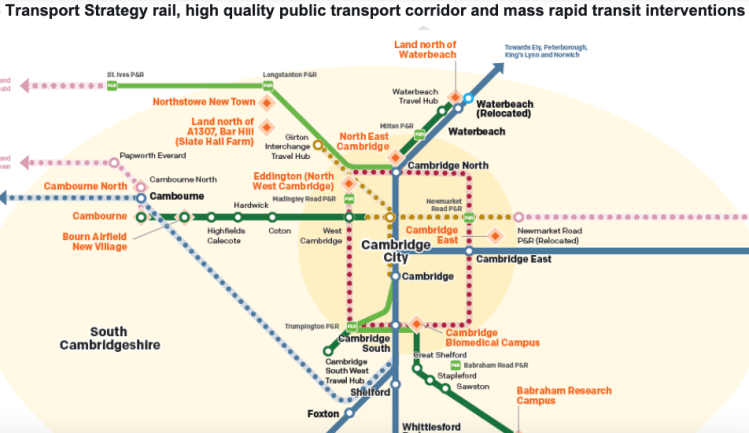
Above – Draft interim Greater Cambridge Transport Strategy, p30 / p44pdf
There’s a low quality geographical diagram on p36/p51pdf
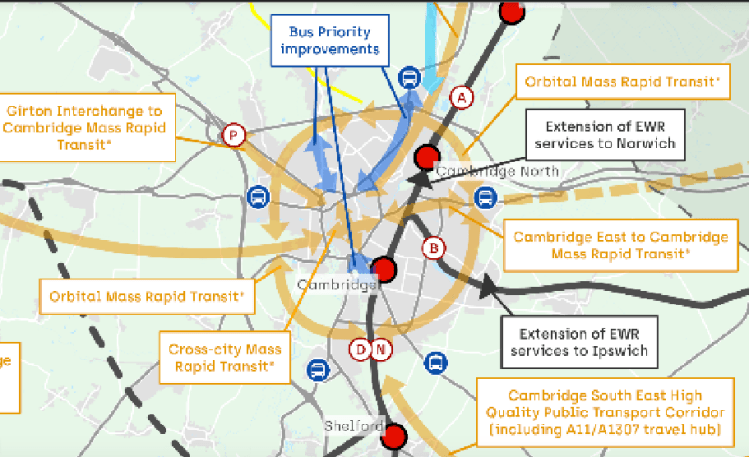
Above – Draft interim Greater Cambridge Transport Strategy, p36 / p51pdf
The proposal that Haverhill-Cambridge will be a busway is incredible given the motor traffic jams. Far, far better to have it incorporated either into the national rail system or within a greater Cambridge light railway network. Cambridge city centre simply does not have the capacity for more buses. Note that the route has to serve the teenagers getting to Cambridge for their studies. A service that terminates at Addenbrooke’s won’t be sufficient.
Power struggles between politicians and professions
This for me reflects the power struggle between the democratically-elected CPCA Mayor Paul Bristow and the transport professionals. Last month the Government made an announcement on urban mass transit. Mayor Bristow responded in a statement:
“I put light rail back on the agenda when I was elected. We now have a mass rapid transit study underway in partnership with the Cambridge Growth Company, and this week’s announcement, including the new Mass Transit Taskforce and the consultation on devolving more transport powers to Mayors, offers real promise for that work.”
Above – Statement from the CPCA Mayor Paul Bristow 22 May 2026
That he was not able to state ‘light rail’ despite his manifesto commitment shows how big the challenge is against opponents within the transport infrastructure professions – and perhaps beyond them, The Treasury.
The former transport minister, Norman Baker MP (Lib Dems – Lewes), now at the Campaign for Better Transport

For those of you interested in the historical cases for trams and light rail, I have digitised a number of publications from the mid-20thC from the old LRTL here.
With big reports, I normally go for the pages with pictures first
I find it easier to process. Then I go for the tables.
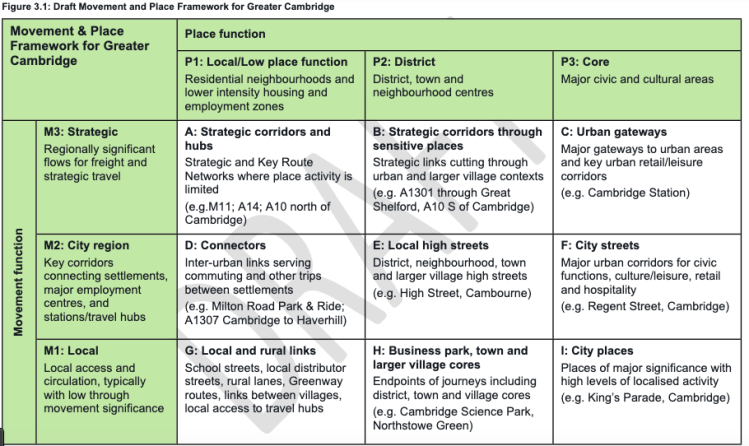
Above – Draft Movement and Place Framework for Greater Cambridge p16 / p31pdf
There is still a lot more work to do on the transport strategy
Given that the Minister for Housing and Planning stated early on that he wanted to see the urban extension of Cambridge ‘in at least one direction’ back in 2024, I cannot see how the current draft will be sufficient to meet the massive expansion in housing alone without a light rail system that includes a tunnel under the city centre so as to link the villages north of Cambridge to the Cambridge Biomedical Campuses and the additional hospitals being built there, and the southern villages to the densified Cambridge Science Park.
Bringing in and training up a new generation of tramway and light railway professionals and specialists
Given the expertise continental Europe has on this, one thing ministers could do is to bring in a critical mass of experts to get that culture change within institutions and professions and commission them to train up a new generation of locally-based workers and experts across the country. This needs to be part of a wider industrial plan that co-ordinates:
- New resilient supply chains for the manufacture of components and rolling stock
- New resilient skills institution to recruit and retain the new generation of engineers to build and maintain the light rail infrastructure
- A wider culture change that can incorporate the best that the advertising world / social marketing world has, alongside working with schools, colleges, and a new generation of lifelong learning colleges to de-stigmatise the public transport sector. eg. the pejorative reputation of train spotters – not realising their presence deters malicious security threats.
“Whether you prefer to be called a trainspotter, a train buff, a rail fan, a rail enthusiast or even a ferroequinologist, you will get a warm welcome at all our stations. Our advice and guidance will help you enjoy your passion safely”
Above – Guidance from Network Rail
After all, a handful of blokes with tripods and cameras? That’s evidence-gathering.
The challenge on the culture change needs to involve the awe-inspiring footage of some of the larger infrastructure projects – especially when they can combine inspirational architecture and urban design with the clearly-communicated substantial improvements to people’s lives and experiences as a result of using the new infrastructure.
The chronic failures of co-ordinated infrastructure planning and construction in and around Cambridge shows we’ve got a lot to learn from other places. World-beating we are not.
If you are interested in the longer term future of Cambridge, and on what happens at the local democracy meetings where decisions are made, feel free to:
- Follow me on BSky
- Spot me on LinkedIn
- Like my Facebook page
- Consider a small donation to help fund my continued research and reporting on local democracy in and around Cambridge


