When was the last time local government in your town and city researched and produced such a comprehensive guide to the public services where you live?
I’ve digitised the book here for you to read online
With undiagnosed AuDHD one of the things I’ve learnt is not to feel guilty about what the time is when I’m on a roll. Even though it is gone 01:20am in the morning. But I had just come to the end of of scanning a 98-year-old book that I bought off the internet about local government in York and found this gem of a map.
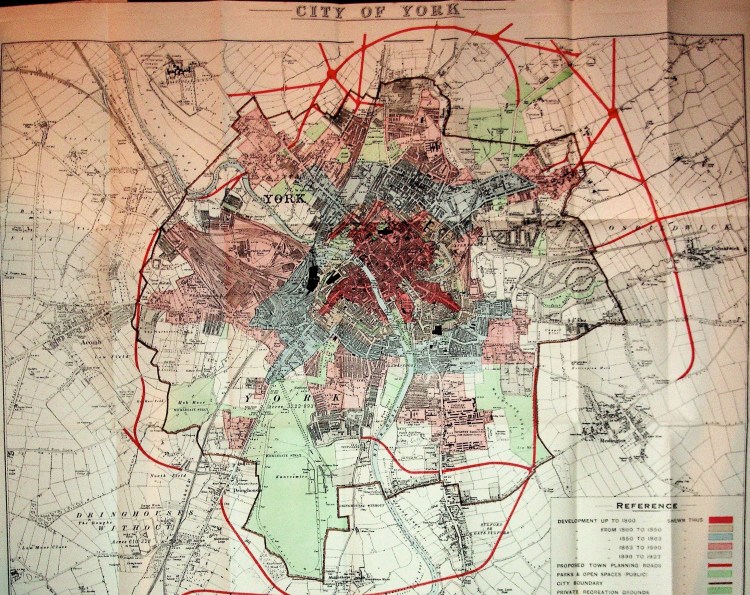
Above – City of York (1928) Map from How York Governs Itself
Other cities also published splendid guides in the interwar era, including:
The reason why these matter to Cambridge is because our governance structures historically have been a mess, and no one has been able to overhaul them to create something that enables our city to function greater than the sum of our parts.
One of the central themes of my blogs going back 15 years has been about creating a city that is greater than the sum of our parts
I even put it in the city council election manifesto of my old social media avatar Puffles back in 2014:
“So how can we bring our community groups together to influence what happens in local democracy? How can we become greater than the sum of our parts?”
Above: Theme 1) – Community Action – A Grassroots Challenge (2014) from ‘A Manifesto for Cambridge’
It’s nice to see people in corporate positions in large institutions beginning to use that phrase about the future of Cambridge. Because it has been a very long journey.
“I’m also of the view that Cambridge still isn’t functioning anywhere near to its potential. We could be so much greater than the sum of our parts, but all too often we fall short. From my vantage point watching local democracy, local institutions fighting against each other is one of the biggest problems. But how do you persuade the current lot of ministers that local government reform would be a good idea in the face of the political crises of this era?”
Recall that this was a time when Theresa May’s rocky minority government propped up by the Democratic Unionists in Northern Ireland, with her successor plotting in the wings. And we know how that ended.
Cambridge has not had the sort of guide that York, Birmingham, and Leicester produced because its local council never had the legal status that those three great cities had at the time – and still have. Cambridge City Council remains a lower tier district level council that has few powers and even fewer resources. Which is why many residents get the sense that no one is actually in control. Because no one is.
The Conservatives hold party political responsibility for much of the governance mess – most of it from their time in central government.
- They created the current two-tier split between city and county councils in 1974 despite having the option of a unitary council as recommended by the Redcliffe Maud Report (the Royal Commission on Local Government in England 1966-69, the key recommendations of which they rejected)
- They created Peterborough as a unitary council in their review of local government but not for Cambridge despite the growth ambitions of the time
- They created the Greater Cambridge Partnership as a means to appease their Liberal Democrat Coalition Partners who wanted a new unitary council for Cambridge along with investment in transport and housing infrastructure
- They created the Combined Authority for Cambridgeshire and Peterborough despite the lack of popular demand for such an institution
- They moved the headquarters of Cambridgeshire County Council out from Castle Hill, an historic site in Cambridge, out to a business park on the western side of Huntingdon at Alconbury, only to find that the building and main council chamber is not big enough to hold all of the councillors
- They proposed and made the first moves for the Greater Cambridge Development Corporation – the principle of which remains unpopular with local councils of all local political parties
Compare the fragmented nature of public services in and around Cambridge with what the City of York has for chapter headings:
- The development of local government in York
- Civic Administration
- The Function of Finance
- Education
- Public Health – the prevention of disease
- Public health – hospitals
- Public health – housing and re-housing
- Highways and bridges
- The protection of the person and property (police)
- Recreation
- Municipal trading
- Alleviation of destitutionCollection of vital statistics
- Administration of justice
- What it all costs
- Conclusions
Above – How York Governs Itself (1928) Contents Page (which I spent the last few hours digitising!!!)
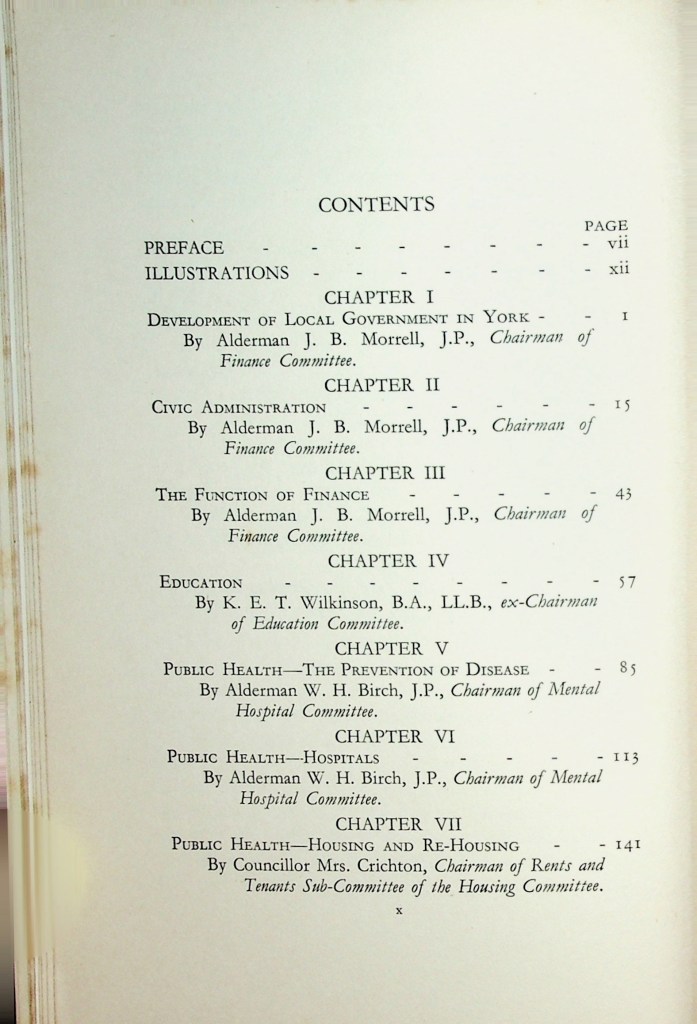
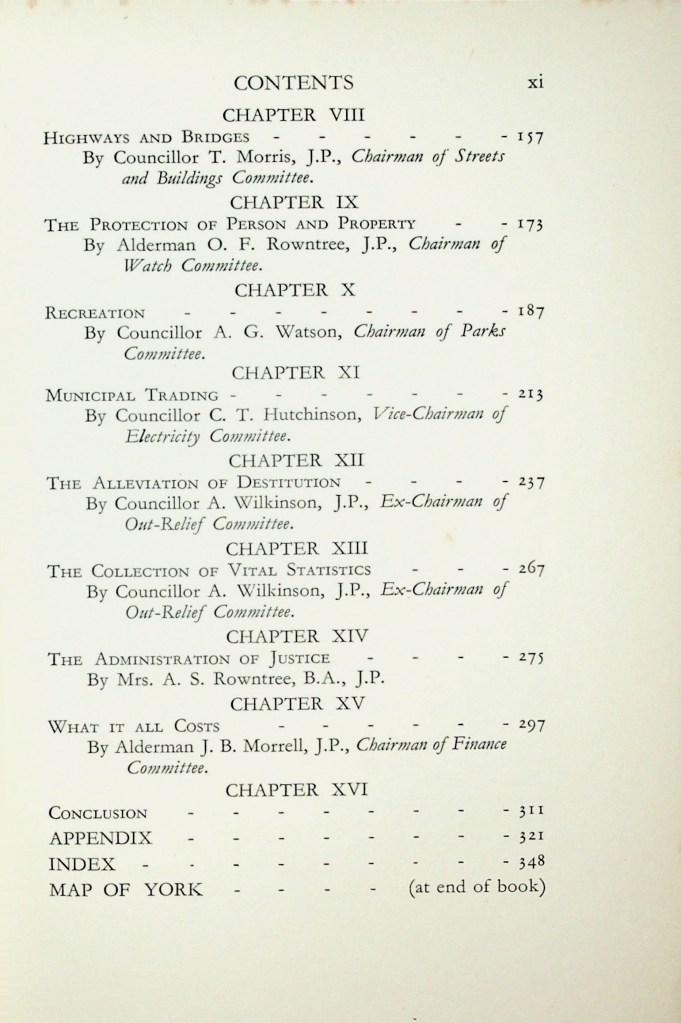
Above – note the multiple authors for each section.
The guide gives more than a few examples of civic pride too
Take their law courts of 1928.
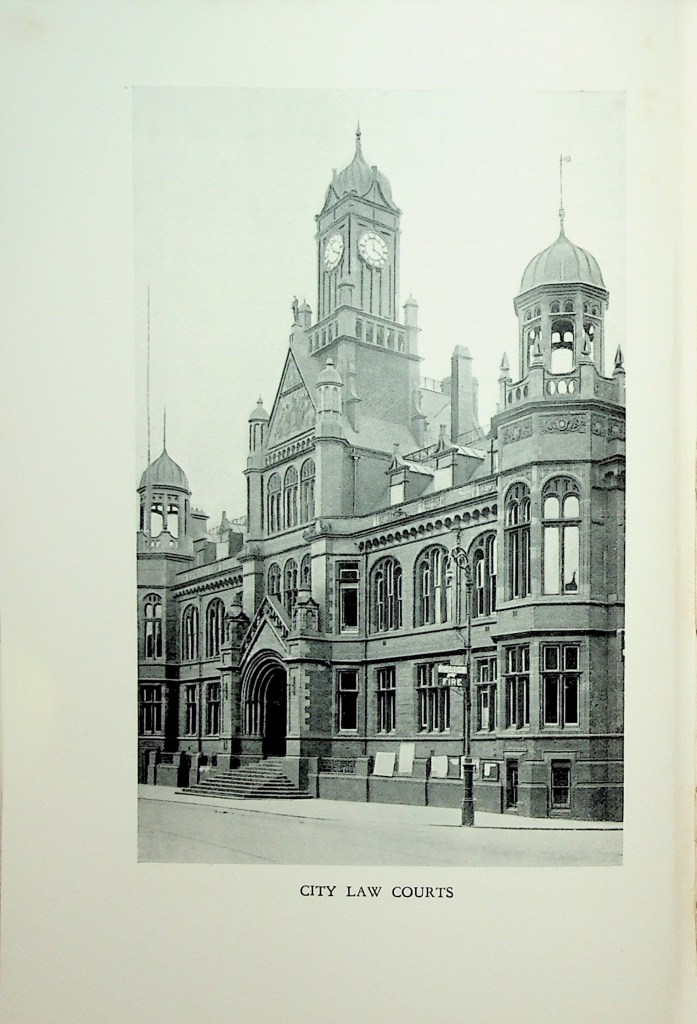
Above – the City Law Courts which is still there today

Above – from VictorianWeb – Cambridge does not have a civic building that gets anywhere near the splendidness and civic pride of this building.
We could have had something similar had Mayor (later Sir) Horace Darwin and architect (& future RIBA president) John Belcher been supported with their plans for a new Cambridge Guildhall in the late 1890s and again in 1913.
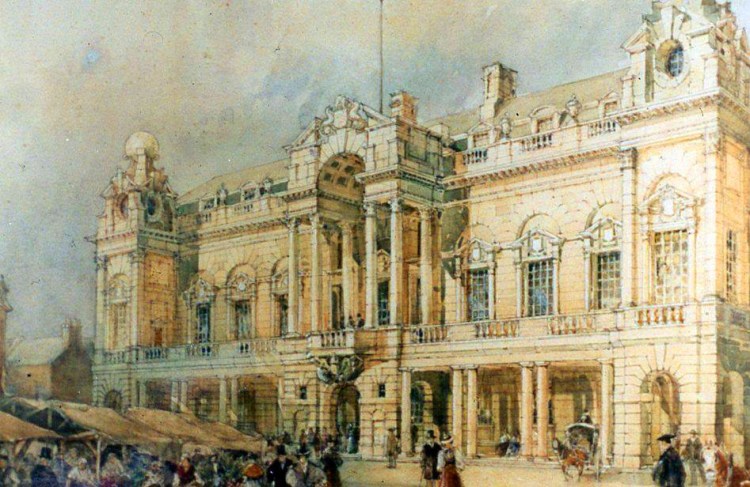
Above – the splendidness of John Belcher’s proposed design for Cambridge Guildhall, 1898
But as it was proposed by the Liberal Party and not cheap, the local Conservatives opposed it. Which is why we have Charles Cowles-Voysey’s lump of a building there – a design that incurred the wrath of Kenneth Robinson in 1964.
““If anyone can remember why that got built, can they remember why the Guildhall thrust itself into Market Square?” Asks Robinson.”
Above – The Other Cambridge – 1964 in Lost Cambridge
If you want to know the answer, it was the only really bad decision Mayor Florence Ada Keynes made in her decades in public life serving our city. But then her opponents are just as much to blame for not uniting behind a single design, as the brilliant Sid Moon illustrated in his satirical cartoons of the mid-1930s.


Above – I think we got carried away with the options.
The only part of his design I like is the clock feature – which is where this blog gets its name from.

Above – ‘Dawn’ the Cockerel and ‘Dusk’ the Owl’ at the top of Cambridge Guildhall.
What Leicester in 1939 taught Cambridge
The introduction from Prof William Robson to Leicester’s guide is a wonderful summary of sound municipal local government:
“The services provided by the Municipality affect the lives and happiness of the community in a direct, vital and intimate way. Civilised life as we know it would be not only intolerable but impossible without the ceaseless activity of the local authorities in:
- maintaining the highways
- administrating the police forces
- providing education and public health services
- inspecting and building houses
- relieving destitution
- supplying gas, water, electricity and transport
- maintaining fire brigades
- providing public baths / swimming pools, libraries and recreation grounds.
“In short, for all the necessities and amenities of a municipal character which we have come to regard as indispensable elements in our complex and highly organised society”
W. A. Robson (1939) – quoted in Civic Affairs, City of Leicester
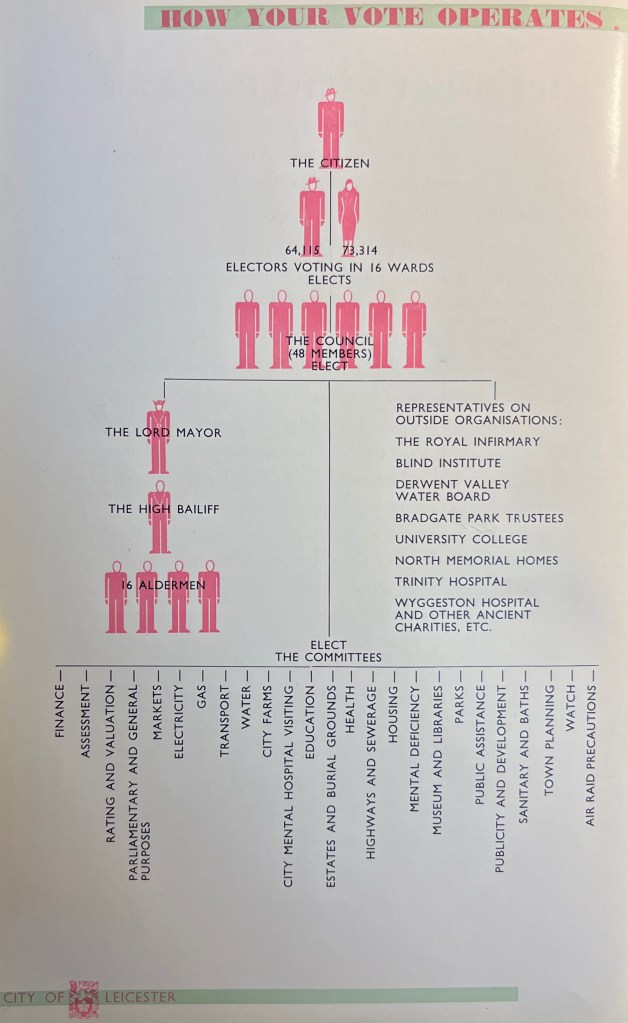

“How does Cambridge compare with the above set up?”
Let’s have a look:
- maintaining the highways – A mix of County Council / Combined Authority / Highways England
- administrating the police forces – centralised by the Home Office
- providing education and public health services – the former was centralised by Michael Gove, the latter with the exception of housing was centralised as part of the establishment of the NHS.
- inspecting and building houses – building houses effectively outsourced to the private sector.
- relieving destitution – A mix of direct council housing provision and contracted out to specialist providers
- supplying gas, water, electricity and transport – Regionalised/Centralised by successive governments then privatised by the Conservatives in Thatcher’s Government
- maintaining fire brigades – Covered by the county council
- providing public baths / swimming pools, libraries and recreation grounds. – A mix of outsourced to specialist providers (swimming pools), transferred to the county council (libraries due to central government policy) and direct provision (parks and open spaces).
Until the changes to the administration of justice in the early 1970s, the Mayor of Cambridge also acted as the chief magistrate of the city. Again, legislation and government policy broke the direct link between magistrates and local government. During my university years I spent a summer in the year 2000 working in what was the Lord Chancellor’s Department in what was their ‘Magistrates Courts Division’. Which was a formative learning experience of life and work in the big smoke.
What might a modern day public services guide for Cambridge look like today, and what conclusions might it have?
This is where the City of York guide is helpful – because it has recommendations for the future governance of their ancient and historic city:
Scroll through to page 315 of the guide. It’s top recommendations include:
- Proportional Representation with multi-member wards instead of First-Past-The-Post with single member elections
- Elections for the whole council once every three years instead of by thirds
- Elections in May instead of in November (Which was delivered by a previous government) due to the impact of bad weather on campaigning and turnout
- Further use of co-opted members (Which wasn’t!) to enable people with talent/expertise but who were put off by party politics to take part
- Abolition of the necessity for the confirmation of local bills by a Poll of Citizens (due to the problem of low turnout)
- Reduction in costs of obtaining powers from Parliament for new legislation specific to York. An old practice, this has effectively been dealt with through the use of enabling powers in primary legislation to enable much shorter secondary legislation to be area specific. Eg the legislation used to set up the Greater Cambridge Development Corporation.
- The transfer of Civil Marriage from the Guardians to the Municipal Authority – this was achieved via the abolition of the hated Poor Laws and the old Guardians system shortly after this guide was published.
- The consolidation of all Health Services under the City Council – note the reference to the then Minister for Health, a certain Mr Neville Chamberlain, who said that voluntary run hospitals could carry on as separately run institutions, with vaccinations being under the oversight of municipal medical officers. [With that in mind…how many of you spotted the CUH NHS Meeting on 10 June, and the opportunity to table public questions?]
- Pressure from the Ministry of Health on the more backward authorities – so as to raise the standard of health across the country, and use financial penalties to force such councils to invest in housing
- An examination of the whole system of rating and the distribution of Government Grants – which is effectively what the Layfield Committee of 1976 dealt with. See the summary from Parliament here. Local Government Finance remains in the ‘too difficult to deal with’ pile a century later.
- And finally… …Consideration for a Municipal Civil Service
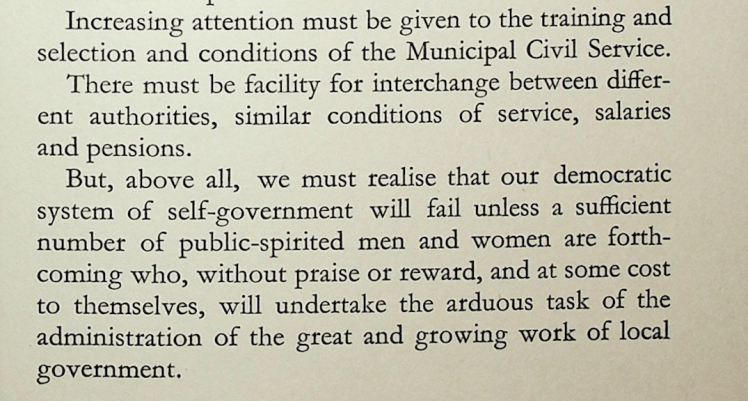
“Where is the passion?” Asked Trevor Dann of Cambridge Radio in 2024 to local election candidates
It’s worth listening to the radio hustings of 28 April 2024 on Cambridge Radio here. Was Mr Dann correct in his assessment?
I wrote about the radio show in the run up to the city council elections of May 2024 here, noting the impact of generations of centralisation, outsourcing, and privatisation.
I suspect most people involved in local government are utterly exhausted – hard to be passionate in the face of situations where you have few powers but lots of the responsibilities. Just ask those former councillors who lost their seats in the recent elections. It’s not easy.
For me, one of the things that is missing in the university-and-business-led debates is that understanding of local public services and the importance of democratic accountability.
Part of the reason I believe is because of the toxic reputation that ‘Politics’ has. Why would any business want to tar their brand by getting involved in something full of negative publicity and questionable ethics? Questionable because things have gotten so bad in public life that The Government has established a new independent Ethics and Integrity Commission

Above – the Ethics and Integrity Commission
What would they recommend for improving Cambridge’s governance structures and for encouraging more people from all walks of life to take part?
Food for thought? (It’s now 02.45am – so nearly an hour and a half on a roll!)
If you are interested in the longer term future of Cambridge, and on what happens at the local democracy meetings where decisions are made, feel free to:
- Consider a small donation to help fund my continued research and reporting on local democracy in and around Cambridge
- Follow me on BSky
- Spot me on LinkedIn
- Like my Facebook page


