
The new strategy for 2026-29 will also need to account for the restructure of local government which inevitably means splitting up the service into at least two new ones
Around one in seven of us have a library card that we have used
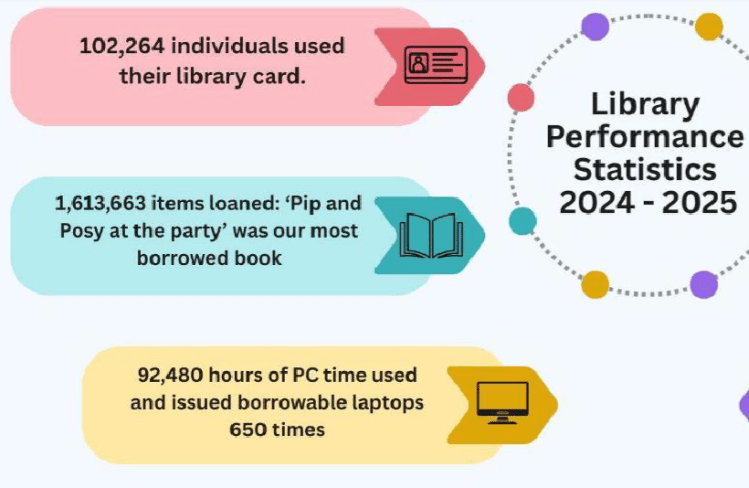
Above – Detail from Item 7 Appendix 1 p4
“In 2024/25 the core library budget was made up of £5.9M Council funding (including property costs) supported by £1M of additional income.”
Above – Detail from Item 7 Appendix 1 p4
This compares with:
- Employees (£4.15M)
- Buildings (£1.65M)
- Library Stock and Systems (£0.6M)
- Additional expenditure includes vehicle maintenance, security, stationary, training and event support (£0.47)
The service still remains dreadfully underfunded, and staff perform miracles on a shoestring. If anyone knows how this compares with previous years, shout, only I can’t find historical comparisons on spending in the historical committee papers here.
“Can councillors join up the work that libraries do with the Government’s agenda on loneliness, driven in part by the Jo Cox Foundation?”
The Officer’s Report states:
“Priority 6: Stronger ties – Libraries provide inclusive, welcoming spaces that support social connection, volunteering and community activity, helping to reduce isolation and strengthen relationships within and between communities.”
Above – Item 7 Officer’s Report p2
One thing the unitarisation will do is connect up what the libraries service is doing with what the city council is doing on community development. Two different institutions with their different systems and silos inevitably create barriers. One of the other things the report highlights is the library services working with local community groups – the most high profle round my way being the Cherry Hinton Hub and Library which has a new cafe in the old library building. It also has a small community room and a presentation room for workshops and public talks.
That also stems from the principle of co-location of services provided by other organisations. In the case of Cherry Hinton the books section of the library was slightly reduced (Sadly resulting in the significant reduction of the local studies books on offer) to create the social and meeting space. Had local government had greater and wider powers to tax the wealth generated in the economic sub-region (or in the case of Cherry Hinton Library, around the corner at ARM’s HQ on Fulbourn Road), the service might have had the resources to go beyond the basics.
Which is perhaps why it feels unambitious. The system won’t allow the Library Services to have the resources to do more than tread water. Until Ministers and HM Treasury decide to change their policies as recommended in the recent Re:State report, we’re stuck.
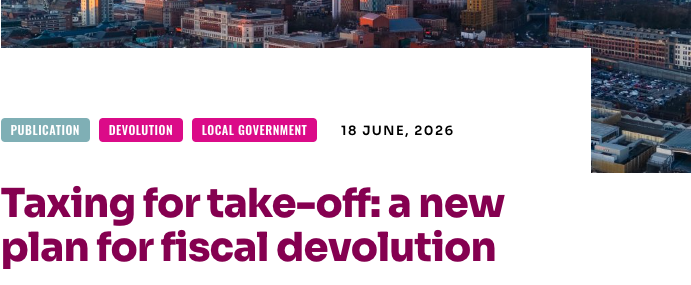
Taxing for take-off: a new plan for fiscal devolution
A significant piece of work on one of the least popular but most important public policy areas: Local Government Finance. It has been in the ‘Too complicated’ box for at least 30 years.
“What does it say?”
For a start, Andy Burnham was on the advisory committee for this piece of work. We find out in the next few hours whether he will become an MP again. (And if so, PM).
Also interviewed for the report were a couple of familiar names to regular readers of this blog:
- Professor Dame Diane Coyle, Bennett Professor of Public Policy, University of Cambridge
- Professor John Denham, Centre for English Identity and Politics, University of Southampton
Some of you will recall that Prof Denham was the former Secretary of State for Communities and Local Government – the final one in Gordon Brown’s Labour Government, and also covering some of the time that I was working in that department. One policy area that he wanted to push through was Total Place – but ran out of time. I wrote about it and his call for Total Place 2.0 to come forth.

Prof John Denham had an online discussion with Jess Studdert, then of New Local.
In a nutshell it involves pooling the multiple pots of funding allocated by central government to local government and lets them get on in deciding how to spend it. That former Labour Government had a performance management structure for councils to meet in return – with data being collected across a range of some 198 variables and metrics, with targets negotiated for up to 35 of them. (This was the old Local Area Agreements framework abolished by the Coalition)
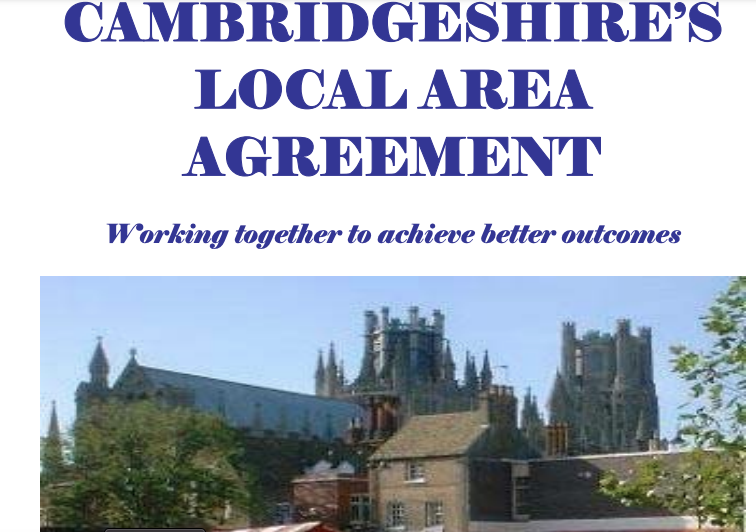
Above – Cambridgeshire’s old Local Area Agreement which I wrote about in 2022 here, which also had a target to increase libraries use.
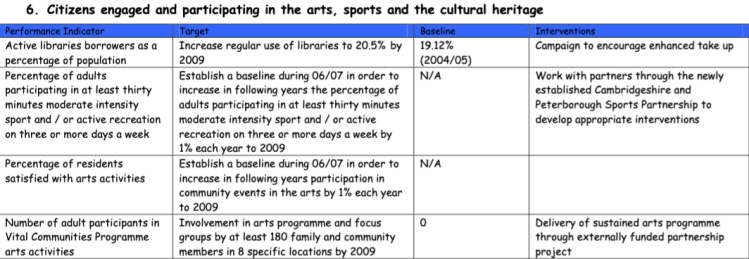
Above – the county council had a target to increase the number of active borrowers as a percentage of the county’s population. (Cambs LAA 2006-09, p35)
I hope there are brighter days for the local libraries service under the unitaries structure – and much greater funding for it too.
In the meantime, keep an eye on the return of the Mill Road Library building to grassroots community use, at https://millroadlibrary.com/
If you are interested in the longer term future of Cambridge, and on what happens at the local democracy meetings where decisions are made, feel free to:
- Follow me on BSky
- Spot me on LinkedIn
- Like my Facebook page
- Consider a small donation to help fund my continued research and reporting on local democracy in and around Cambridge.


