
Set up by Dean Perryman in Essex after the untimely death of a close friend, the Empty Chairs grassroots movement has spread across the country. And it started from an empty chair, an orange t-shirt, and a website
For a crash course, see https://emptychairs.org.uk/ and scroll down to see the list of dates and venues.
“What does it involve?”
It’s even more simple than the ‘TeaCambs2’ gatherings I ran in 2025 that resulted in one of the few mayoral hustings in Cambridge for that year’s CPCA elections (see the concept described here). It involves deciding what social space (eg pub, cafe, community centre, library) you think would be a good place for people to gather, deciding on a time and date, adding those details to a website, and then turning up wearing an orange t-shirt and seeing who rocks up.
And that’s it. As a host, your job is just to be there. It’s not therapy, it’s not counselling, it’s not professional help. It’s simply friendly safe spaces for people to go to to have some company in a place and at a time where they may not have many close friends nearby, or close friends at all.
Turning up in an orange t-shirt is Mr Perryman did just over 18 months ago at a time of year when many people do feel lonely and isolated in the face of ‘compulsory fun’ in the runup to Christmas
Fast forward to this month and over 1,000 separate meet-ups for strangers have taken place.
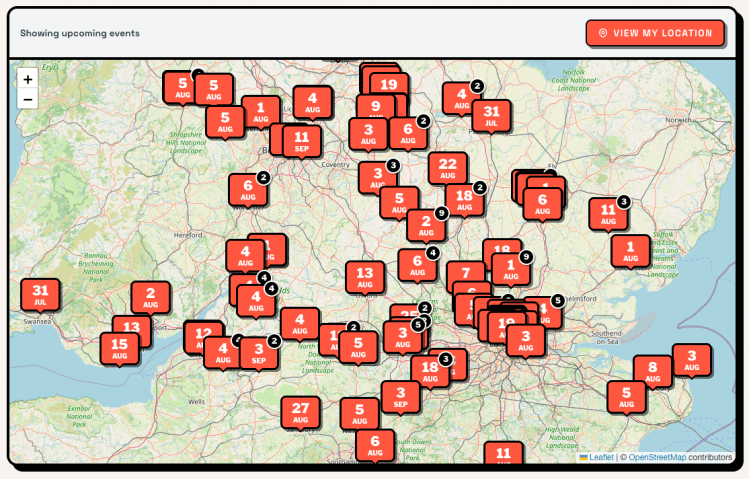
Above – a detail of the list of upcoming events scattered on a map, noting the cluster of events in Cambridge.
Avoiding the rain at the Handsome Prince new pub on King Street
I went to one of the meetups yesterday evening as it was not far from The Cambridge Room’s event on Houses of Multiple Occupation – the session being an open space for just over a dozen or so of us who turned up – a combination of small-scale landlords, tenants, longtime residents who are home owners, and me.
The two takeaways I came away with from the Cambridge Room event were:
- The complexity of the issues around HMOs – many of which originate in central government
- Lack of council housing leaving too many people desperate and vulnerable to predatory, irresponsible slum landlords – who can be absentee landlords who leave the day-to-day running of letting properties to property management companies
- The huge imbalance of power between tenants and landlords
- Limited options to deal with very disruptive tenants which has a negative impact on the quality of life of others in the neighbourhood, irrespective of housing tenure, and also on the state of the house being rented itself
- The hollowing out of both local government and community institutions that might in previous eras have nipped problems in the bud.
- The lack of enforcement of existing laws – again not helped by successive governments creating such a confusing picture of who has legal powers to do what in the face of such limited funding where the sector requiring regulation to reduce the problems associated with it does not bear the full costs of that enforcement.
Most of the people at the event with a handful of exceptions were middle-aged or older. Which contrasted with the Empty Chair event where all but me and one other person were in their early 20s.
Hence getting something of a crash course of what things were like for non-graduates in and around Cambridge – in particular those that have to travel into Cambridge from surrounding towns and villages to get to work. Which is why there was a lot of cross-over between the two gatherings.
Our host was Lewis who works at CJ’s Vintage Clothing on Emmanuel Street. And the conversations were very wide-ranging – pleasantly so (because it took my permanently whirling 24-7 AuDHD brain off of the topic of politics for once!) Yet even in the range of topics we discussed, there was a political element to them all. For example the declining night life in Cambridge compared with other places (London being better, outlying towns being even worse). Potholes, e-scooters, and even Jon Culshaw’s take on Jeremy Kyle given the latter’s alignment with TeamNigel. Rizzle Kicks called him out long before this back in the early 2010s with Lost Generation.
Aside from the Loneliness issues that I’ve been blogging about for over 15 years – my first post on my old blog dating back to 2011 here, it struck me that Cambridge’s public institutions have no means of engaging with young adults who are not at university. Which means they don’t get to shape local planning policies. (We had a discussion about the sports and leisure things they’d like to see in and around Cambridge – and also where Cambourne is (from their perspective) getting so much so badly wrong. (Back in 2023 I blogged about how there should be an inquiry on what went wrong with Cambourne and Northstowe before any more new settlements are planned. )
Are decision-makers underestimating the impact that transport issues are having on their other policy responsibilities?
- Too many young adults cannot go on nights out in Cambridge because the public transport to get them back home is non-existent and the cost of taxis is now prohibitively expensive
- The wages and salaries of young adults are out of synch with the costs of renting and living in Cambridge – with a disproportionate share of their income going on rent, and thus being extracted from the wealth of the city and going into the pockets of landlords (due to high market rents) which results in a net transfer from the wealth creators to asset owners. (New co-living newbuild options also came up, on how different this was as it involved creating a new asset rather than a wealthy individual/firm buying up an existing asset such as a house designed for long term living/family living, and sweating it as an over-crowded HMO for their own benefit while depriving the city of the benefits of a longer term residents who want to get involved in the life of the city)
- The saturation marketing of all things science & technology in Cambridge is grating for those that perhaps:
- don’t work in those sectors and find that sci-tech investment is crowding out other industries essential for the life of the city (both the Beehive and the Grafton were mentioned without me prompting)
- did not enjoy science at school for whatever reasons, and are now seeing the science industries making things even harder for them (not helped by the reluctance of the sci-tech sectors to engage with and support the arts and humanities – compare how the slimmed down Cambridge Folk Festival did not have the big sci-tech firms next door off Fulbourn Road breaking down the doors to sponsor the event)
- find themselves unable to take part in activities because the speculative land bubble means that no one can afford to establish them anywhere in the city, and because the transport links across the economic sub-region are so woefully poor that places where land is cheap is also inaccessible for the many.
Younger generations have the ideas and energy on how to take on many of the problems Cambridge faces today. But institutions have not figured out how to engage with them en masse
How we as a city and county deal with this is an acid test for public engagement – recalling what the Minister for Housing and Planning is instructing the Greater Cambridge Development Corporation:
“[The Development Corporation] will be asked to create exemplary engagement structures to enable broader community participation, including from residents, community representatives, and town and parish councillors.”
Above – Matthew Pennycook MP, Minister for Housing and Planning, 08 July 2026
The young adults involved in the more detailed discussions must be paid for their time and expertise.
It’s similar to the principle with large town planning applications where local communities are expected to give a huge amount of time to scrutinising planning applications and getting nothing in return. Some of the very low levels of public engagement are all too visible in statements of community involvement. Developers and the planning system more generally cannot carry on like this.
Ultimately the solutions can’t come from me – they have to come from the younger generations themselves. And that means institutions a) doing the hard work and b) senior figures and decision-makers doing things, going to places, and having conversations that make them as influential figures ***feel uncomfortable***.
After all, that’s what goes with the higher salaries and remuneration, does it not?
If you are interested in the longer term future of Cambridge, and on what happens at the local democracy meetings where decisions are made, feel free to:
- Follow me on BSky
- Spot me on LinkedIn
- Like my Facebook page
- Consider a small donation to help fund my continued research and reporting on local democracy in and around Cambridge


