
The Cambridge Growth Company has published a landing page for the new Greater Cambridge Development Corporation ***following approval by Parliament*** of the Minister for Housing’s motion to establish the institution
You can browse through the pages and the FAQs here
The list of members of the interim board so far include:
| Name | Role/Background |
| Peter Freeman CBE | Chair |
| Baroness Sally Morgan of Huyton | Master of Fitzwilliam College, former Chair of OfSted, former member of the Olympic Delivery Authority (which was a development corporation) |
| Professor Sir John Ashton | Former President of the UK Faculty of Health |
| Mayor Paul Bristow | Mayor of Cambridgeshire & Peterborough Combined Authority (Conservatives) |
| Richard de Cani | ARUP, formerly Transport for London |
| Ros Kerslake CBE | Chair of Homes England Investment Committee (Also sister of the late Lord Kerslake, former Permanent Secretary at the Ministry of Housing, Communities and Local Government – then DCLG). |
| Cllr Lucy Nethsingha | Leader of Cambridgeshire County Council (LibDems) |
| Paul Schofield | Professor of Biomedical Informatics, University of Cambridge |
| Cllr Bridget Smith | Leader of South Cambridgeshire District Council (LibDems) |
| Cllr Katie Thornburrow | Leader of Cambridge City Council (Labour) |
“I thought we had a growth company to do the delivering?”
We did – the CGC was established by the former Levelling Up [remember that?] Secretary Michael Gove to undertake the preliminary work on his future vision for Cambridge. The incoming Labour Government under the new lead of the Minister for Housing and Planning, Matthew Pennycook MP (Greenwich and Woolwich) chose to keep the framework and follow through on establishing a development corporation to manage the future strategic growth of Greater Cambridge.
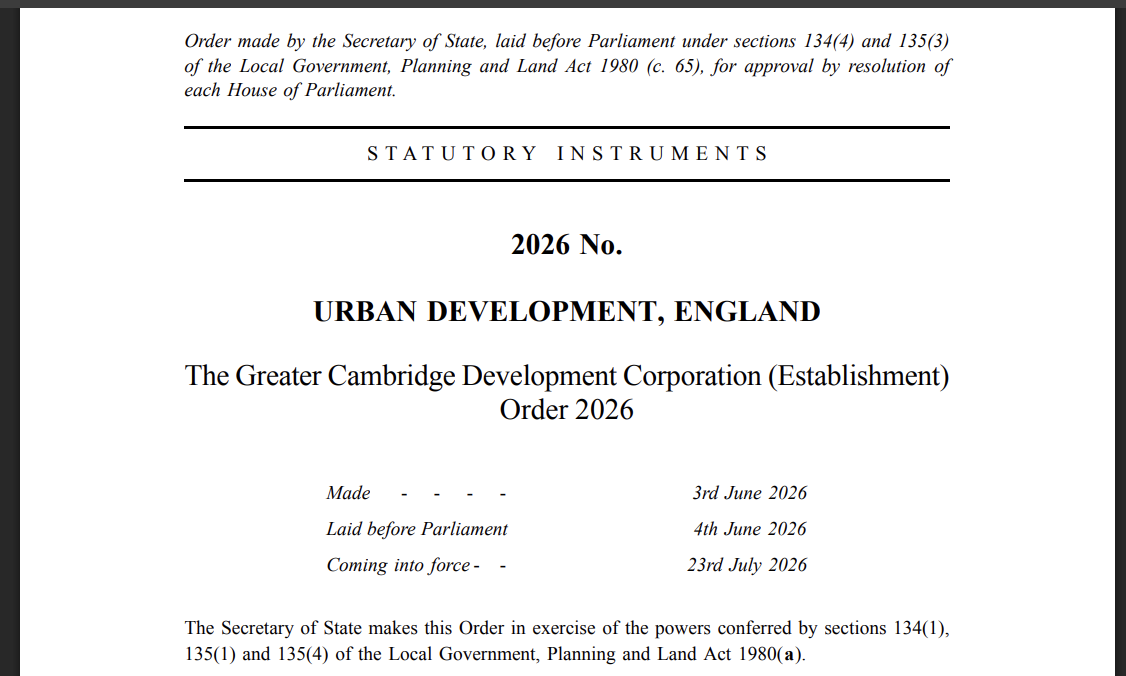
Now that the Greater Cambridge Development Corporation has been established in law, this is the institution that will acquire the powers that ministers and Parliament subsequently grant it. So keep an eye out for future announcements as more statutory instruments are laid before Parliament for MPs & Peers to debate and vote on.
The FAQs deal with a number of persistent issues that local residents and councillors have raised
That doesn’t mean everyone is going to like the responses, but it should help clarify where the institution stands policy-wise. That said, there are still a number of issues (water?) that need to be resolved – and more than a few of these will require ministerial action.
Which is why the role of the Members of Parliament in and around Cambridge will be essential in providing updates for local residents *and* holding ministers to account as the work of the development corporation progresses.
If you have an issue that you would like ministers to respond to regarding the future of Cambridge, email your local MP via https://www.writetothem.com/ and ask them to forward your questions onto the department responsible for a ministerial response
Some MPs publish regular updates on social media on their constituency work, such as:
- Pippa Heylings (LibDems – South Cambridgeshire) on FB here
- Ben Obese-Jecty (Conservatives – Huntingdon) also on FB here

Above – Ben Obese-Jecty MP with an update for constituents on FB 03 August 2026
If you think your MP should be providing more, regular updates on constituency issues and decisions being made by ministers that affect Greater Cambridge, you will need to contact them and ask them.
Having been doing this for over 15 years, I’m a bit like a stuck record when it comes to constituency outreach and broadcast updates. Such requests that come from people who have never contacted their MP or those that very rarely do tend to have more of an impact than those that come from me.
Planning applications (individual ones) and future local development plans
There has been a lot of coverage on who gets to work on what planning applications – and the proposed ceiling of 250 homes above which planning applications should be processed by the development corporation. The FAQs state that the development corporation is focused on strategic developments – ones that typically involve over 1,000 homes. Their reasoning is that some developments of between 250-1,000 may still fall under strategic developments (Eg a mixed development with employment, leisure, transport infrastructure purposes). While the development corporation can delegate sites under 1,000 homes to the existing Greater Cambridge Shared Planning Service, the GCSP cannot escalate applications up to the development corporation.
“In practice, most developments between 250 and 1,000 homes are expected to be decided by the Greater Cambridge Shared Planning Service.”
Above – Greater Cambridge Development Corporation
“I can’t see anything about water. Or heatwaves”
This remains a make-or-break issue for the growth of Cambridge – and currently sits within the remit of a quango called Water Resources East. WRE seem to publish most of their announcements on LinkedIn – such as the declaration of the drought for East Anglia. And it’s not just us – the source of future water supplies, Wales, has also confirmed it is now in a state of drought.
“Wales? In drought?!? How. On. Earth?!?!”
The driest July on record – going back nearly 200 years.
Which means that East Anglia should be looking towards alternative solutions including but not limited to:
- Infrastructure-level rainwater harvesting
- Infrastructure-level measures to reduce evaporation (such as the use of solar panels over some man-made water structures similar to what other countries are now installing)
- Mass retro-fitting of existing houses and communities (eg so that valuable potable water is not wasted eg on toilet flushing)
- New infrastructure on pipes to drip-feeding some agriculture, and learning from the recent research on the integration of solar panels (again) with some agriculture that can reduce the impact of extreme heat on vegetation
- Funding research into the reuse of desalination waste to generate new supplies of chemical products as new desalination plants are inevitably built, to prevent the poisoning of seas through submarine outlet pipes as is currently the case.
“And the draft local plan for Greater Cambridge?”
The final public consultation has been launched after which the Greater Cambridge Shared Planning Service will submit all the documents and a refreshed final plan to the Secretary of State for Housing, Communities and Local Government. Then begins the fun and games of the Examination in Public (It’s gruelling and not for the faint-hearted!) after which if all is well the Planning Inspectors will make a recommendation on whether to approve (with or without amendments) the draft local plan to the Secretary of State.
It is only after the approval of this draft local plan for Greater Cambridge that ministers intend on transferring local plan-making powers to the Greater Cambridge Development Corporation
It remains to be seen what the arrangements are for the Greater Cambridge and Peterborough Combined Authority which is getting new spatial planning powers and responsibilities. At the moment there is only a confirmation that the CPCA and the development corporation will work closely together.
If you are interested in the longer term future of Cambridge, and on what happens at the local democracy meetings where decisions are made, feel free to:
- Follow me on BSky
- Spot me on LinkedIn
- Like my Facebook page
- Consider a small donation to help fund my continued research and reporting on local democracy in and around Cambridge


