The article “Cambridge widow left feeling ‘isolated and alone’ as more HMOs pop up on estate” by Local Democracy Reporter for Greater Cambridge Eoin McCaul highlights broken economic structures and enfeebled local government not just in Cambridge but nationwide
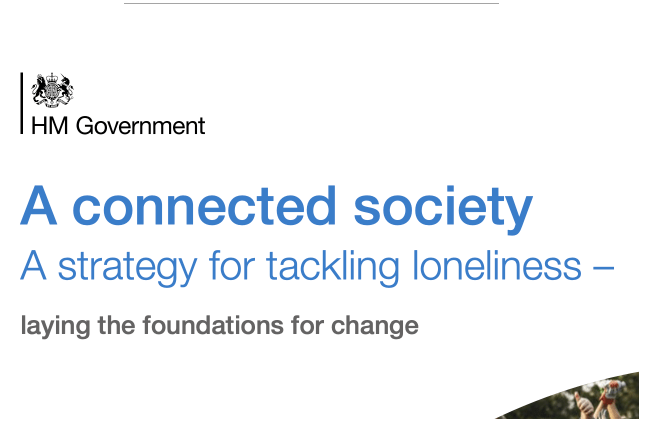
IMAGE: Loneliness Strategy 2018 from Theresa May’s Government.
“A widow in her 80s said the spread of HMOs in her estate has left her with “no one to call on for support””
Above – Eoin McCaul in Cambridge News, 05 Aug 2026
Note that this blogpost should also be read in conjunction with my earlier post on improved living for young adults such as this co-living development in Cambridge – esp those currently unable to afford anything more than a cheap but poorly-managed HMO.
The article featured the Red Cross Area Residents Association, which is near Addenbrooke’s Hospital. (See G-Maps here or alternatively follow Trumpington Local History’s guide here). The future of the old Bell Language School is one of the big challenges they have got coming up following its somewhat unexpected closure.
In the same publication, Cait Findlay wrote about her experiences in July 2024.
“I think the number of HMOs will only increase as demand for housing grows and landlords see that they can make more money from renting individual rooms rather than a whole house.”
Above – Cait Findlay in Cambridge News, 22 Jul 2024
This sounds like me in not-so-old age if I’m not careful
This month is 15 years since I left the civil service – six months later I had a mental health crisis that has left me with CFS/ME – although it took the NHS over a decade to diagnose it. (And in the years in between I had one suspected, and one actual heart attack – the latter in 2021 both of which required stays in Addenbrooke’s and Papworth – old and new). Which means I have not been able to work full-time or permanently since the age of about 32. And that has had an inevitable impact on my quality of life, social relationships and friendships because I don’t get to see the same group of people on a daily basis. How can I when even half-a-day of work means spending up to three days with Post-Exertional Malaise resulting in three days stuck indoors?
In the dash for new houses, Cambridge risks forgetting about its existing residential communities
I think that is one of the things that is behind the steady rise of the The Green Party in Cambridge in recent years – mainly at Labour’s expense. A critical mass of voting residents could not see what visible positive impact local government was making in response to the sense that everything was not functioning well and decided to shake up the system by voting for new challengers that amongst other things visibly reflected the city’s longstanding concerns about the environment and climate change. Which for what it’s worth reflects the greater prioritisation of the environment by Cambridge Labour than perhaps some of their other local counterparts across the rest of England.
I’ve spent the past 15 years trying but feel I’ve got very little to show for it
It’s strange to think I started blogging in August 2011 after what was an unhappy exit for those of us taking voluntary redundancy from the civil service and wider public sector as George Osborne and Eric Pickles wielded the axe. I sometimes wonder what the former has to show for his time in No.11, even though the print press still give him a soft ride. As the impact of the climate emergency gets stronger, history may judge his record more harshly than his contemporaries in the corporate world.
On the concept of ‘self-help’ with loneliness
One of the themes running through society over the past few decades is related to the ‘self-help’ concept – putting the onus on the person in need of help rather than expecting the state or society to do things for you. Anecdotally all to often I’ve found that it leads to a polarising of positions about who is expected to do what vs who should be expected to do what – and also who should show gratitude to whom.
One of the assumptions with the concept is that the opportunities for people to undertake the ‘Why don’t you do this?’ recommendations are actually there. Because once you start testing those assumptions against the reality of people’s lives, the barriers come up. As those of us dependent on public transport – such as the people I met at the Empty Chairs event in Cambridge, spoke to me about.
What inevitably gets lost is any discussion on collective action and institutional responsibilities.
One very good example of this is with recycling – within the wider context of waste collection and processing. One of my social media feeds is currently full of algorithm-driven posts about how big business-funded campaigns to recycle ignore the structures, systems and processes that create such huge volumes of waste in the first place. Few places in Cambridge for example have adopted what Alice Lightowlers has created with her mobile Vanjarred Refillery
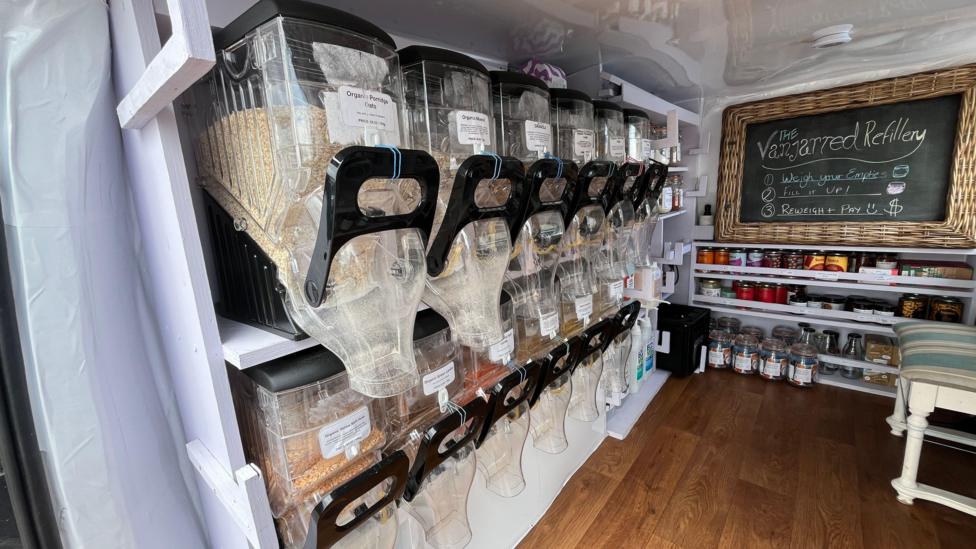
Above – Vanjarred Refillery at Cambridge Market Square, in Food refill van promises ‘zero effort’ shopping – BBC Cambridgeshire 10 May 2026
The loss of daily interactions as supermarkets and food shops move to self-service checkouts
If I wanted to reduce my spending significantly over a single year, one of the items I could stop buying is coffee on a daily basis. A back-of-an-envelop calculation shows I probably spend over £1,000 a year on cups of coffee alone. Divide 1,000 by the number of weeks in a year, and then divide that number by five working days in a week and what do you get? And how does that compare with the price of a coffee from a coffee shop?
So why do I keep going other than perhaps a caffeine addiction? Often it can be the only thing that gets me out of the house – especially if PEM flares up. Which means the only conversation I might have during the day is with the staff behind the counter. Because it’s not at any of the convenience food shops nearby which are mainly self-serviced, with those going to the kiosk doing so for nicotine and spirits, or those who want to be served by a member of staff. Which means there’s nearly always a queue.
A quarter of a century ago I started working at one of those shops – then under a different brand. (The other convenience shops didn’t exist back then). And because I had a regular shift for 18 months during my years at sixth form college, you got to know the regulars (one of whom at the time was Syd Barrett of Pink Floyd – even though I could never recognise his face! But then in those days he kept himself to himself and as locals we never troubled him.) And as the shifts were evening shifts, many of those were people finishing work, or older people popping in on cue for a packet of cigarettes (you learnt quickly who wanted which brand).
Taxing the supermarkets that have self-service checkouts
I’ve sometimes wondered what impact such a policy would have on youth unemployment if the supermarkets and convenience shops had to pay a levy for every hour a self-service checkout was in operation in order to incentivise them to employ people as an alternative – i.e. removing the financial benefits/savings of having them in the first place. Because the financial benefits / savings made on wages by having self-service checkouts is inevitably captured by an asset-owning class, wealth that otherwise would have gone to working staff. And that wealth more than likely would have been spent locally (although in this day and age a greater proportion would have been spent online).
“What does the academic and policy research say?”
The first is that there’s not enough research on the structural, economic, and social causes of loneliness. Which is striking given that loneliness has been a ministerial-level public policy issue since at least as far back as 2018.
‘Only the Beginning: How the UK Made an Impact on Loneliness and How it Can Do It Again’
The above is from Alex Smith at the Harvard Kennedy School from April 2026
While the pandemic raised the profile of loneliness further, it wasn’t matched politically.
“…the pandemic eventually precipitated a sharp decline in funding, leadership, action, and coverage on loneliness, and that progress on the issue stalled after 2022. Indeed, there was an equally strong consensus that UK infrastructure around loneliness has been weakest from 2022 to the present day.”
Smith attributes this in part to the implosion of the Conservatives in Government represented by the turnover of prime ministers. He also highlighted the underuse of the 2018 data and research that informed the 2018 Loneliness Strategy from Theresa May’s Government. (See also the Tackling Loneliness Hub update from 2023 here).
The Mental Health Foundation, and the Wales Centre for Public Policy
You can read the MHF recommendations here, but the only policy that gets anywhere near the economic policies are to do with the built environment. While it highlights the cuts to local government budgets it mainly stays within its public health remit rather than looking at much wider, indirect impacts. It’s a similar case for the WCPP in their report here. They also highlight the importance of the physical environment in one of six factors:
- community attitudes
- public policies
- demographic diversity
- physical environment
- social environment, and
- area deprivation
Corporate responses to loneliness critiqued
This article by Elena Bray & Iacopo Prinetti also got me thinking about the ‘rent a desk’-type workspaces and loneliness.
“The so-called “Economies of Loneliness” have emerged from this advancement of the capitalist model – which proposes solutions as fragile as they are discouraging in a vicious circle that hopes the disease will also act as a remedy. These economies rose in the form of companies such as WeWork or Second Home, communities founded solely on an economic contract promising shared and social workspaces, and services such as Rent-a-Friend for renting “friends” by the hour from an extensive catalogue. “
What I’ve never been able to get my head around concept-wise with the likes of WeWork is how people connect meaningfully if they are all working on separate unrelated projects and sectors. I think this is one of the things I struggled with when Together Culture opened their sadly short-lived space down the road from the Grafton Centre. I found the concept of having a familiar space to go to really useful, but – and this is probably more to my neurodiversity disposition and CFS/ME, was unable to really connect with people in the way I wanted to. I.e. finding a group of people with multiple shared interests working towards similar collective goals that are greater than the sum of their parts.
The final piece I spotted was the conclusion on “Lonely Places or lonely people?”
“In order to develop appropriate interventions further research is required to investigate how area-level factors combine with individual-level loneliness vulnerability measures to generate increased levels of loneliness in deprived areas.”
Christina R Victor, Jitka Pikhartova (2019) – note the link to the peer-reviewed version of 2020 here
You could say one further step is to connect those area-level factors with macro-level economic and financial drivers. Because research there may well reveal some very difficult public policy challenges – especially for those with the most wealth in society.
If you are interested in the longer term future of Cambridge, and on what happens at the local democracy meetings where decisions are made, feel free to:
- Follow me on BSky
- Spot me on LinkedIn
- Like my Facebook page
- Consider a small donation to help fund my continued research and reporting on local democracy in and around Cambridge


