At the recent Cambridge Biomedical Campus Open Forum (21 September 2026) The chief executive Eilish Midlane referred to me as ‘young man’ in the Q&A – which I’ll take as a win given I’m in my mid-40s!
You can:
Note there are two other NHS Foundation Trusts that serve Cambridge:
If you are a member of a political party but don’t want to stand for election / take on anything onerous but want to do *something*…
…then enrolling for free as a member of one of our NHS trusts is something that you can do to be an extra pair of local eyes to both scrutinise and support local health and social care services.
Most people don’t even know the public can sign up for free to become trust members (there are some benefits with membership – see the links) because we don’t have a tradition of citizenship and democracy education in the UK, and furthermore this level of detail is not covered in what little of it is taught. (I want this number of GCSE Citizenship Studies entries in Cambridgeshire to rise substantially when the new Citizenship curriculum is brought in)
Why this matters to me
Staff helped me dodge another swipe from the grim reaper.
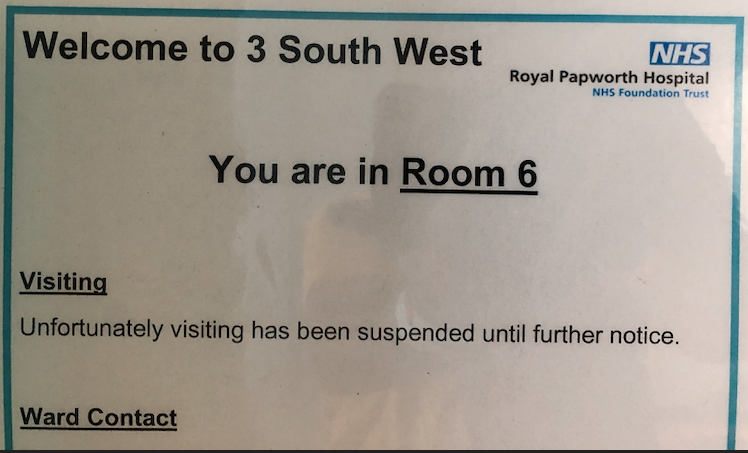
Above – by me in December 2021 when I was an in-patient during a mini-lockdown
What the strategy says
Every NHS Trust has to have a five year strategy. Royal Papworth has summarised their 36 page document into a single page, the important bits are in the table below
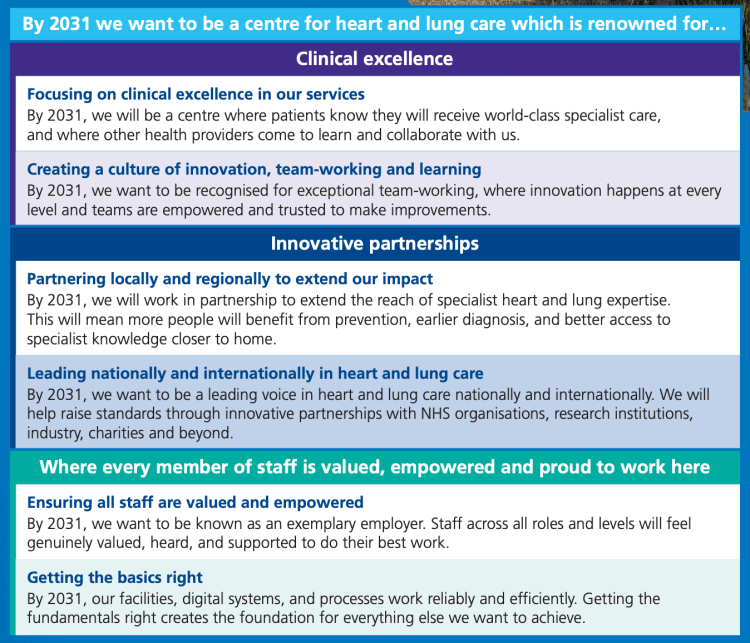
Above – Royal Papworth’s single page summary 2026-31 <– Feel free to print out and display in community centres and libraries in/around Cambridge
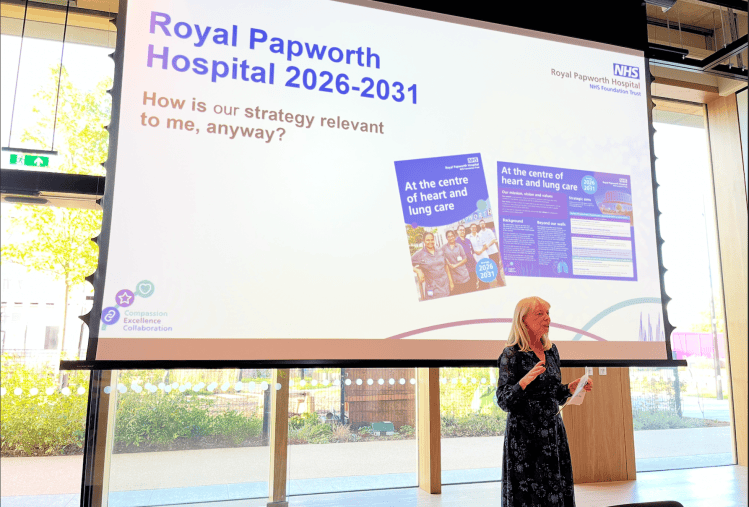
Above – CEO of Royal Papworth Hospital Eilish Midlane at The Hub [they’ve got to come up with a more imaginative name] on the Cambridge Biomedical Campus by the new Cambridge South Station.
(The Hub is open to the public and open to 8pm weekdays, last food orders 7pm. See here, scroll to the bottom)
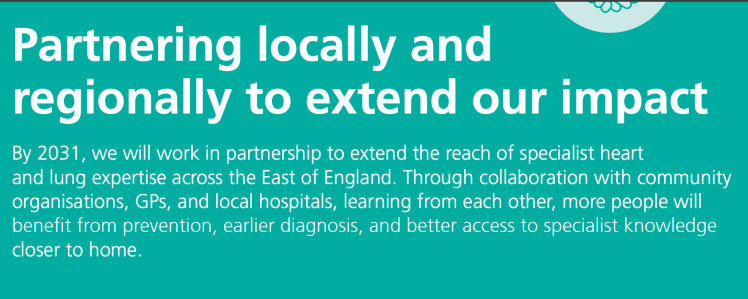
Partnering locally and regionally
This is the bit of the strategy I’m interested in. (from p20 of the strategy document)
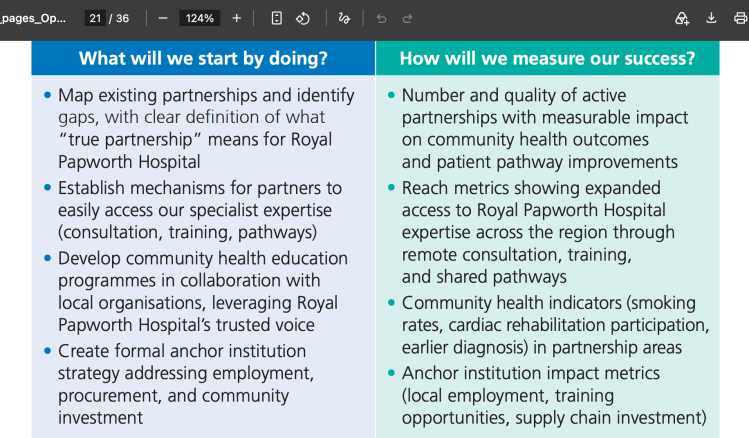
I’m not going to give a breakdown of my own experiences post-op other than to day that the gaps they identify are definitely there because I’m living through and with them. Furthermore, a fair amount of the gaps are the result of not having the shared information and data sets. Which is why the automated data sharing between Addenbrooke’s and Royal Papworth that I thought was the norm is something that has only recently been agreed.
My questions were based around how familiar RPH staff were about the future plans on public transport, and the wider functioning of local government institutions. The reason being that when I was an inpatient with little to do, I asked all of the staff members caring for me (from consultants to cleaners) about their experiences of travelling into work, and about public transport more generally. I wrote it up here and then told the then CPCA Mayor Dr Nik Johnson all about it when we bumped into each other at a public talk on the campus not long after.
Another point picked up was on the design shortcomings of Cambridge South Station – I followed on from a couple of earlier questions asking why Cambridge Biomedical Campus had not identified a suitable site for a small supermarket between the station and RPH so that commuting staff could pick up healthier food items to/from the station and any other essentials. Many of us live/have lived that commuting life where the last thing in the world you want to do is to cook a meal when you get back, but you still want something that is both vaguely healthy and fulfilling. Which is why so many urban design failures are so glaring when the completed designs show their shortcomings.
All too often it’s outside of the remit of the institution responsible – or that they’ve outsourced the responsibility to someone else to cut costs. The Department for Transport / Network Rail and Cambridge South Station is a good example. Not surprisingly, I’ve moaned about design issues with the recently-opened station (here in 2020, then here in 2022 on the planning approval, and here in 2024
As a result, there was no space made for things like:
- A sit-down cafe
- A convenience supermarket
- An integrated transport interchange to connect to a large number of local bus services.
It’ll be interesting to see what future generations make of the station when the new hospitals (The Cambridge Cancer Hospital and the Cambridge Children’s Hospital) are completed.
Network Rail can’t say they weren’t warned. Not least by Smarter Cambridge Transport.
If you are interested in the longer term future of Cambridge, and on what happens at the local democracy meetings where decisions are made, feel free to:
- Follow me on BSky
- Spot me on LinkedIn
- Like my Facebook page
- Consider a small donation to help fund my continued research and reporting on local democracy in and around Cambridge

