
The Greater Cambridge Partnership Assembly discussed buses in light of issues raised at Cambridgeshire County Council, as one of the meeting papers reminded me of the data collected about transport journeys that most people miss. Plus a look back at Smarter Cambridge Transport’s travel hub concept from a decade ago.
Image: Cambridge Area Bus Users – would be good for politicians and employers to encourage the public for more people to get involved given how central bus service provision is to the success of their policies.
“So, how does June 2026 compare with 2023 and 2019?”
Let’s have a look. If the figure is in a ***red box***, it is good. (i.e. above pre-CV19 levels and above 2023 levels.
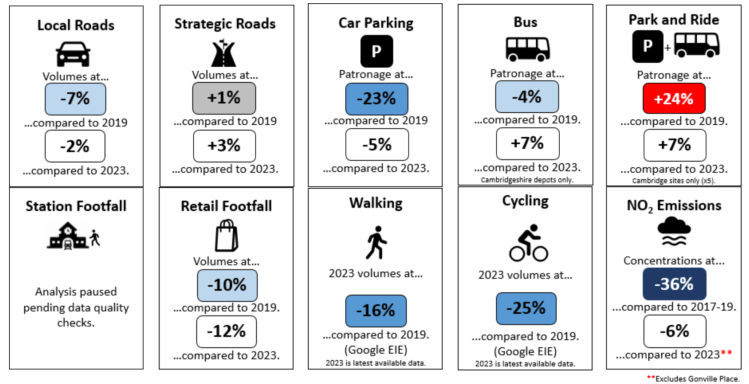
So it looks like the Park’n’Ride data seems to be looking good. But we’re still below pre-2019 levels for overall bus patronage. That said, we don’t get the that might explain some of the changes. For example the opening of a very large business park or employment site, or the closures of major retail employers.
The collapse in car parking – mainly the result of the decline of the Grafton Centre
And that’s before you consider the heatwave of June 2026. The data is from Cambridgeshire and Peterborough Insight’s quarterly transport statistical release.
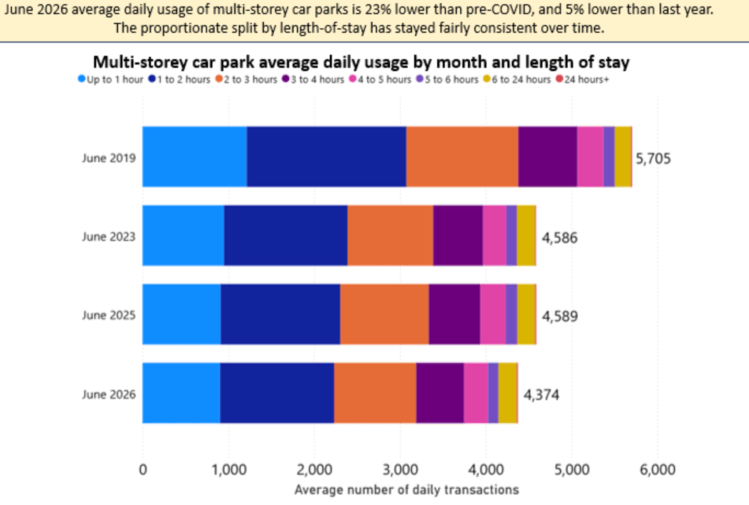
Above – Cambs Insight (Transport – Cambridge & South Cambs) June 2026, slide 38
When broken down by car park location, the difference between The Grafton and Grand Arcade/Lion Yard is staggering when you consider that The Grafton was meant to be the second urban centre for Cambridge, one with far more convenient car parking than at the Lion Yard.
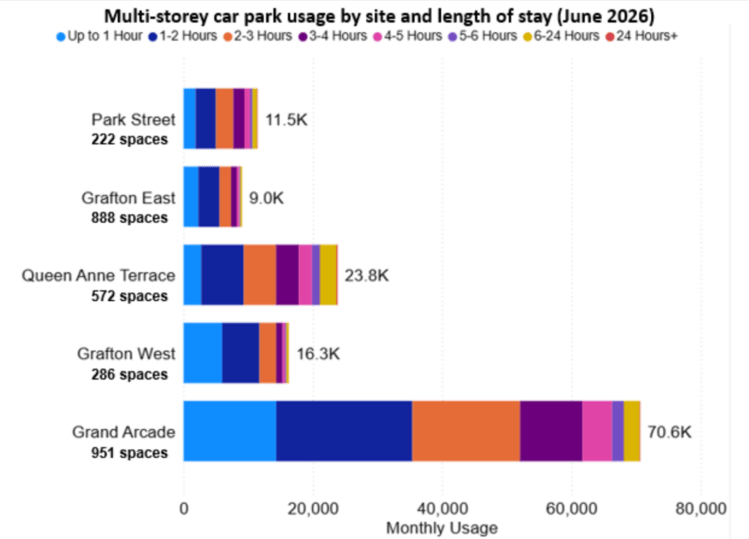
Above – Cambs Insight (Transport – Cambridge & South Cambs) June 2026, slide 38
The vast majority of people still travelled by car in June 2026 in Cambridge
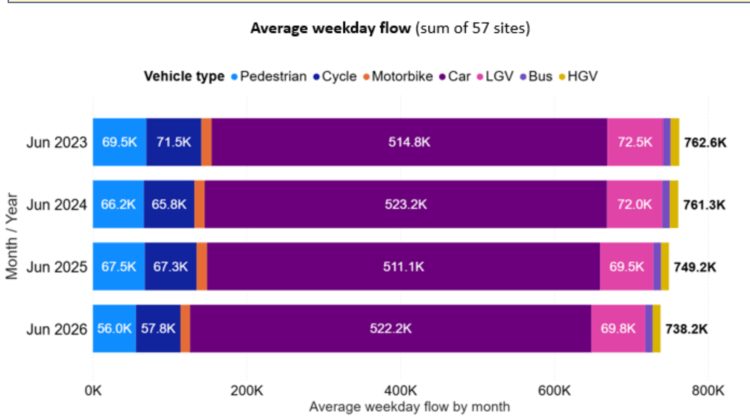
Above – Cambs Insight (Transport – Cambridge & South Cambs) June 2026, slide 25
When I look at the bar charts above, I wonder how politicians and highways engineers continue to have faith in buses to get that massive step change (or **Stomp Change**) needed to get people out of cars and onto public transport or active travel.
“What did the Greater Cambridge Partnership Assembly say earlier?”
The Leader of the Green Party Group on Cambridge City Council, Cllr Sefira Davison (Greens – Arbury) reminded everyone of the GCP’s failure to deliver the ‘City Access Project’ – one of the key pillars of the City Deal Agreement in 2014 which was meant to deal with the ‘last mile congestion’ in Cambridge.
The debate on the Cambridge South West Travel Hub reflected the fragmentation of public services in and around Cambridge, where the institutions responsible for commissioning the infrastructure (Eg Park & Ride sites) are structurally separate from the institutions responsible for the actual bus services. The point raised by Kristin-Anne Rutter (representing the Universities and who is the CEO of Cambridge Biomedical Campus Ltd) on conversations with the bus companies reflected this. Note this is also in the context of the points made by Cllr Dr Alex Bulat (Labour – St Ives South and Needingworth) to Cambridgeshire County Council, and her issues with service cuts on the existing Cambridge-St Ives busway earlier this week. (See my blogpost including extensive quotations of her points here)
The GCP’s vision for Cambridge 2030
The latest conceptual iteration of what public transport and active travel should be like for Greater Cambridge gives the impression that the busway routes do ‘something special’ eg go underground, when in actual fact the diagram key simply labels the broken green lines as “City centre bus routes”
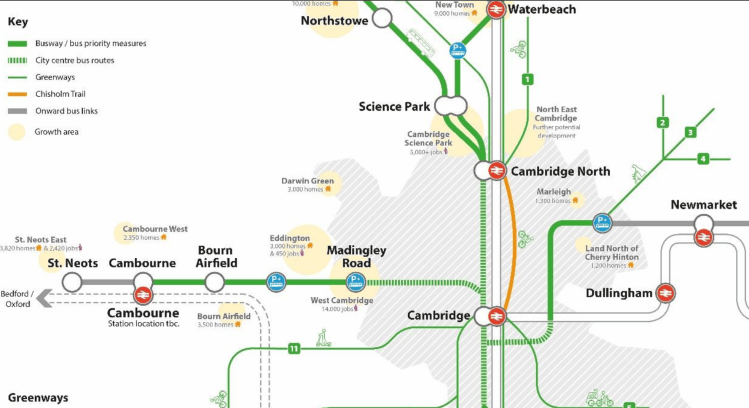
Above: Cambridge South West Travel Hub – Full Business Case, p2
Talking of the South-West Travel Hub south of the Hauxton junction of the M11, Cllr Heather Williams, the last Conservative standing on the GCP structures, was scathing about another car park on the Green Belt.
It wasn’t just the city access project that the GCP failed to deliver
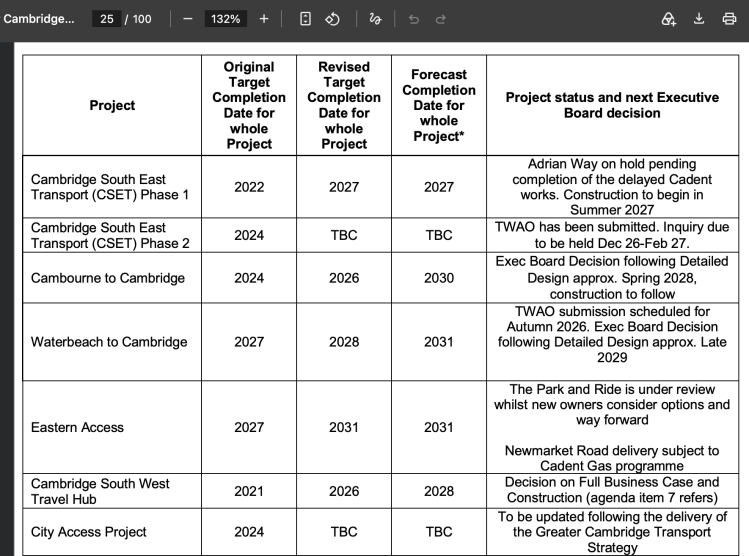
Above – Item 6, p7 of the Progress Report – table of transport projects.
Or at p25 of the full meeting pack. The City Access Project is tied up in the multiple mentions of “Last-Mile” issues – the phrase coming up 37 times in the Combined Authority’s Transport Strategy for Greater Cambridge but with perilously little detail on how it will be overcome. See my recent blogpost on the draft CPCA Transport Strategy for Greater Cambridge here. Other shortcomings included:
- Cambridge Eastern Access – which when the first Combined Authority Mayor was elected, was extended to try to integrate with the abandoned CAM Metro.
- Cambridge South East Transport – was meant to connect with Haverhill but for whatever reason nothing happened of note between transport officers and senior politicians in both Cambridgeshire and Suffolk in the 2010s to make that happen
- ‘A1134 and Hills Road projects (formally Cycling Plus)’ – little progress here while the road itself remains snarled up by poorly-communicated gas works in a part of the city where over half of the county’s A-level students study at institutions in the ward where the road works are happening (Queen Edith’s). With the teenagers living in rural areas disproportionately more likely to be using public transport, you can see the even greater disproportionate impact this has. (There’s a separate story as to *why* Cambridge ended up with such a concentration of sixth form provision, state and private, in such a small part of the city and county).
“We were told it wasn’t going to be a Park & Ride, but now we’re renaming it to what it actually is, which is a Park & Ride”
Above – Cllr Heather Williams to the GCP Assembly 15 October 2026.
This reminded me of the multiple criticisms of the South West Travel Hub by Smarter Cambridge Transport.
“Smarter Cambridge Transport does not support any of the proposed options for expansion of Trumpington P&R or building a second site at Hauxton. We believe instead that the short-term focus should be on improving rural bus services; and in the longer term, to identify a single site to serve as a gateway to Cambridge for people travelling from beyond the local transport network (rail, ‘metro’ and bus) in South and East Cambridgeshire.”
Above – Smarter Cambridge Transport consultation response to GCP – 21 December 2018
This was followed up by a response to the then Chair of the GCP Board, former Cllr Lewis Herbert (Lab, Coleridge 2004-2022) stating what Cllr Heather Williams stated at the recent GCP Assembly.
“As Smarter Cambridge Transport coined the phrase ‘travel hub’, we would like to correct its misuse by the Greater Cambridge Partnership (GCP). [Travel Hub] is not a euphemism for park-and-ride. A travel hub is a multi-modal interchange with high quality walking and cycling connections to a village or group of villages. From the hub, express bus or train services run regularly to major destinations from 6am to 11pm. Local and/or demand-responsive bus services provide connections from a wider catchment area as well as inward connections to local business and leisure destinations. Car parking provision is typically small, reducing as connectivity improves.”
“What is a Travel Hub and how is it different to a Park & Ride?”
“The defining feature of a Park & Ride is a large car park, which grows over time as usage increases (e.g. 274 spaces being added at Trumpington…)”
Above – Chris Rand for Smarter Cambridge Transport in the Cambridge Independent of 24 July 2019
Smarter Cambridge Transport explained more in further depth here. With a P&R you drive to the P&R site, you park you car, wander over to the bus stops, buy your ticket, get on the next bus that goes to your destination.
A travel hub should be something much more comprehensive, as the above-lined SCT post listed below on what a Travel Hub could include.
- Train or tram platform(s)
- Bus stop(s)
- Taxi rank
- Car set-down/pick-up area
- Car parking
- Toilets
- Baby changing facilities
- Secure cycle parking
- Waiting room with sufficient seating and heating in winter
- CCTV covering main waiting areas and cycle parking
- Refreshments kiosk*
- Small shop*
- Parcel collection point*
- Tourist information point*
- Free wireless Internet access
- Attendant
Above – Smarter Cambridge Transport: Travel Hubs, 26 May 2016
“That was written over a decade ago!”
I know. The post then continues to expand on what now begins to sound like a local centre with a travel hub attached to it rather than the other way around.
- public library
- post office
- police contact centre
- local authority exhibitions (e.g. of local plans and developments)
- health screening
- Citizen’s Advice Bureau
- farmers’ and craft markets
- mobile cinema
Above – Smarter Cambridge Transport: Travel Hubs, 26 May 2016
So in that sense a travel hub can be located within an existing community. It does not automatically assume that there is a big open plot of green space or unused land waiting to be turned into a giant car park with added bus stop.
The group then went to town with what effectively was an alternative vision for the Greater Cambridge City Deal signed in 2014.
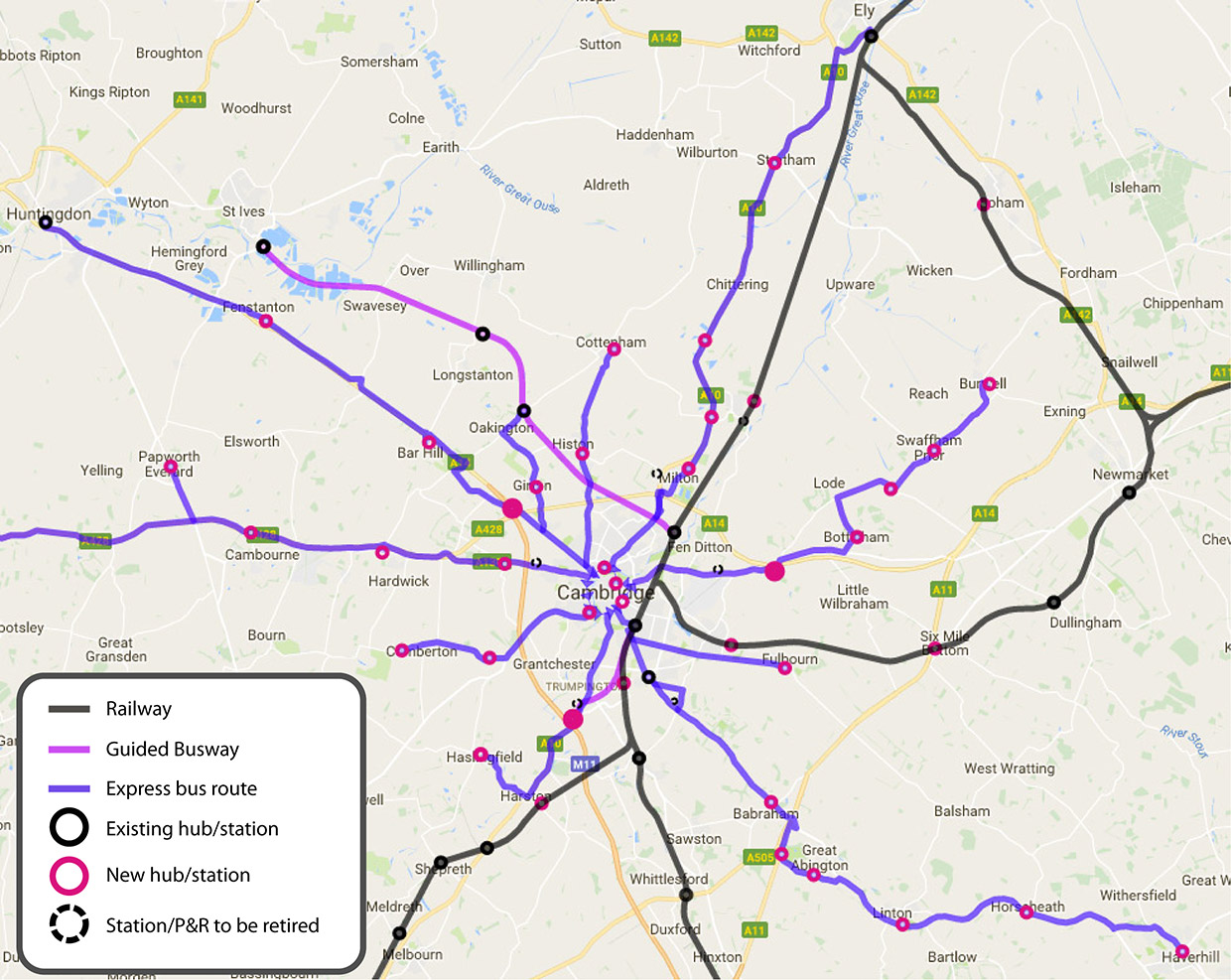
Above – a bus-based transport network (at a time Cambridge Connect Light Rail was still in its infancy and before Michael Gove launched his ‘supersize Cambridge’ proposals). – Smarter Cambridge Transport: Travel Hubs, 26 May 2016
The concept behind this if I recall correctly was to have smaller buses serving smaller villages taking passengers to/from the larger travel hubs. The larger ‘express buses’ would then pick up larger numbers of passengers and head to Cambridge and/or employment sites, stopping at far fewer stops on the way – i.e. only the travel hubs.
Given the significant changes in the growth ambitions of ministers since 2016, some of those express bus routes and travel hubs have since become more suitable for light rail or suburban rail – such as the Haverhill-Cambridge disused railway line.
Where the Greater Cambridge Development Corporation fits in
The difference between the GCP and the CamDevCo is that the former was tasked primarily with busway-related big transport infrastructure give or take a few cycleways. The CamDevCo is responsible for something far more complex – for which it has been given far, far greater powers by Parliament and ministers.
CamCycle did a splendid job of making a much bigger success of rural cycleways than perhaps had initially been expected at the start – recalling that in the early days of the GCP it had a board of 2 Conservatives and one Labour member. CamCycle members were organised enough to ensure its members were informed about public consultations at the right times so they could indicate their support for them. (*Declaration of interest – I am a member of CamCycle because when you grow up in Cambridge you learn to cycle before you learn to walk…). It’s also worth noting that Anna Williams, CEO of CamCycle criticised the shortcomings of the GCP over its Greenways projects – including on how they engage with local communities. You can watch Ms Williams tabling her public question to the GCP here. I’ll leave you to be the judge of whether GCP officers gave a conciliatory response or not.
What the GCP was not tasked with doing was the equivalent of building entire new communities
Therefore, all of the things that were listed in the Smarter Cambridge Transport Travel Hub list could easily be struck out as ‘out of scope’ and/or the responsibilities of other organisations. In an era of austerity, few in local government could find the funds to cover the expenses involved in building out a travel hub.
In one sense one of the missed opportunities was to engage positively with parish councils, which could have become the beating hearts of their local travel hub, and giving them their own local identities and even names. (For me the word ‘Hub’ sounds to bland and corporate).
One of the things ministers will need to commission once the GCP winds up is an independent evaluation including **why** the GCP model was created, what the alternatives were, and why they were discounted. Furthermore, there’s a separate study on the consultation processes because as the GCP Assembly members noted, the sheer number of projects they are now working on and trying to manage is now itself a risk.
If you are interested in the longer term future of Cambridge, and on what happens at the local democracy meetings where decisions are made, feel free to:
- Follow me on BSky
- Spot me on LinkedIn
- Like my Facebook page
- Consider a small donation to help fund my continued research and reporting on local democracy in and around Cambridge


