This is especially the case when authors of books on politics and public policy present their publications
I was at the Cambridge Literary Festival talk for Prof Mariana Mazzucato of UCL. To get a sense of what her book: The Common Good Economy is about, have a watch of her interview on Channel 4 below.
Above – Channel 4 News 01 June 2026
She summarises her key recommendations in her substack post here
- “Purpose & Directionality: Setting a clear direction or mission, proactively aligning activity towards collective goals.
- “Co-creation & Participation: All stakeholders at the table deciding what the common good should be and working together to make it possible. Genuine interfaces between public, private, and civil society.
- “Collective Learning & Knowledge-Sharing: How we embed shared learning in governance structures: IP rights, open access platforms, institutional capacity to learn together.
- “Access for All & Reward-Sharing: Redistribution and pre-distribution policies are critical for equitably sharing risks and rewards.
- “Transparency & Accountability: The enforcing pillar. Without visibility and accountability, the other four cannot hold. Openness is not optional.“
I had a seat up in the gallery having popped into a bookshop to get a copy of her big blue book – I brought along her other book about the corporate consultancy industry which is also essential reading for anyone in public services that has to work with them.
Above – Left, at the Cambridge Union, and Above-right, books
Encouraging people to talk to each other about her ideas
It would have been nice to have had some breakout areas for small group facilitated discussions given how radical and thought-provoking Prof Mazzucato’s ideas are – and also given who she is advising.
There was and is something strikingly ‘middle class’ about the literary festival events!
Scenes at the entrance with the crowds, and trying to work out who was ‘a friend of the Festival’ and who was not, had a farcically comical touch. Which reminded me of Mark Steel lampooning our city at The Junction not so long ago. (In the full version, even Clifton Road’s Screwfix gets a mention!) The concept of having a comedian doing a tour of the country and writing a different show for each one based on where a handful of people local to each place take him to, is a great one – not least because no show is the same)
Furthermore, I got the sense we were the type of audience who see Nelson from BBC’s Mongrels from the early 2010s as a lifestyle hero!
Above – Nelson the Fox singing “Middle Class is Magical” at the Proms – tick off the number of stereotypes that apply to you. (Alternatively, violent cousin Vince the **** provides the sharp contrast)
There is a more serious point than singing puppets singing songs about social class issues
At a previous Cambridge Literary Festival Isabel Hardman presented her book Why we get the wrong politicians – pictured below with Puffles the Dragon Fairy. It still reads really well today, several years after it was published.


Above-left: Why we get the wrong politicians, by Isabel Hardman. Above-right, Ms Hardman with Puffles the Dragon Fairy – of the latter back in 2014, 89 residents thought the cuddly dragon would make a better councillor than the other candidates in Coleridge ward.
In hindsight I think the audience would have had a productive set of discussions facilitated in small groups after Ms Hardman’s talk on the issues she raised in her book. Especially where people get to talk to those they’ve not met before or people from backgrounds they might otherwise not normally meet. (Which then makes the Cambridge Union a slightly awkward venue for such breakout sessions). What actions would/could have arisen from the discussions? This is something that I wanted to put to the audience at Prof Mazzucato’s event in the very short Q&A at the end:
“As a result of what we’ve heard from Prof Mazzucato this morning, what small one off action or one small behaviour change are we prepared to undertake individually as a result of coming along today?”
Above – it’s a similar question I think that should be put to audiences at the end of public talks: something that encourages people to take action without telling them what to do – getting them to think for themselves.
‘What is to be done?’ Asked Prof Mazzucato
One of the Q&A discussion points was on what advice she would give Andy Burnham, and also what her first priority would be if she had to pick one. The ones she picked weren’t the obvious ones:
- Changing the fiscal rules
- Removing the tax breaks on companies that successfully apply for patents on intellectual property – the patent itself should be a strong enough incentive without a further subsidy on profits made from it
- Nationalising the water companies
- Insourcing – and getting rid of the system that creates the huge consulting industry.
…were some that I picked up.
On the last of those points, Prof Mazzucato mentioned that nearly half a century ago something like 80% of architects worked in the public sector. Today that figure is under 10%. That change is the direct result of a move by Margaret Thatcher’s Government to get rid of the role of in-house local council architects. We had Gordon Logie in Cambridge whose radical schemes for Cambridge never came to fruition.

Above – Gordon Logie’s futuristic proposals for Cambridge in July 1966 which I wrote about here.
Prof Mazzucato also highlighted the importance of having positive visions for the future – not least to compete with the dystopian ones coming from ‘The Bros’ that one way or another manipulated or took advantage of broken regulatory and policy systems to acquire unimaginable sums of wealth. Hence her points about pre-distribution and the state using its powers to ensure the workers that create the wealth get more of the rewards for their work than the investors and asset class – or the ‘sterile class’ she mentioned someone referring them to as. (I.e. the very high rents charged by landlords ‘sterilise’ the innovation that might otherwise come from reinvesting that income/wealth back into the system).
Applying Prof Mazzucato’s thinking to the future of Cambridge
This is something that the Greater Cambridge Development Corporation [CamDevCo] could look into regarding future events with internationally prominent speakers talking about public policy issues relevant to the city. She briefly mentioned some of the problems Cambridge had both socially (the inequalities – and also of the private school privileges) as well as the broken regulatory systems of the pharmaceutical industry capturing so many of the benefits that should be for the public.
It could be a fairly straight-forward template:
- Brief the keynote speaker to include a section on how their area of expertise applies to the challenges of a future Cambridge
- Have small group discussions after the presentations – they don’t need to report back unless people want to
- Encourage participants at the end to commit to one small one off action or behaviour change as a result of participating.
….and then see what happens in the longer term
And if the CamDevCo can help facilitate those events and capture the learning for the longer term, so much the better. At least that way it will get more out of guest speakers and also raise awareness across the city of how to feed into the policy-making processes that all too often get stuck inside bubbles. A risk far greater now with the decline of local daily newspapers. (The Cambridge Futures project of 1999-2003 benefitted from a week-long campaign in the daily Cambridge Evening News in 1999 which at the time had a circulation of 40,000 at a time when the population of the city only just over 100,000 people). We don’t have anything like that coverage today.
My one big policy recommendation if given a choice
Citizenship education for adults – there’s no point in talking about participation and ‘local anything’ if a critical mass of the public does not know the first thing about how their political systems function and malfunction. In wartime – especially the Second World War, the country was very good at democracy education and facilitating discussion groups.
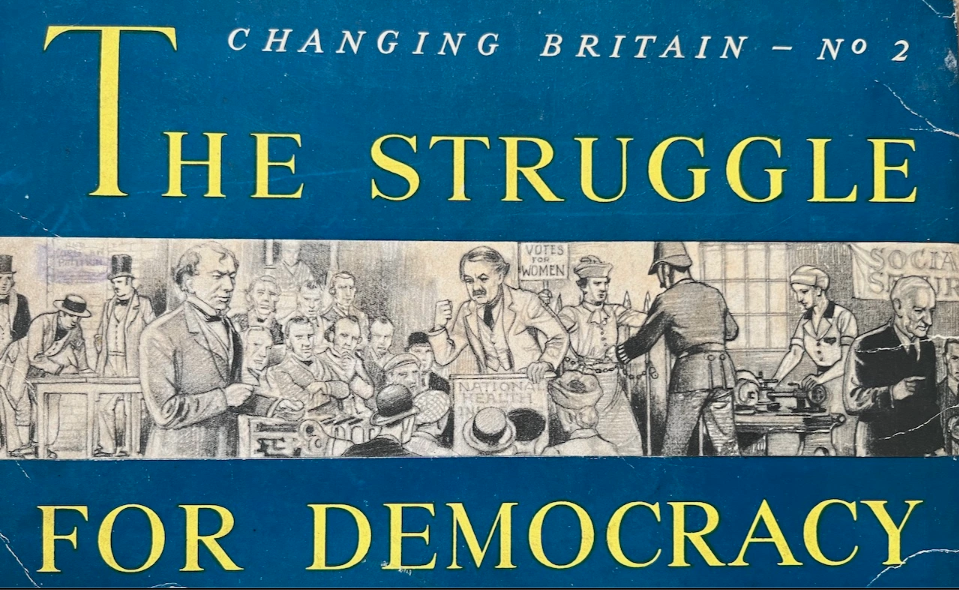
Above – The Struggle for Democracy published during WWII, which you can browse through here along with some other old publications from times when democracy was in even more trouble than today
This is one component I’d love to see Prof Mazzucato help make the case for: Lifelong learning (not least as a means for democracy education so that we know what we’re fighting to protect!)
If you are interested in the longer term future of Cambridge, and on what happens at the local democracy meetings where decisions are made, feel free to:
- Follow me on BSky
- Spot me on LinkedIn
- Like my Facebook page
- Consider a small donation to help fund my continued research and reporting on local democracy in and around Cambridge


