
The Head of Comms for East West Rail Stuart Ratcliffe-Jones gave an in-depth presentation on East West Rail at Rail Future’s annual Cambridge meeting, and also answered some questions on the Business Case issue
For the record, I’ve been in favour of re-connecting Oxford to Cambridge by rail for well over a decade – back in 2013 I asked Ed Miliband, then then Leader of the Opposition about on a visit to Cambridge.
Rail Future East is on FB here and is also at https://www.railfuture.org.uk/East+Anglia – if you want to see the slides drop them an email.
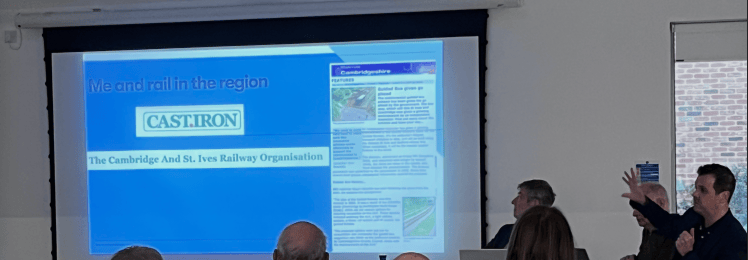
Above – A BBC reporter in a previous life, Mr Ratcliffe-Jones [with the wavy hands bottom-right!] was around to report on the Cambridge-St Ives busway alternatives including https://www.castiron.org.uk/
“Yeah – that’s great. What about the Business Case?”
In the Q&A I asked him to put front-and-centre what he had just told us that afternoon. In the meantime, see below:
East West Rail states:
“A full business case will be submitted to Government for approval before building can start. We expect an early version of our business case to be shared with government around the same time as we submit the Development Consent Order (DCO) for approval, but this will not be the final version.”
Above – EWR Business Case Q&A
Which means that the a draft version of the business case [which should have much of the substantive material people are looking for in it] should be made public
I’d be surprised if it wasn’t because people will want to examine the business case in order to inform their comments at the public consultation stage of the DCO process.
Mr Ratcliffe-Jones told us that since the planning work on East West Rail had commenced, Government policy had changed significantly. Things that were being quoted in the media about the low BCR did not incorporate things like:
- 1) The Universal Theme Park at Bedford that now has planning permission.
- 2) Proposed housing growth at Tempsford (New Town – note the problems and opportunities via the RPTI here) and Greater Cambridge (with the new Greater Cambridge Development Corporation)
- 3) The Government’s review of HM Treasury’s Green Book on infrastructure spending.
In principle those should improve the benefits while at the same time increasing the emphasis on factors that support the investment over those that do not.
Land value uplift – can we ensure that this is captured to help fund new infrastructure?
One of the things I’ve asked numerous public questions about is post-construction evaluation – both on housing and transport. Some of you may want to look at the evaluation of the Elizabeth Line / CrossRail in that context – in particular house prices and when the rises kick in.
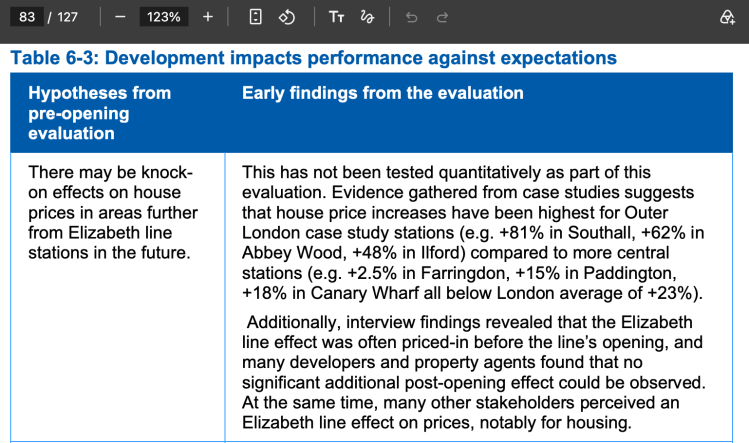
Above – Elizabeth line post-opening evaluation – Transport outcomes: full report (2025) Department for Transport / Transport for London, p83
The debate on the direction of entrance to Cambridge was closed *ages ago*
This remains an issue with some villages in South Cambridgeshire because they’ll get the line but no stations. I.e. incurring costs but no benefits.
It’s one of the reasons why I think the line between St Neots and Cambridge should be four-tracked so that stopping suburban services or light rail services can make use of the transport corridor without blocking the faster trains on the East West Rail line. Furthermore, with St Neots not being a ‘stop’ on the line, four-tracking the line would enable the stopping service / light rail service to terminate at St Neots. (If you want to see why having a stop at the existing St Neots Station was too difficult to design in at a reasonable price, see the map here)
East West Rail beyond Cambridge East Station eastwards, and beyond Oxford westwards
These are all outside of the scope for the company as things stand. It would take a change of government policy to bring in new things. That’s not to say people and organisations are not lobbying for this: they already are.
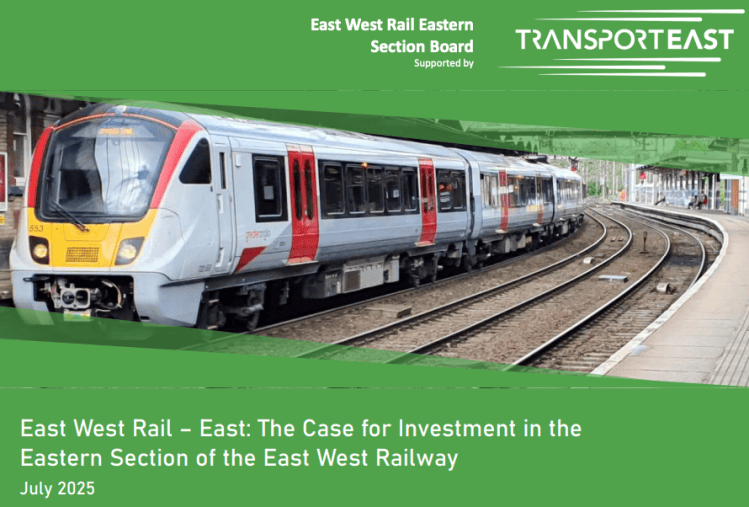
Above – East West Rail – East: The case for investment in the Eastern Section of EWR (2025) Transport East.
The document includes existing challenges including Ely Junction-related ones (£Half-a-billion needed for that major upgrade which includes upgrades for freight from Felixstowe
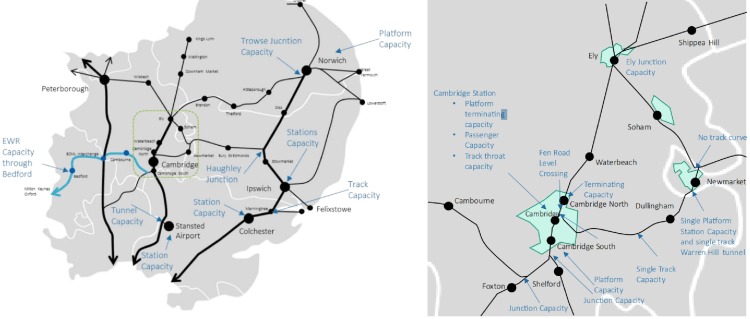
Above – EWR East (2026) Transport East, p28
The difference between services east of Cambridge and services south of Cambridge once EWR is complete, are stark. Up to 16 trains per hour heading out of Cambridge southwards, with just one train per hour heading out to Norwich, and one train per hour heading out to Ipswich.
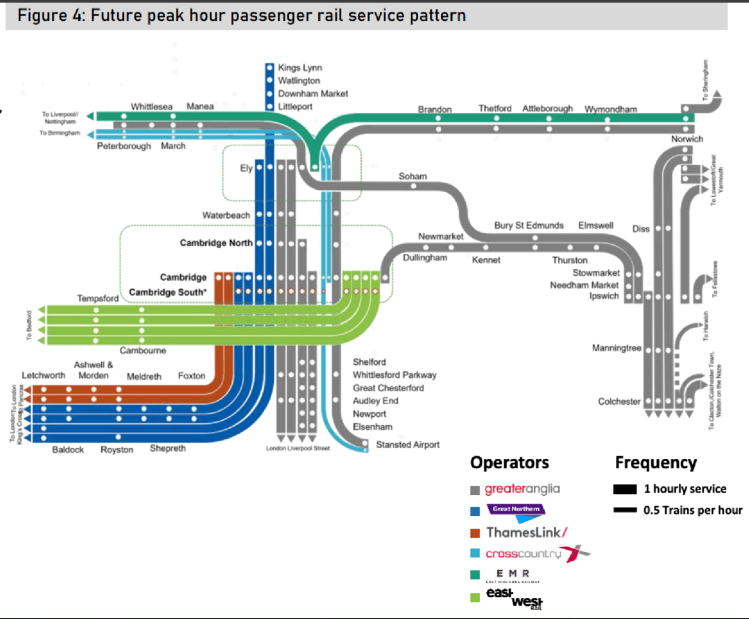
Above – EWR East (2026) Transport East, p16
Bedford and Northampton as landing spots for growing Cambridge firms
I had a look at this a year ago arguing that if ministers took the view that not everything needs to be in Cambridge (as I wrote in 2023 here) and that they could designate specific towns as ‘landing zones’ for firms that got too big for Cambridge and/or needed land/property to be more affordable, they could keep the ‘clusters’ benefits while at the same time improving rail connections to Cambridge. Hence picking Bedford (due to be re-connected via EWR) and further westward, Northampton.
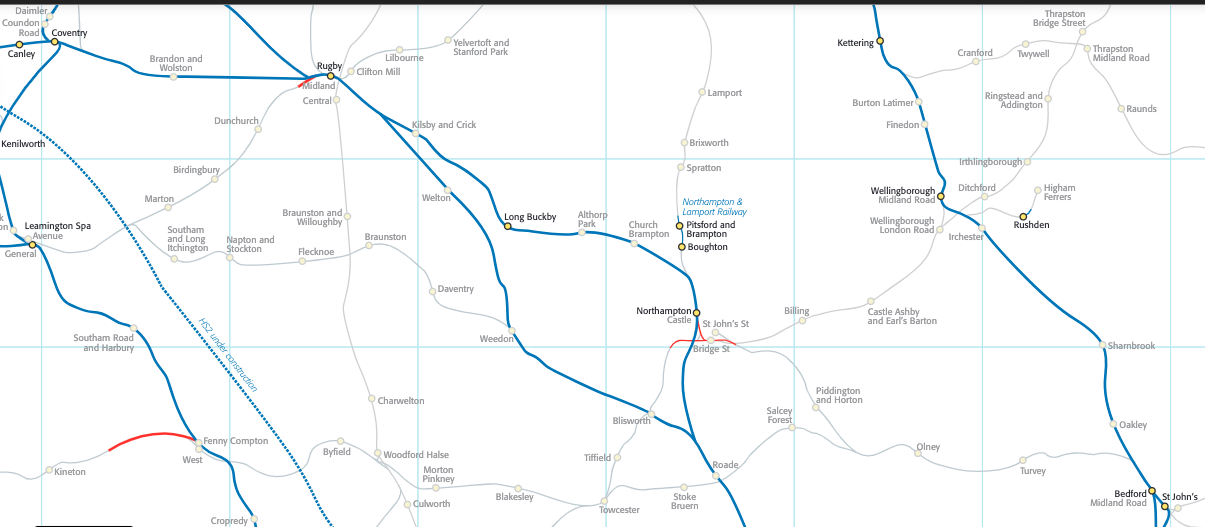
Above – The old railway map of England here from the New Adlestrop Railway Atlas “…shows that in principle there is an old rail corridor between Bedford and Northampton that could be revived (obviously depending on how much has been built over since Beeching’s cuts).”
But that would be for the people and politicians of Bedford and Northampton to make the case for. Two historic county towns with industrial riverside locations that may need/want investment in the future. Could it be done?
If you are interested in the longer term future of Cambridge, and on what happens at the local democracy meetings where decisions are made, feel free to:
- Follow me on BSky
- Spot me on LinkedIn
- Like my Facebook page
- Consider a small donation to help fund my continued research and reporting on local democracy in and around Cambridge


