“In Part 2, I’m going to go into how in my opinion civic arts and communal/collective music should have grown with the city but instead have gone in the opposite direction. (I wanted to write about that originally but spent too long in this post explaining the above!)”
…so I wrote at the end of my previous post.
Which means there’ll probably be a third part…
Some of you may recall the Lost Cambridge blogpost on the 1990s when the Cambridge Evening News put everything in one place on a named day every week.

Above – Cambridge Evening News 27 Aug 1998 in the British Newspaper Archive

Above – Cambridge Evening News 02 Dec 1994 in the British Newspaper Archive
It also covered clubs, gigs, stage, and cinema.
Which is why the closure of places like the cinema at the Grafton Centre and also the nightclub at the top of the Lion Yard are striking in the face of a city that has grown at the rate that it has done.
On how young people are being hit by the decline in provision – IPPR
The Institute for Public Policy Research published new research on growing up in the UK, and the results painted a devastating picture. One of the findings that struck me was the one on parties, dances, and discos.
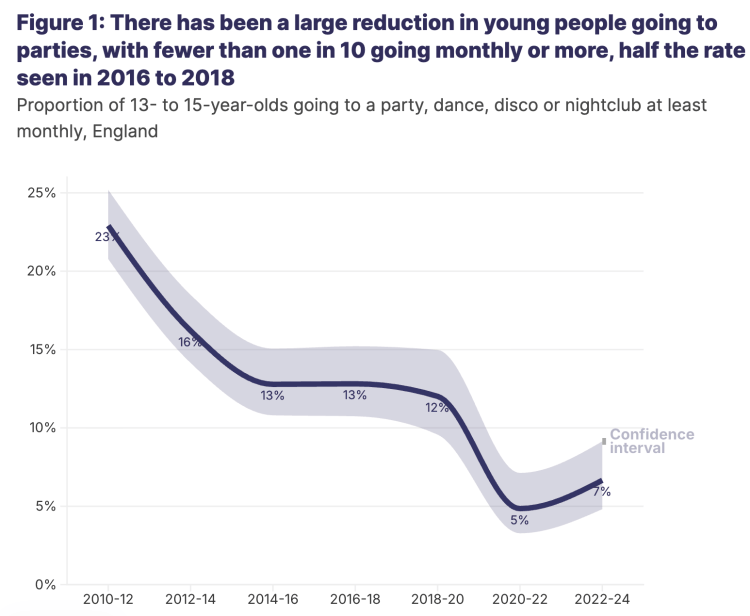
Above – IPPR Blog 25 November 2026
Why the arts – including performing arts, music, and drama all matter
Which is why the likes of The Fiver at The Junction are ever so important both for providing young musicians and groups the opportunity to play on a big stage, and as a venue for their friends to support them at. (See December’s line up here). Which is why more firms in Cambridge should be supporting the Junction.
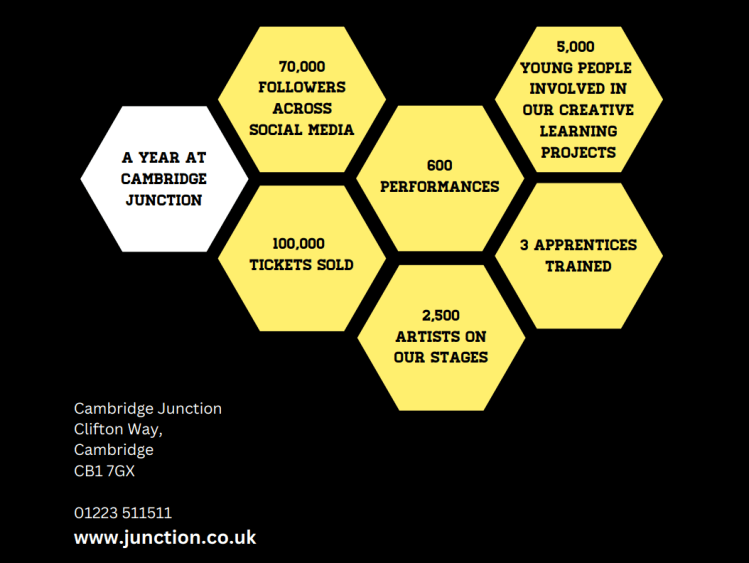
Above – from the Junction’s sponsorship page – See also individual supporter pages here
The case for a North Cambridge Arts Centre
Back in 2020 I wrote about how the old proposals for the Cambridge Waterworks Site (now abandoned) should have included a sister institution to The Junction. This could be something that the intensifying Cambridge Science Park could consider – one located close to the Guided Busway stop so as to enable residents in King’s Hedges to access the site easily.
Bring back the Big Weekend on Parker’s Piece
Last September I wrote that the new unitary council should bring this event back

Above – back in 2023 I wrote: “The cancelling of The Big Weekend represents a collective failure of Cambridge’s wealthy business sectors to support our city”
And while it remains that way, the lack of a big unifying summer event on Parker’s Piece will remain a stain on the reputation of Corporate Cambridge.
“What are the community institutions that bring people together – and keep people together?”
Good question – because in my lifetime in Cambridge (since the very late 1970s) the city has experienced the decline of traditional churches and work/employment-based social clubs. That’s not to say there haven’t been new groups and institutions emerging – especially those serving individuals and communities that have moved to the city to work in some key industries and sectors – especially health and social care. Furthermore, there’s something not working with the town and transport planning system when you see some groups having their Sunday services in old warehouses with really poor transport access. (And the inevitable car parking problems that arise). What should a city do when its residents of religious faiths don’t live and work around a small neighbourhood, but instead are scattered across the city and district? This is one of the reasons why transport planners should not restrict themselves into planning only for A-to-B commuter travel.
“What about non-religious people?”
Some of you may be old enough to remember the Sunday Assembly movement which briefly appeared in Cambridge (I wrote about it here in 2013) which had a brief spike in publicity in the early 2010s (See the BBC’s news report from 01 November 2013 here where it was erroneously described as an ‘Atheist Church’ – which may remind some of you of the Atheist Bus Campaign of the late 2000s) leading to the rapid rise and fall of Sunday Assembly branches. Only the London Sunday Assembly plus a handful of others are still going. There have been a number of interesting pieces of academic research such as those by:
- Rowena Blackburn – Exploring experiences of attending a non-religious congregation (2022)
- Josh Bullock – The sociology of the Sunday assembly: (2018)
- Rhiannon Grant / Ian Toombs – ‘Nones’ Belonging: Sunday Assemblies, Cathedrals and Quakers (2020)
- Hayley Jarvis – Religion-free church lifts your spirits (2018)
If anywhere should have succeeded in establishing and sustaining a Sunday Assembly local movement, you’d be forgiven for thinking Cambridge would have been ideal. But as with so many other places, organisations and community groups, the cost of premises and the time involved and expenses involved in organising and advertising proved prohibitive. That’s not to say they shouldn’t have tried. Instead for me it highlighted some of the problems that community groups and organisations in general face in a city with such a high cost of living. Amongst many other things (see what an AI came up with here).
Communities within the city – structures matching the colleges and Cambridge University?
The concept of Cambridge becoming ‘greater than the sum of its parts’ is something that I’ve long pondered over. Yet at the same time, I recall a conversation with a former local government officer who long-since moved away, who told me that Cambridge by its very nature is a fragmented one similar to how the colleges are their own internal communities which resist attempts by the University’s central management to tell them what to do.
That was back in the early 2010s (population around 125,000). We’re now heading into the late 2020s (population over 150,000).
One of the comments I had on my previous post highlighted that for a critical mass of people, things were going well. A vibrant school community for their children, active local community groups and active business/employment forums that put on events.
Given Cambridge’s inequalities, both can be right – for some the city can be a soulful and vibrant place. For others, it can be the opposite. Let’s look at the IPPR report agaion.
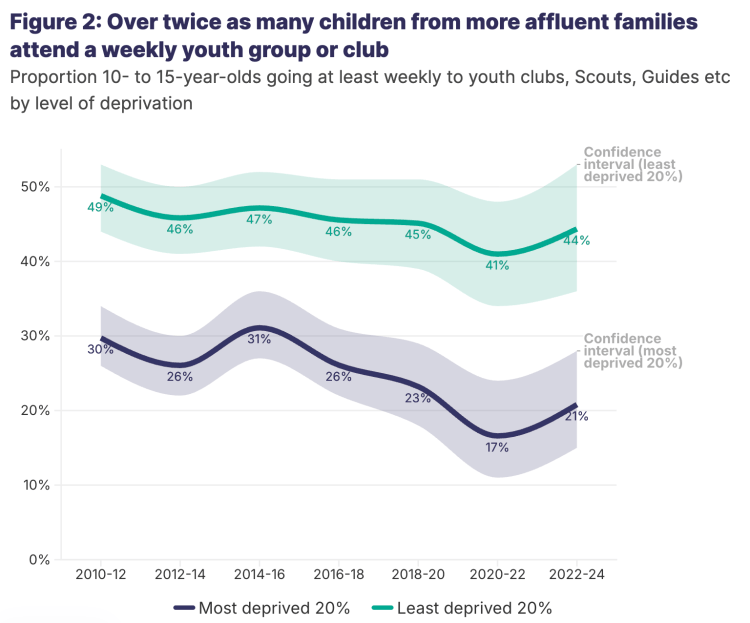
Above – IPPR 25 November 2026 – weekly youth club/group attendance
And this comment from one youngster a couple of summers ago still hurts re: lack of youth services provision
And I think one of the reasons why it still hurts even now was because I was one of those youngsters in the late 1980s/early-mid 1990s who didn’t have a council-run [i.e. secular] youth club to go to – only later finding out what positive difference it could have made to my life.
I was going to go into the civic arts and music bit but as predicted I wrote too much in this section – getting side-tracked. Again.
Sorry!
If you are interested in the longer term future of Cambridge, and on what happens at the local democracy meetings where decisions are made, feel free to:
- Follow me on BSky
- Spot me on LinkedIn
- Like my Facebook page
- Consider a small donation to help fund my continued research and reporting on local democracy in and around Cambridge


