On the Demos report of 25 September 2026 and why it is a challenge for a place like Cambridge
You can read the Demos report here. It has one really powerful statement emerging from focus groups that highlight the scale of the problems facing everyone, and it is this:
“Yet the prevailing sense was that the underlying drivers of fragmentation – from rising housing costs and population churn to political division and the retreat into technology – are so entrenched that society is set to continue drifting further apart, not back together.”
- Rising housing costs
- Population churn
- Political division
- Retreat into technology
I’m not going to say that Demos should have addressed all of these – there are existing reports that already do this. I’m at the stage where it feels like I’ve browsed through so many reports that similar to my own blogposts, they restate the same things with slightly different words over-and-over again.
Yet at the same time I found it tough to connect with the content because so much of the policy content sounds so familiar, and yet none of the institutions where I live are in a position to be making any of the suggestions below in the executive summary actually happen in real life across the city. (What action there is from local government is geographically and financially limited in scope to time-limited neighbourhood-level interventions).
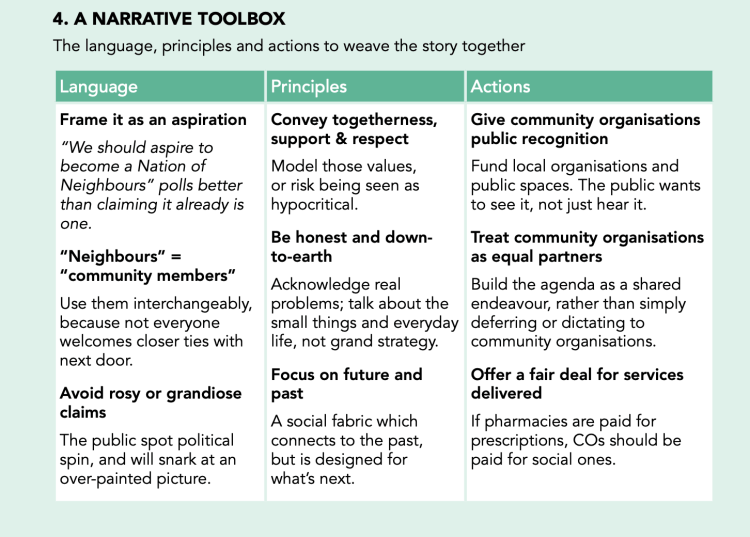
Above – Becoming a nation of Neighbours (2026) Demos p11
Rising housing costs and neighbourhood stability
I was struck by the sharp change in housing tenure between 2021-22 in the State of the City Report for Cambridge City Council published recently.
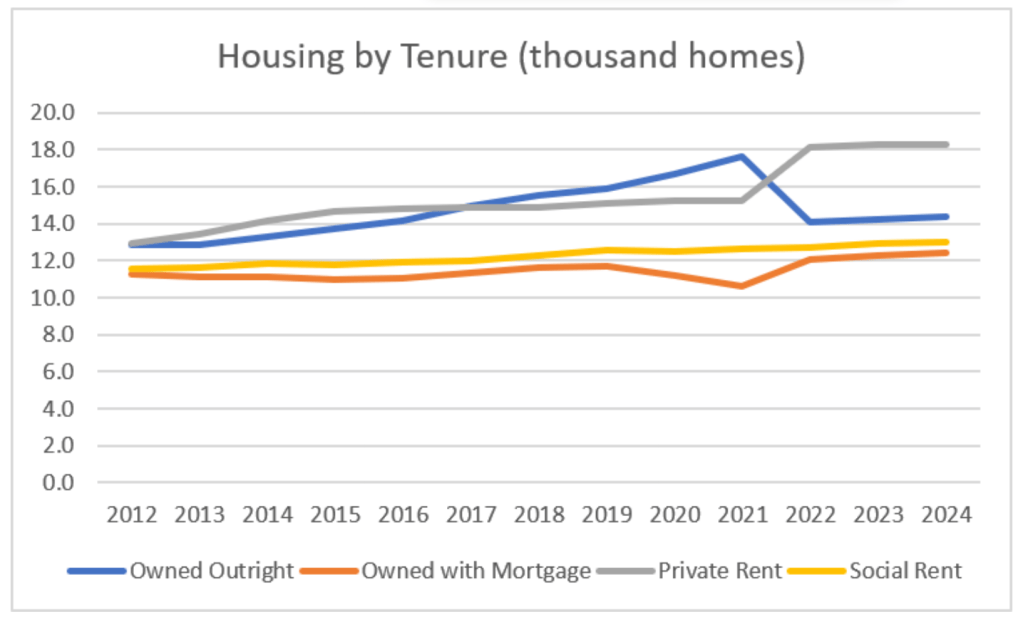
Above – Housing Tenure in Cambridge 2012-2024. State of the City 2026, p23 of the second report at item 12 here.
It’s as if 4,000 home owners had died during the pandemic and three-quarters of their properties had been snapped up by the property-owning class to let out as rental properties of whatever sort, while only a quarter had been bought by people wanting to settle down and put down roots – as reflected by the rise in homes owned with a mortgage. It’s a very blunt observation because of the number of ‘buy-to-let’ mortgage deals on the market. It’s not clear to me how this unwinds and I don’t have the headspace on a Friday night to look it up after playing the latest UK Edition of Cards Against Humanity at the Empty Chairs event at The Handsome Prince. (Lewis convenes it on the last Thursday of every month. Orange t-shirt, long brown hair, you can’t fail to spot him).
Population Churn
Does the jump in rental properties correlating with the fall in owner-occupied housing reflect some of the more recent churn in population? In South Cambridge the changing demographics has been very noticeable, with a much more international local population compared with a few decades ago. It’s something that has positives and negatives depending on who you ask and what their experience of those changes has been. For example on the positive side some community institutions and places have become more sustainable as new residents have made use of them. On the other hand we don’t have the solid shared social institutions that enable new arrivals and long-term residents to get to know each other. Hence the Soft Edges report as part of the Building Communities case studies from Humanise is more than relevant here.
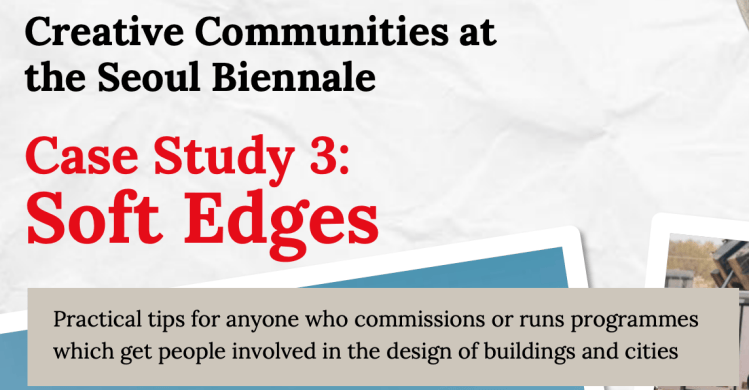
Above – Soft Edges by Humanise (2025) – part of their Building Communities case studies
Population churn from a student perspective
I still carry the chip on my shoulder from my university days even though next year will be a quarter of a century ago since I graduated. And my negative experience is something that has tainted my view of the entire sector ever since – not least because I’ll never be in a position health-wise to pay off my student loan. Which makes me wonder how many former students (irrespective of whether they graduated/dropped out) feel a similar sense of neurodiversity-rage that I do. (My social media feeds get bombarded with such content of people with neurodiverse dispositions with strikingly detailed takes of their experiences in higher education and life more generally).
It was that population churn that made it impossible to settle – combined with the disinterested take from university staff and executives about the housing crisis they helped cause by expanding numbers far beyond what they had the capacity to accommodate themselves. On top of that, they did not have the administrative capacity to support students (a critical mass of whom were from other countries, paying full fees, and living abroad on their own for the first time). While my experience was far from unique, I noticed when I returned to Cambridge how it shaped a person’s sense of belonging and also loyalty towards their university institutions later in life.
The fight between local residents on low incomes that are not low enough to qualify for social housing, vs students (anecdotally preferred by landlords for a variety of reasons including the council tax exemptions, and also by developers/speculators of purpose-built accommodation which has fewer, profit-absorbing requirements in law) was one of the most depressing things I have witnessed – something that increasingly enfeebled local councils have had little power to do anything about. Not least because local government has no power to restrict the number of students an educational establishment can enroll. (Question: What would it look like if local councils were given strong powers to limit the number of students that institutions (universities, higher education colleges, private ‘cram’ colleges, and language schools etc) could enrol each year as a percentage of housing available to different groups in their area of control?) As I asked back in June 2026, is Cambridge University’s continued expansion unsustainable?
Political tensions
In Cambridge (town as opposed to gown) the tension is mainly between the long-established Cambridge Labour Party (still leading the city council but no longer in full control as it was between 2014-26 to the May elections) and the rapidly-rising Cambridge Green Party, with the Cambridge Liberal Democrats effectively having declined back to their core strongholds while conquering all in South Cambridgeshire District. Fortunately we have not seen the party-political extremes on the right that Fenland saw when the Conservatives lost almost all of their county councillors to TeamNigel in that part of the county in 2025. Nor have we seen (so far) the worrying rise of street movements, the limited responses of which from the police and ministers have been alarming. (And also something to watch for with Labour’s annual party conference starting on Sunday (You can read the party’s conference guide here – note who is sponsoring which debates!)).
Retreat into Technology
To be fair to Ed Miliband the new Foreign Secretary, he has put both the risks of technology and also climate change front and centre of his very public speeches – highlighting the need for international regulation and international political agreements of both. On the technology side, again I was struck by how few Anglia Ruskin students were out and about in Cambridge (they started arriving nearly 2 weeks ago) compared with previous years. Yet when you look at the cost of technology combined with the imbalance of student loans and rents – leaving little left over, and put that against the cost of drinks in city centre venues, it’s not hard to see why spending habits have changed.
Part of the retreat into technology has also been the rise in subscription-based TV, a very different world to that of four TV channels. The comprehensive subscription packages of sports and cinema start at over £60 per month. Which might be the same as a couple of nights out at best when you think food, drink, and transport.
The root causes which the DEMOS report does not go into detail about, is something that cannot be solved by a single nation state on its own. This was one of the messages that Andy Burnham put out on his social media feeds such as here on IG when he was in New York prior to the General Assembly of global Heads of Government. He’s learnt from his predecessor that on communications, he cannot rely on the existing broadcast media and print press institutions to communicate his messages to the public. He has to do it himself and directly. Not only that, the content *and* delivery has to be sound as well – as do the production values.
Social responses to shared challenges
One thing I’ve mentioned in Lost Cambridge – my local town history blog is how political parties used to organise and host multiple social events throughout the year. Major political figures in national politics of those eras would turn up to some of these – such as the Countess of Warwick rocking up to the Romsey Town at the old Romsey Labour Club back in 1925. In the current climate I can understand why politicians might be wary about organising social events. Which is why it’s striking to see a very full events calendar for the Cambridge Green Party. Normally it’s the students’ societies that organise events and they rarely go beyond student circles. Something which I think is a shame for young adults who are not students in Cambridge. (What would it be like if students’ societies made more events open to town residents aged 18-25?)
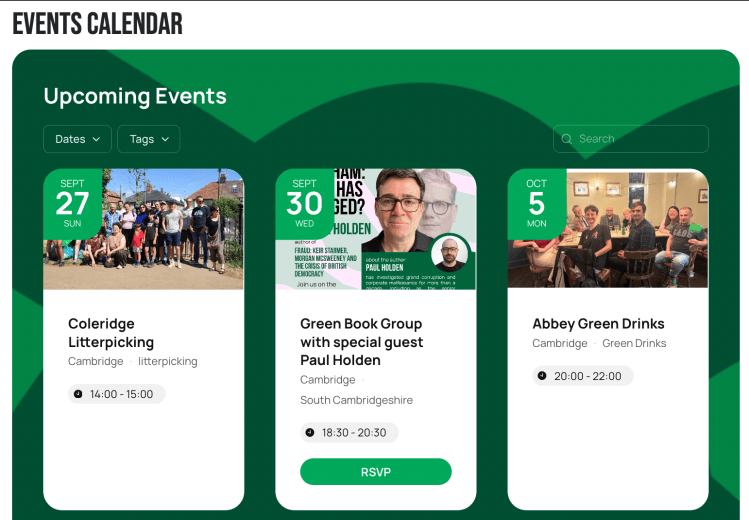
Above – a snapshot of the Cambridge Green Party’s event calendar Sept-Oct 2026 – note the variety of activities from being out and about in communities, public talks, to social drinks with the latter covering a wide geographical area in residential neighbourhoods
A big picture alternative – the Common Good Economy
I’ve lost count of the times people on telly/the internet have said that ‘We are living through a historically significant era of major change – and such changes are rarely peaceful and stable’
Which is nice to know.
What we definitely don’t know is what will happen after the dust has settled, let alone what we should be working towards.
Prof Mariana Mazzucator of UCL has published a book called The Common Good Economy which she will be speaking about at the Cambridge Literary Festival on 21 November 2026 at the Cambridge Union.
Browsing through the chapter headings alone shows that the book is well worth reading – part 1 from her substack page highlighting:
- Purpose & Directionality: Setting a clear direction or mission, proactively aligning activity towards collective goals.
- Co-creation & Participation: All stakeholders at the table deciding what the common good should be and working together to make it possible. Genuine interfaces between public, private, and civil society.
- Collective Learning & Knowledge-Sharing: How we embed shared learning in governance structures: IP rights, open access platforms, institutional capacity to learn together.
- Access for All & Reward-Sharing: Redistribution and pre-distribution policies are critical for equitably sharing risks and rewards.
- Transparency & Accountability: The enforcing pillar. Without visibility and accountability, the other four cannot hold. Openness is not optional.
Above – Mariana Mazzucato: Common Good Economy – A New Compass
Alternatively, have a watch of her short video clip here
If you are interested in the longer term future of Cambridge, and on what happens at the local democracy meetings where decisions are made, feel free to:
- Follow me on BSky
- Spot me on LinkedIn
- Like my Facebook page
- Consider a small donation to help fund my continued research and reporting on local democracy in and around Cambridge


