
Some of you may have seen the recent headlines about their recent Ofsted Report. The community should not have to face their challenges alone
In one sense, the contrast could not be greater. Geographically Orchard Park, an urban extension to Cambridge that administratively sits outside of Cambridge City Council’s boundaries, also has Cambridge Science Park as a neighbour – see their recent planning application here. The latter is owned by one of the wealthiest land owners in the country – Trinity College Cambridge.
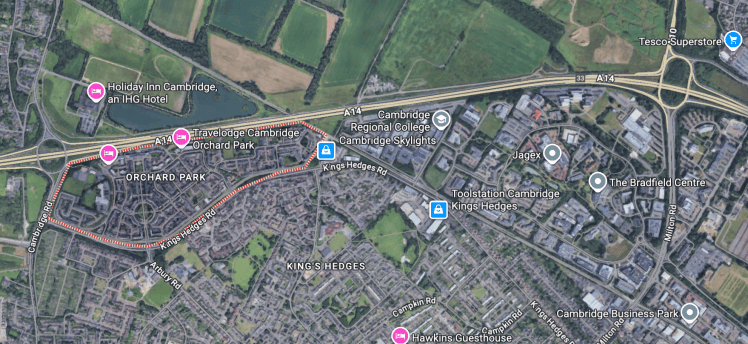
Above – Orchard Park on G-Maps, with the traffic-filled A14 to it north, and Cambridge Science Park to its east. It is enclosed by a combination of the A14, the Guided Busway, King’s Hedges Road, and Histon Road/Cambridge Road.
Which institutions are responsible for ensuring a more equitable distribution of the wealth generated in and around Cambridge so we avoid situations that core institutions such as Orchard Park Community School now find themselves in?
Orchard Park Community School in special measures
You can:
- read the news article that may have alerted you to the news
- the update from Cllr Ros Hathorn (LibDems – Histon, Impington, & Orchard Park)
- the statement from the school
- the report from Ofsted from the regulator’s website
- see the Orchard Park Community Council website (which in effect is an urban parish council as South Cambridgeshire is parished, and Cambridge City is not)
- Go along to the People’s Assembly event at Orchard Park Community Centre on 04 Oct
Orchard Park – like many Cambridgeshire schools, is historically underfunded
Cllr Ros Hathorn wrote the follow in her newsletter:
“I want to add, Orchard Park has some quite significant challenges. Although effectively a city school it suffers from the same challenges a rural school has in terms of budget and numbers of students. Budgets are set based on one day a year and if some children are away on that day it has a significant impact on next years budget. Put simply balancing the books and covering the costs for a single form entry school is really hard.”
The school also has a higher-than-average number of children eligible for free school meals
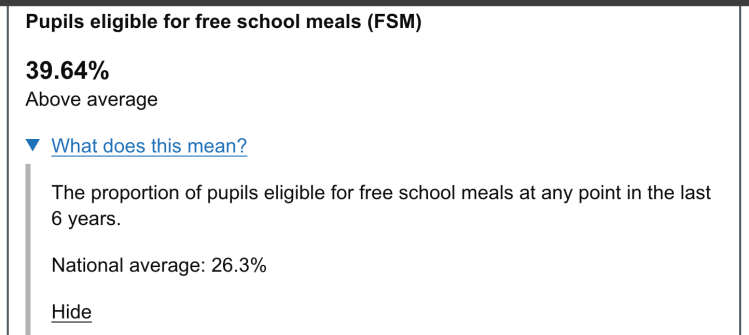
Above – Source: Ofsted
“What does it look like for a city to support a school to come out of special measures?”
I don’t know – but it would be good to have some publicly-accessible case studies to hand. (Ideally we’d have a big local history section in a very large public library that might store such reports in a ‘contemporary issues’ sub-section!)
Orchard Park matters because it is still a relatively new community – the primary school opening as recently as 2007. I hope the news of the OfSted report and designation will help concentrate the minds of those in philanthropic local civic circles such as Cambridge Pledge to come up with something that involves working with the local community to support the school as it recovers.
Post-occupancy evaluations matter
With the school approaching its 20th anniversary next year, that might be a good time to undertake a post-occupancy evaluation for the school – and maybe even the wider neighbourhood. Emma Cooke of the Quality of Life Foundation wrote how important such evaluations were in response to the Newtowns taskforce’s interim report – which I covered here. One of the early evaluations on Orchard Park for Cambridge City Council dated June 2009 is titled:
“Review of the Orchard Park Development and
Lessons to be Learnt for Future Major Developments”
The headings of the review are:
- Connectivity (transport)
- Community
- Climate
- Character
- Evaluation against Quality Charter [Cambridge Quality Charter for Growth – part of the old Cambridgeshire Horizon’s organisation)
How does the development read against that report nearly a generation later, where newborn children in Orchard Park in the late 2000s who stayed in the area are now older teenagers/young adults?
It’s even more important for the future communities in an expanding Cambridge – mindful of the recent speculative application put in by Pigeon Land and chums for a development of 4,000 new homes around Shelford Rugby Club? Because there are some striking similarities (as well as some clear differences)
Similarities and differences between Orchard Park and Pigeon Land’s Shelford plans
Similarities
- Both are very close to a major sci-tech park
- Both are in effect ‘urban extensions’
- Both have major multi-lane roads that form a barrier to countryside access and further housing growth/provision of community facilities – the barriers also being major sources of noise and pollution
- Both have historic parishes nearby
- Both have newly-built developments nearby
- If a tram/light rail system is built for Cambridge, both could easily have stops built for them (in the case of the former replacing the busway stops, and for the latter along the railway line to Royston).
Differences
- One’s on the northern edge of Cambridge, and the other is on the southern edge!
- Orchard Park borders on King’s Hedges Ward – one of the most economically-deprived in the whole of Cambridgeshire. The land around Shelford Rugby Club has very expensive newbuild homes on one side, and very expensive older houses on the other.
- Orchard Park’s urban footprint extends right up to the A14, while the proposals for the latter indicate an open green space will form a barrier between homes and the busy motorway that is the M11
- Orchard Park should [in my opinion) have had provision for and easy pedestrian access to major sporting facilities included for it in the Darwin Green developments (See Histon and Impington Hub here). Eg in the form of a wide, gentle green bridge over Histon/Cambridge Road. With the latter, I expect new facilities will be attached to the Rugby Club.
Your chance to meet the developers in Great Shelford:
The developers got in touch with Great Shelford Parish Council with an invitation which you can read here.
“Have your say: Join our consultation events to learn more and share your views on Cambridge South.
- Monday 5th October from 3pm to 7pm
Shelford Rugby Club, Cambridge Rd, Great Shelford, CB22 5JJ
- Saturday 10 October from 10am to 2pm
Little Shelford Memorial Hall, 13 Church St, Little Shelford, CB22 5HG”
Above – from latest news item from Great Shelford Parish Council
Would be great to see other people going along and writing blogposts, articles, and producing videoclips and vlogposts on what they think about the plans – and on the future of Cambridge more generally. (Even I get bored of the sound of my own moaning!)
If you are interested in the longer term future of Cambridge, and on what happens at the local democracy meetings where decisions are made, feel free to:
- Follow me on BSky
- Spot me on LinkedIn
- Like my Facebook page
- Consider a small donation to help fund my continued research and reporting on local democracy in and around Cambridge


