First Secretary of State Louise Haigh of Cabinet Office said at the Labour Party Conference earlier, the concept of Total Place will be returning. It has to go beyond pooling budgets and ensuring that the organisations, governance, and administrative arrangements are in place too
You can watch Louise Haigh’s speech here
It’s easier to explain the concept when things go wrong. Like in Bottisham.
Village pays £16,000 for new bus shelters only for bus service providers to pull the bus services they were built for
You can read the story here. That’s an example of the opposite of Total Place: one provider looking at their bottom line and making decisions based upon that, while another looks at their collective needs and making decisions assuming that a service provided by someone else will continue – having no influence on said service.
Youth centres – the classic cases of centres being built but councils having no funding to open them

Above – from my teenage years in Lost Cambridge here, where by that time very few places had any youth service provision. In hindsight I never really knew what a ‘youth club’ was – which 30+ years down the line shapes my perceptions of politics today.
Total Place 2.0
I wrote about it here – the first version was introduced when Professor John Denham, the former Communities and Local Government Secretary in Gordon Brown’s Government introduced it in 2009-10, before Eric Pickles of the Conservatives scrapped it. It also helps explain *why* we’re going through local government re-organisation. Pooling budgets, people, and resources is much easier to do if different parts of the state work to the same boundaries.
“Don’t they?”
No – and Item 3 of the up-coming Cambridgeshire & Peterborough Health and Wellbeing Board of 02 October 2026 will show this.
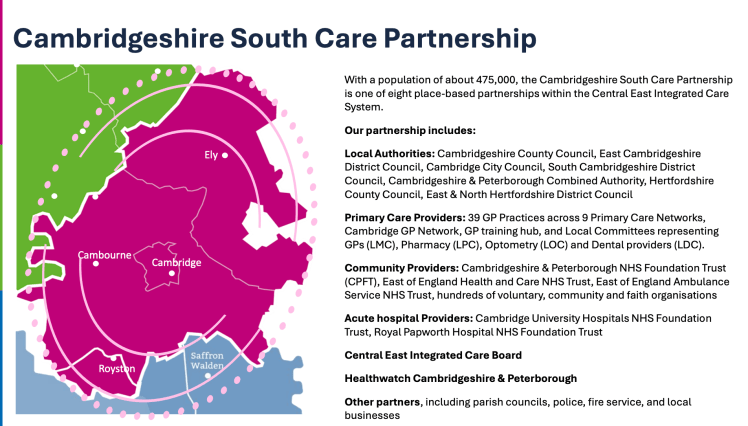
Above – Item 3, Annex 5, page 3, showing the boundaries of the Cambridgeshire South Care Partnership
“I didn’t know we had a Cambridgeshire South Care Partnership. Or a Wellbeing Board for that matter”
Well you do now.
What makes things messy from a local government perspective is having towns that are over the county border (i.e. Royston) included for healthcare. They were given the choice to become part of Cambridgeshire back in the 1880s (as was Newmarket) in the run up to the Local Government Act 1889, but both declined.
Government confirms in-sourcing as new public policy, bringing back cleaning and catering contracts back in-house
…rather than contracting out to mega-corporations headed by highly-paid executives
This was one of several major announcements from Ms Haigh which you can read here. This makes me wonder if we will see similar with local government. For example the provision of leisure facilities owned by Cambridge City Council, which are currently outsourced.
Another further move from ministers is with empty buildings
“The changes will reduce the period a property must be empty before it becomes eligible for an EDMO from two years to six months, allowing councils to act sooner where homes have been left vacant and preventing properties from falling into serious disrepair.”
Above – GovUK Press Release 27 September 2026
“Which reminds me – progress update with the Hobson Street Cinema Building?”
Anyone want to ask Cambridge City Council a public question on this?. There’s a full council meeting coming up this week – see the agenda here for Thursday 01 October 2026.
Petition to Cambridge City Council on the impact of Growth
The petition I wrote about back in July here is going to be debated at the full council meeting above. You can read the full text of the petition here, which was signed by over 1,900 people
“We need to look at the combined effect. Transport schemes, road changes, housing developments, laboratories, offices and changes to the city centre may each have their own justification. But when they are all added together, what does Cambridge look like and how does it work for the people who live here?”
“Many residents believe that question has never been properly and independently answered.
“That is why this petition calls for a full independent review of the overall impact of transport policies, planning decisions and major developments on the future of Cambridge.”
Above – Petition to Cambridge City Council for Full Council 01 October 2026
This is similar to the question I asked about transport impacts with the multiple transport assessments that developers pay consultants for in support of large planning applications. (See my blogpost from June 2026 here). This reminds me of a more recent blogpost where I mentioned the controversial Forest City project
Other groups have raised the cumulative impact as well
Cambridge Past, Present, and Future questioned the doubling in size of Cambridge – in 2025 they asked:
- “how the services and infrastructure that will be needed to support this rapid level of growth can possibly be provided?
- “How will our hospitals and health services cope?
- “What about traffic congestion?
- “Or the city centre streets already full people?
- “And where will the water come from?
“These are legitimate questions that the plan, our councils and government will need to answer if it is to be approved.”
And in one of the early consultations back in 2020, Histon Road Residents Association included it in their response.
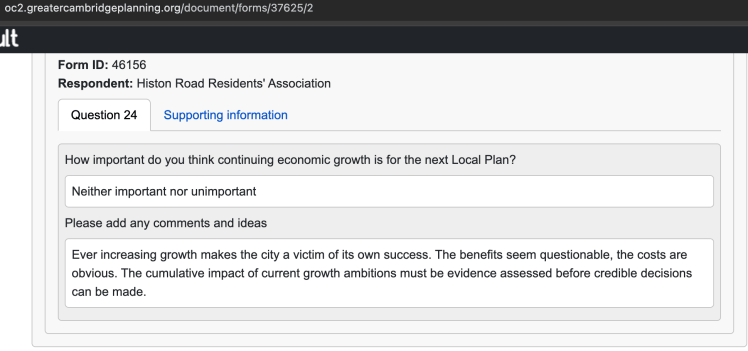
Above – from Greater Cambridge Shared Planning, 2020 issues and options consultation
“The problem nobody owns: cumulative impact”
So wrote Joe Reeve of the Forest City consortium on 20 September 2026 (today!)
He continues:
“Every piecemeal option shares one flaw. Each application is judged on its own, so nobody is responsible for the total.”
While there are units in Whitehall responsible for government policy on the future of Cambridge, it’s not clear to the general public which senior civil servant has been tasked by ministers to manage the cumulative impacts. And if you are a director-level senior civil servant, public profile comes with the salary. It should not be a more junior civil servant taking the heat for it. And where decisions have been taken / directions have been given by ministers, those should also have much higher profiles. (That way the general public know when to contact their MPs to hold ministers to account for those decisions and directions).
The way I am looking at cumulative impact is in the context of very large facilities and amenities. i.e. sub-regional level and scale that cannot be provided for at a local or neighbourhood level – or even a large town/small city level. Very large indoor arenas (see the list here) with minimum capacities of 5,000 people are one example.
“What chances are there of a major independent review?”
While I don’t think the powers that be (ultimately central government) will grant the full independent review, the petitioners’ challenge is a reasonable one – one that tells ministers they need to set out what they think Cambridge will look like once the major works are completed. I can see consultants being appointed to produce a report, but not one that involves public hearings of the like we saw for the C2C busway.
“Sounds a bit like Cambridge 2065 to me!”
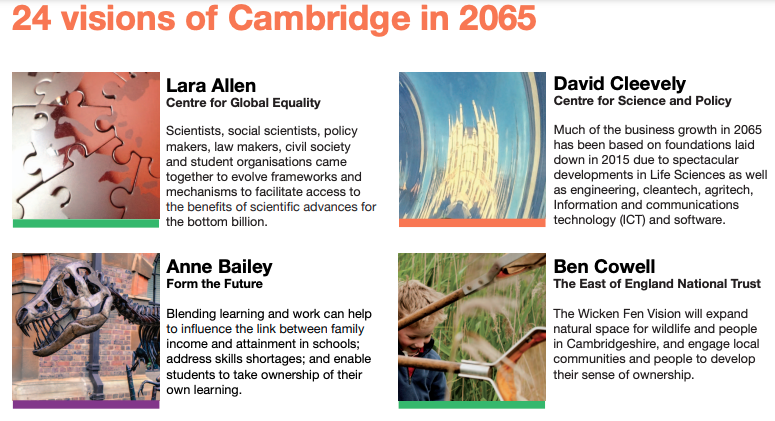
Above – The visions of Cambridge in 2065 document which was published in 2014. I wrote about it in this earlier blogpost from 2021
That blogpost talks of Cambridge 2065 in a climate emergency. But even then I didn’t have visions of forest fires and wildfires in the UK in the midst of an extended drought with heatwaves interspersed. The blogpost also highlighted some of the responses to the call for sites for the draft local plan which will get sent to ministers for the Planning Inspectorate’s Examination in Public. This is where the public get to find out (if someone’s listening and keeps a check on who says what!) which major landowners are upset that their application to build on valuable land has not been included. One feature of the last round was the number of educational establishments – both university and private, wanting to build on green spaces that they included photographs of in their publicity to prospective students (or rather their parents!) about the green spaces students enjoy!
Keeping track of the updates
One of the submissions not included was this one for ‘New East Cambridge’ that I had covered in a previous blogpost, and which has since been updated here (see the ‘supporting evidence’ tab and scroll down to the most recent documents circa 2025). It says:
“An initial capacity testing exercise identifies that the Cambridge East Expansion Land
could accommodate in the region of 2,750 – 3,250 new homes and 2,000 jobs”
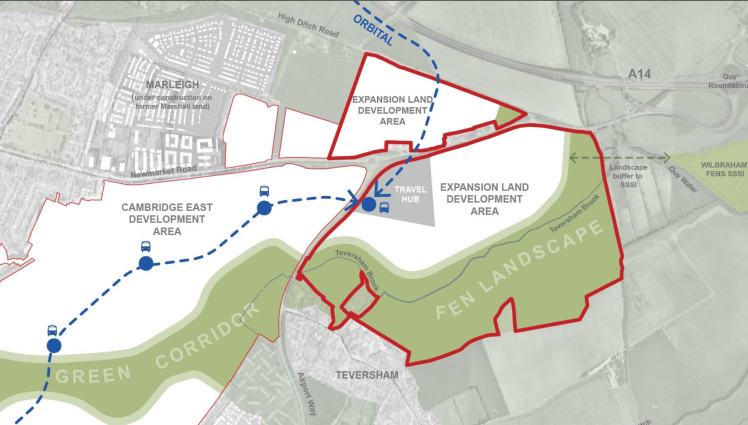
Above – New East Cambridge (not included in the draft local plan), figures from p23
The evidence base from the developers was refreshed to incorporate the new Cambridge East Station and a potential link-up with Cambridge North Station that had been a concept dreamt up in a previous local planning phase.
Cambridgeshire and Peterborough’s new neighbourhood approach
There’s a very blurred diagram on Item 3 App 5 p6 of the Health and Wellbeing Board’s papers.
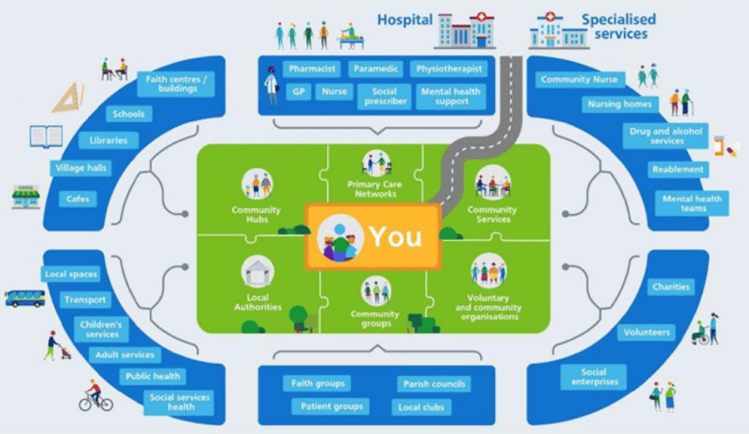
Above – from Cambridgeshire and Peterborough’s Wellbeing Board 02 October 2026 Item 3 App 5 p6 – their neighbourhood approach
Conceptually it’s great – the sort of thing I was used to seeing in my civil service days by people and organisations that had put in the effort, by putting the individual resident at the centre, rather than starting with the government at the top of a top-down chart.
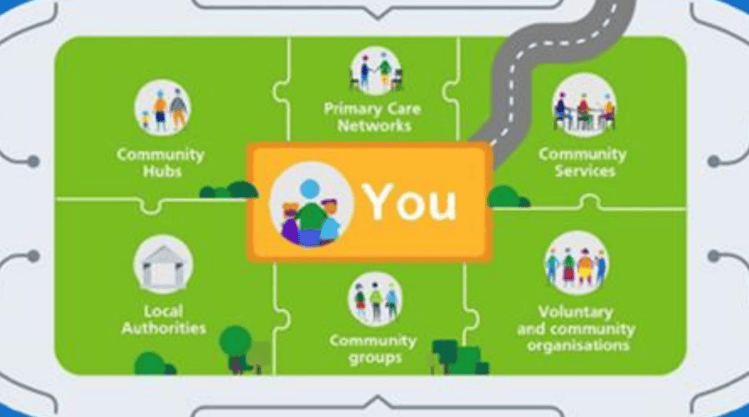
Detail of the earlier snapshot
What do you do if most if not all of the six in the above diagram are broken after 15+ years of austerity?
This is where the town planners need to be crystal clear on what the shared problems are, and who else is needed to solve them.
That wellbeing board paper needs more scrutiny because paradoxically by listing all of the components of their neighbourhood approach, they have also identified where lots of the existing gaps are – gaps which are not necessarily within their remit (or competency) to resolve, but which are essential to their success.
Food for thought?
If you are interested in the longer term future of Cambridge, and on what happens at the local democracy meetings where decisions are made, feel free to:
- Follow me on BSky
- Spot me on LinkedIn
- Like my Facebook page
- Consider a small donation to help fund my continued research and reporting on local democracy in and around Cambridge


