The Government confirmed a new public inquiry for the controversial CSET Busway in early September 2026 – but why have so many objectors criticised the GCP and its consultants over poor communications and consultation?
You can read:
- The core documents for the CSET inquiry here
- The statements of case from the applicant and those parties with interests including the objectors here
- Go along to the Greater Cambridge Partnership Assembly meeting on 15 October 2026 at Cambridge Guildhall, remembering to table any public questions in advance. (Especially if they relate to issues in the CSET Public Inquiry papers that criticise the GCP)
Cambridge’s south eastern transport proposals were originally meant to connect Haverhill, but in the end have come to an abrupt halt at the A11 where the planners have identified a new settlement proposal near The Abingtons and Granta Park – which I wrote about in November 2025 here.
CSET – Cambridge South East Transport…it goes back to the mid-2010s
I moaned about it here having opposed the proposals for a bus-based solution (and in favour of a rail-based solution that made use of the existing disused Cambridge-Haverhill railway) for over a decade. Or rather it felt like I spent the whole of that decade being ignored – which is sort of standard for me when it comes to transport infrastructure. Pro-roads-highways engineers have a 100% record against me it seems!
Groups objecting in the statements of case here include:
Cambridge Ramblers: “We are objecting to the inadequate provision for footpaths in the CSET Order, both public rights of way and permissive or customary footpaths”
Cambridge University NHS Trust: Supporting the principle, but have issues with details and delivery, including impact on parking and cycling, and access to emergency service vehicles.
Haverhill town council and ONE Haverhill Partnership: They quite understandably want the old route reinstated with a rail-based alternative. They have suggested small changes to the busway in the event it is approved – one that ‘future-proofs’ the design enabling it to extend to Haverhill.
Rail Future East: Challenging the busway on multiple grounds, including some of the issues I included in this blogpost which originate from Rail Future East.
AstraZeneca: “Since 6 March 2025 when the objection was submitted there has been no
engagement by Cambridgeshire County Council and the Greater Cambridge
Partnership.” AZ p6 Para 4.2
Fen Line Users Association: “We consider that a preferable solution to congestion in the A1307 corridor would be reopening the railway to Haverhill, which was recently assessed as “a good case for future development” by the Restoring your Railways scheme.” FLUA p1 para 2.1
West Suffolk District Council: Objecting over the design and lack of future-proofing
Wellcome Genome Campus Ltd (WGCL): “WGCL believe that the Cambridge South East Transport (CSET) Scheme objectives would be more fully realised, particularly those related to supporting economic development in the Southern Cluster, if the scheme were extended beyond the proposed Travel Hub to the Campus and onward to Whittlesford Parkway Station.” WGCL, p3
Network Rail: Objection over CSET compromising Network Rail’s statutory duties to project railway infrastructure.
Mayor of the Cambridgeshire and Peterborough Combined Authority Paul Bristow: Incompatible with his Light Rail manifesto commitment. Also objects on Value-for-Money grounds. “CSET is categorised as offering low value for money under Department for Transport guidelines. Initial assessment suggests that adapting and extending CSET into a light rail, life sciences line would bring far greater benefits.” CPCA p3
“So the Greater Cambridge Partnership has managed to kick sand in the face of AstraZeneca and others by not replying to their correspondence? That’s a bold move!”
Something like that. Either way, many of the objections could and should have been resolved much earlier in the process. After all, ***they had ten years*** to get their proposals together.
It appears that formal correspondence ended in March 2025 – a date mentioned by several of the objectors.
Why the Greater Cambridge Partnership or its consultants did not respond I do not know. Something some of you may want to pick up at the GCP’s assembly at Cambridge Guildhall on 15 October 2026 – remember to table your public questions in advance! I stopped engaging with the GCP and stepped back from covering its actions back in September 2024 – this blogpost explains why.
Haverhill Town Council’s proposed future-proofing amendment.
It makes sense given past form shows that ministers are prepared to approve schemes that their own inspectors made huge criticism about – such as the C2C busway which planning inspectors said won’t reduce congestion east of Grange Road. Therefore best to suggest amendments that might make it easier to provide for something else later on down the line. Or busway.
Below – AI-enhanced (Sorry! It was a very blurry diagram!) from p5 of Haverhill Town Council’s submission
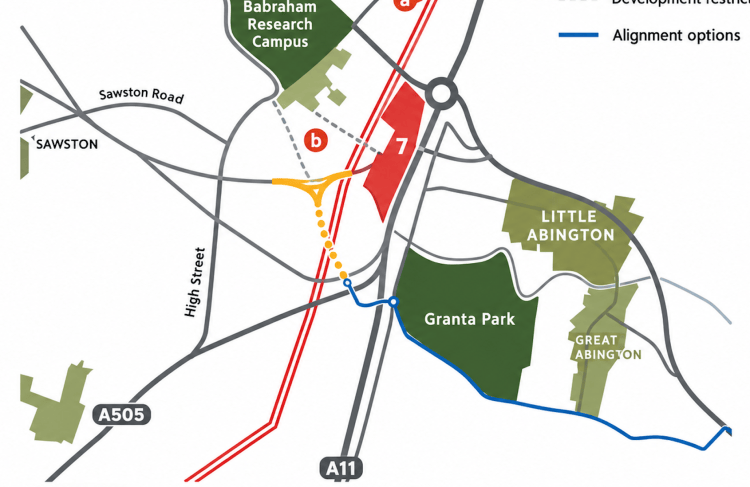
Significant concerns from The Pemberton Family (major land owners)
“Lack of Engagement and Failure to Take Reasonable Steps to Acquire the Land by Agreement”
Above – Pembertons p6 para 5.3
I don’t understand why so many of the key stakeholders (whose co-operation is essential to the success of the busway proposals) have been managed so badly by the GCP. Something has gone very badly wrong with their relationship management. Given that so many of them have raised poor communication and consultation as an issue, the problem is institutional with the GCP. Elected councillors on the GCP Assembly really need to call out the senior managers of the GCP on this.
Over to you.
If you are interested in the longer term future of Cambridge, and on what happens at the local democracy meetings where decisions are made, feel free to:
- Follow me on BSky
- Spot me on LinkedIn
- Like my Facebook page
- Consider a small donation to help fund my continued research and reporting on local democracy in and around Cambridge


