New meeting papers for the city council’s Cabinet include proposals for a new Public Spaces Protection Order for anti-social behaviour driving
You can read the papers here – mindful that the meeting is not taking place at the Guildhall but rather at Anglia Ruskin University (in room LAB 027 – A), East Road, Cambridge CB1 1PT
The issues councillors will debate and vote on include
- Non-Immediate Article 4 Direction for HMOs
- Update on the Housing Development Programme (ie redevelopments of council housing estates to increase density as well as creating some new market housing to pay for it)
- [options for a] Public Spaces Protection Order for anti-social behaviour driving
Houses of/in Multiple Occupation (HMO)
If you’ve been to university and lived away from home, chances are you’ve lived in a HMO. I did and the one I lived in during my second year at uni in Central Hove got shut down by the council as being unfit for human habitation. Which shaped my views about housing policy and the desire/abilities of ministers and senior civil servants to deal with the challenges of such accommodation.
Previous blogposts on these include:
- Donna Ferguson’s petition and data mapping exercise
- The consultants’ report for Cambridge City Council on HMOs – including the report with maps here which form part of the draft local plan evidence base
- One of the new large co-living developments aiming to reduce demand for HMOs so as to make more come back into the longer term residential use they were designed for.
“What is the city council proposing?”
A no-nonsense city-wide direction meaning that any property designated as residential accommodation cannot be turned into a HMO without planning permission.
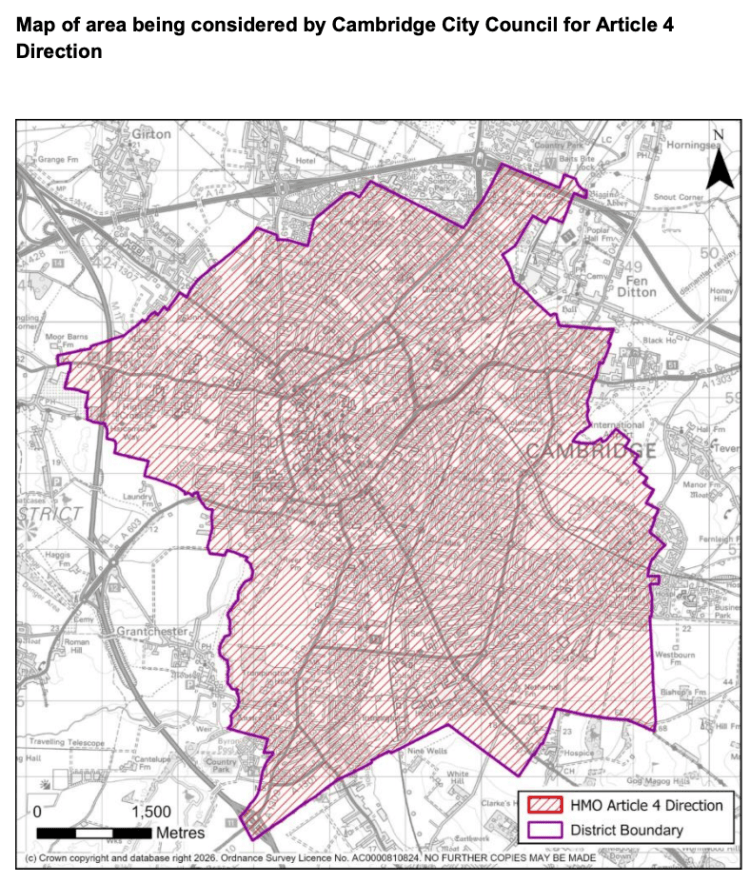
Above – item 4 Appendix 1 of the meeting papers
The consultants report by ICENI stated that as of February 2026 city council data showed there were an estimated 1,727 licensed and unlicensed HMOs (equating to 3% of total building stock) in the City.
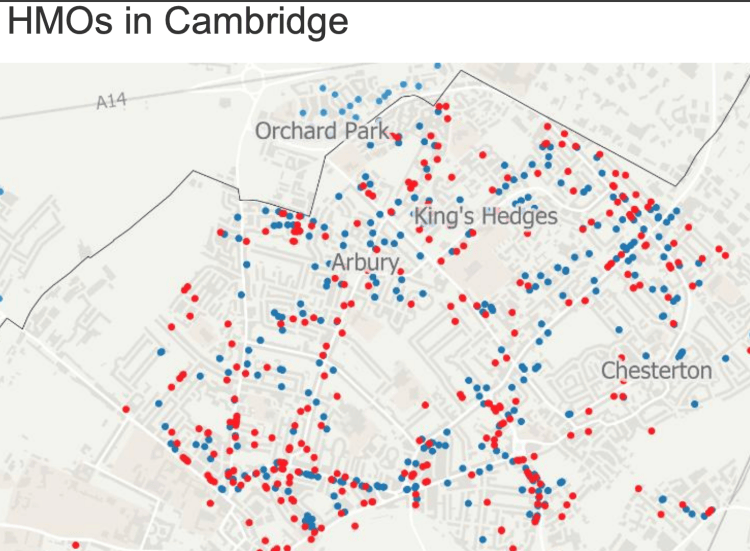
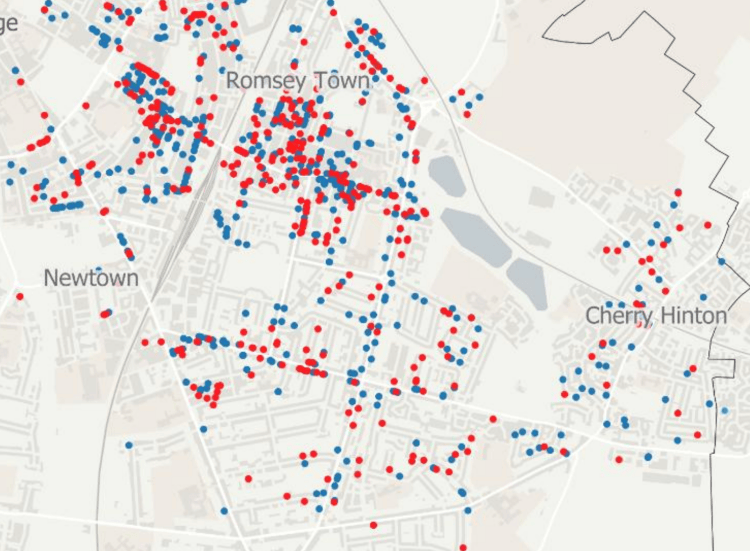
Above – details from the ICENI Report on HMOs in Cambridge (June 2026) for north Cambridge and South Cambridge (p22/97 of the pdf here)
It also stated at the very end:
“The following streets contained or intersected at least three postcodes containing 3 or more HMOs each, and in which HMOs made up at least 10% of addresses, indicating potentially high HMO concentration:
- Mill Road
- Station Road
- Cherry Hinton Road
- Mowbray Road
- Perne Road
- Thoday Street
- Hemingford Road
- Coldham’s Lane
- Devonshire Road
- Mawson Road
- Elizabeth Way
- Victoria Road
- Histon Road
- Milton Road
- Arbury Road
- Kings Hedges Road
Above: the ICENI Report on HMOs in Cambridge (June 2026) – Roads in which HMOs made up at least 10% of addresses (p97/97 of the pdf here)
As I mentioned in an earlier blogpost, not everyone supports a clamp down on HMOs. Housing policy expert Dr Anna Clark who is based in Cambridge told me:
“I do hope someone points out the dire shortage of affordable places to live for single people on low-middle incomes in Cambridge (including students). HMOs are all they can afford, so we should not be clamping down on them IMO.”
This was before we started seeing planning applications for large co-living developments for private residents esp young adults no longer in full time education being brought forward. I think that there’s a case for having some co-living developments located on some of the big sci-tech parks close to major public transport hubs to enable more people to walk to work and to have easy access to the rest of the city.
Noisy motorists and law enforcement
Recall the petition from the Liberal Democrats earlier? When there is no overall control it makes it easier for opposition parties to bring forward things that the largest party might otherwise not want to do.
‘Fewer cars but more outdoor socializing: Paris’ changing noises‘
“Fifteen years of political and social change in the capital has shifted noise from the roads to bar and restaurant terraces. As car noise levels have fallen, individual loud sounds have become more noticeable and less tolerated by local residents”
It was also covered by the World Economic Forum here, and also by France 24 below:
Above – noise radars / detectors in Paris, 15 February 2022
The UK also had some recent trials.
Above – Noise-detection in Devon and Cornwall, by their Police and Crime Commissioner, 12 November 2025
It would be interesting to hear from their PCC and local councils on what impact they had. (If anything, council officers could give them a quick phone call to find out given that the meeting is not for another week, and add an addendum paper to the meeting papers.)
“What do the council officers recommend?”
They’ve given councillors three choices:
- Option 1: Take no further action towards a PSPO at this stage due to lack of evidence.
- Option 2: Commission active technical evidence gathering, including acoustic cameras.
- Option 3: (Officer recommendation) Undertake a time-limited (3 month) public Call for Evidence to determine if there is wider evidence that hasn’t been reported currently.
I can understand why they have gone for the most cautious of the two that result in action, but I think councillors should reject Option 3 and go for Option 2: Commission active technical evidence gathering including acoustic cameras. At the same time they can issue a public call for evidence. No need to wait for one to do the other. Do them both at the same time. At least that way there will be a greater volume of evidence either way.
Evidence from earlier studies on the impact of anti-social behaviour
Rishi Sunak’s Government published some research on this in 2023.
“This study helped to quantify the individual impacts of ASB. Emotional impacts were found among nearly all participants, with annoyance (for 56% of participants) and anger (for 42%) being the most widespread impacts across ASB types.
“Fear, loss of confidence, difficulty sleeping and anxiety were also common emotional impacts. While they were less commonly experienced (each by around a quarter of participants) , they were described as being more severe and longer lasting.”
Above – Anti-social behaviour: impacts on individuals and local communities (27 March 2023)
Interestingly, the research also suggested other policy responses:
“Participants made a variety of suggestions for the improvement of support services, such as:
- “ensuring a timely response and making individuals feel heard
- providing options for anonymity
- being delivered through alternative mediums that are suitable for a range of victims and people who have experienced ASB
- involving the community, for instance through having a community-level support group
- ensuring that there is a multi-agency approach to support offered“
Young people as victims of anti-social behaviour”
You can go through the British Newspaper Archive to find out the experiences of previous generations in dealing with anti-social behaviour. We are also familiar with anti-social characters in comedy sketches.
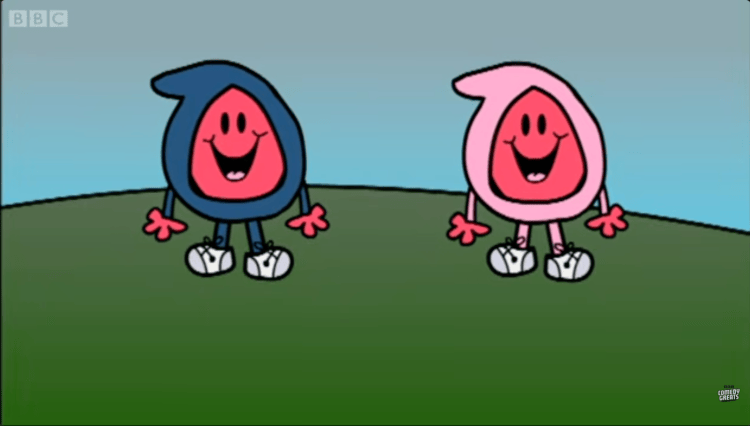
Above – Mr Happy-slapper and Little Miss ASBO in BBC Dead Ringers from February 2007 spoofing the Mister Men books
Both characters were satirical responses to government policies on anti-social behaviour (the creation of Anti-Social Behaviour Orders (ASBOs) in the Anti-Social Behaviour Act 2003, and the the outbreak of violence relating to ‘Happy Slapping’ in the mid-2000s which was little more than filming assaults on people – some of which turned out to be very serious, and in one case fatal.
“While the youngest were more likely to interpret incidents as ‘normal’ behaviour, they were also more likely [(those aged 18 to 34)] than those aged 35 and above to feel that ASB is a ‘very/fairly big’ problem in their local area. This suggests that they have a consistently high exposure to incidents.”
Above Section 2 of Anti-social behaviour: impacts on individuals and local communities (27 March 2023)
Which makes me wonder about what impact the threat of violence in public has on where teenagers socialise at – mindful of the collapse of youth club provision since the Thatcher years.
Which reminds me:
Cambridge City Council and Cambridge University Students Union need to make sure that schools and further education colleges have updated their information following the event in June 2026
You can see details of the event here although I’ve not seen a write-up of it. I hope it becomes an annual thing. (I saw an out-of-date poster from 2025 at my music rehearsal earlier this evening).
If you are interested in the longer term future of Cambridge, and on what happens at the local democracy meetings where decisions are made, feel free to:
- Follow me on BSky
- Spot me on LinkedIn
- Like my Facebook page
- Consider a small donation to help fund my continued research and reporting on local democracy in and around Cambridge


