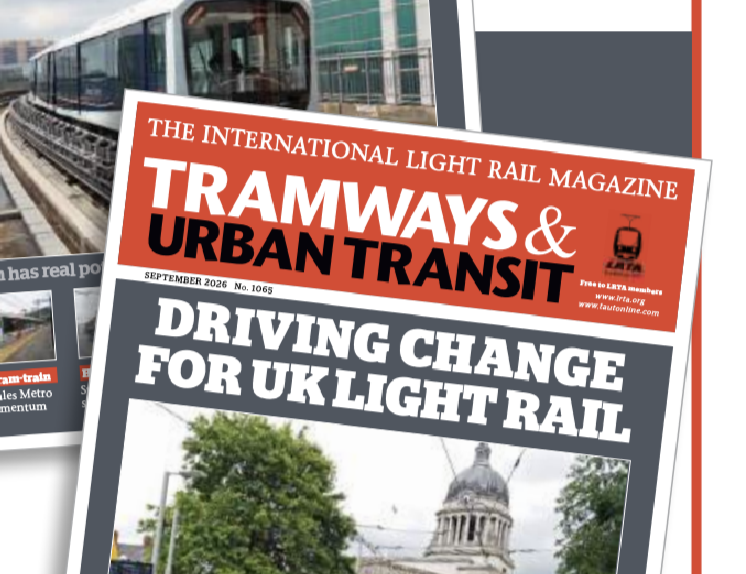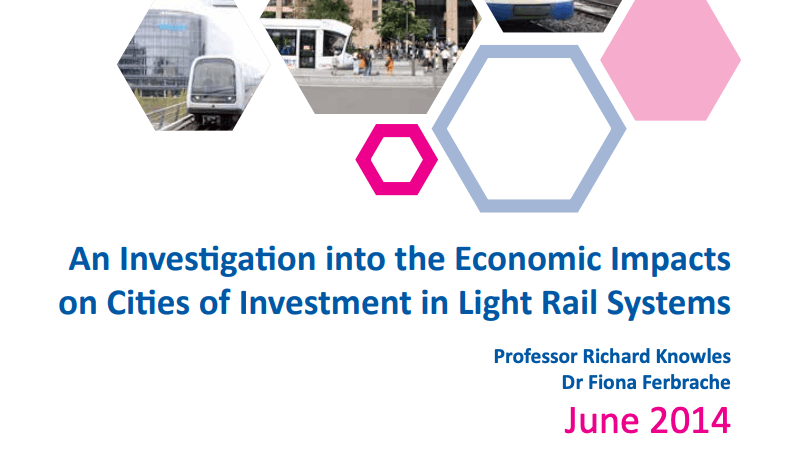
…and other forms of public transport which the Government’s Mass Transit Task Force has been working on over the summer. In the meantime, I continue to look for reports and evidence bases – such as this report for UK Tram in June 2014
UK Tram’s 2014 report on the economic impacts of light rail systems
You can read the report here Its recommendations were:
- “Supportive planning policies should be adopted to maximise the positive economic impacts of light rail investment. Transit-oriented development should become the norm.
- “Mechanisms should be adopted to capture increase in land and property values resulting from light rail investment.
- “Cost Benefit Analysis should be modified to place less emphasis on time saving and value of time, and more emphasis on environmental, social and wider economic effects.
- “Government forecasts of the future price of oil should be reassessed to take more account of independent assessments and the increasing demand pressures as global Peak Oil approaches. This is critical to re-balance the assessment of light rail and other public transport schemes against road building schemes.
- “Impact Studies should be commissioned to analyse the medium to long-term, 10-25 year, economic effects of light rail systems. ‘Before and After’ light rail Impact Studies have hitherto focussed on immediate economic impacts when economic opportunities are unlikely to have been realised.
- “Impact Studies should use similar control areas to isolate light rail’s impacts from other factors and temporal trends.
- “Site specific and contextual factors should be taken into account as similar light rail investments in different locations will not necessarily have the same impacts.“
Above – UKTram (2014) p13
The chapter listings themselves help readers decide which areas to focus on:
- Extension of labour market catchment areas (p14)
- Stimulation of inward investment (p22)
- Unlocking previously hard-to-reach [for whom?] sites for development (p32)
- Reorganisation or rationalisation of production, distribution, and land use p(p38)
- Triggering fresh growth through elimination of significant transport constraints (p44)
- Land and property value increase and capture (p50) – note the University City of Freiburg is featured – population not much more than Greater Cambridge, only their tram/light rail network is visible on G-Maps here. Have a browse through their tram network wiki page here.
- Transit-oriented development (p62)
- Cost-benefit analysis of transport schemes (p72)
- City image and quality (p80) – one of the big findings being that during construction phases, public opinion is negative. But once complete, it’s positive. (We’ve even seen this with the guided busway – except during the extended peak morning and evening periods during school and FE College term time. The children and teenagers deserve better)
The conclusions of the 2014 UK Tram Report state:
- “Investment in light rail systems can have positive economic impacts on cities. Similar light rail investments in different locations will not necessarily have the same impacts – geography matters. However, light rail investment on its own is unlikely to be a sufficient catalyst for economic change without other supportive policies. [Which means other things need to be co-ordinated with it – including the location of new leisure, arts, entertainment and cultural facilities close to light rail stops and transport hubs – not just flats and offices]
- “Light rail systems can improve economic growth by increasing the attraction of locations for inward investment. However, it is difficult to attribute specific investments in economic activity solely to light rail. To isolate light rail’s impacts from other factors and temporal trends, it is important to use similar control areas in Impact Studies.
- “Light rail systems can transform accessibility to previously hard to reach sites such as derelict docklands, brownfield former industrial areas and reclaimed land.
- “By improving accessibility, light rail can provide a trigger to reorganise or rationalise production, distribution and land use.
- “Absence of a well-developed transport system can act as a serious constraint on growth. Transport constraints can be alleviated by increased capacity, better efficiency, new connections and improved accessibility. [You’d have thought Cambridge’s decision-makers would have learnt that by now]
- “Light rail systems improve accessibility, usually increase land and property values, and enable developer contributions to be made. Increases in land and property value are often not captured. [This is something the Development Corporation need to pin down the Chancellor on: What will be the mechanisms to capture that unearned land and property value increases?]
- “Light rail impacts are enhanced when planning policies are co-ordinated in a transit-oriented development (TOD) to focus investment in housing, employment, activity sites and public services around station sites.
- “Cost Benefit Analysis forecasts the costs and benefits of transport schemes, emphasises time saving and value of time, and has difficulty in valuing environmental, social and wider economic effects even after a New Approach to Appraisal (NATA) was adopted. The UK Government appears to have underestimated the future prices of oil, so demand for light rail and other public transport investments has been underestimated and future demand for private car and air travel has been overestimated.
- “Light rail can boost a city’s image and attract inward investment, employers, business and tourist visitors. It can help create a distinct ‘sense of place’ and have an iconic impact on the urban landscape.
“Who are UK Tram?”
An industry lobby group – see https://www.uktram.org/about

Above – take your pick as to which one you want. (Which one technically is ‘the tram’?)
They also link to a learning hub from what Sheffield and South Yorkshire Transport are doing – especially with their SuperTram. You can read their SuperTram business plan 2026-27 here. Given that Sheffield’s population is over 500,000 – a target mentioned in some political circles as something Cambridge should be aiming for (I have environmental and sustainability issues with that number but hey), Sheffield’s transport vision for the next decade is worth a look at.
“Welcome to the South Yorkshire Tram Train Pilot Learning Hub Home Page. Here you will find an extensive suite of information and resources gathered from the UK’s first Tram Train project linking Sheffield and Rotherham. Industry partners and stakeholders can request access to project documentation and resources via the ‘Register’ link above.“
Above – https://tramtrainlearning.co.uk/
Stourbridge ahead of Cambridge
Doesn’t the Stourbridge Shuttle look like fun? (I’d change the colour scheme though!)
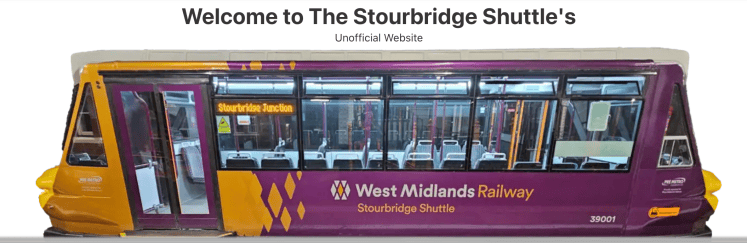
Above – in 2021 Network Rail upgraded the single track line
The railway vlogger GLovesTrains made a video about what is Britain’s shortage train line – have a watch below.
Above – can’t help but think we should commission her to make a video extolling the virtues of light rail for Cambridge. Possibly featuring a guided bus busway stuck in traffic during the school rush hour!
“What about the Mass Transit Task Force?”
No news from the Urban Transport Group as yet. In the meantime:
New busways applications for Cambridge – where we’re at
- Cambourne to Cambridge – approved (despite the failures I wrote about here)
- Cambridge South East Transport (CSET) from Addenbrooke’s to the A11 – public inquiry now open (with objections published too)
- Waterbeach to Cambridge – Cambridgeshire County Council expected to approve a motion to make an application for this third GCP/City Deal-funded busway.
Cambridgeshire and Peterborough’s proposed Transport Strategy for Greater Cambridge
The next draft is due for November’s CPCA Transport Committee which I wrote about here This will be the **fourth transport strategy** for Cambridge since 2015.
You can read the Cambridgeshire County Council transport plan for 2015 here and ask how well they’ve done in the decade since.
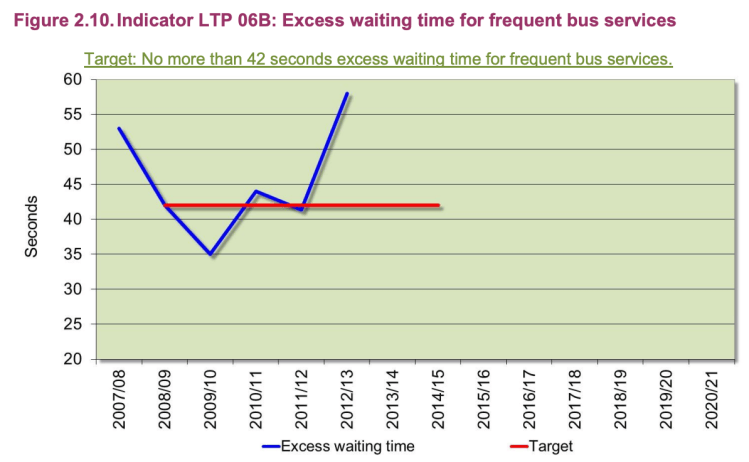
Above – you can see why residents were sceptical about bus-based improvements from the very start when this was their lived experience. (Cambs CC LTP (2015) p2-10)
And did anything come from the diagram below other than arrows on a sheet of paper?
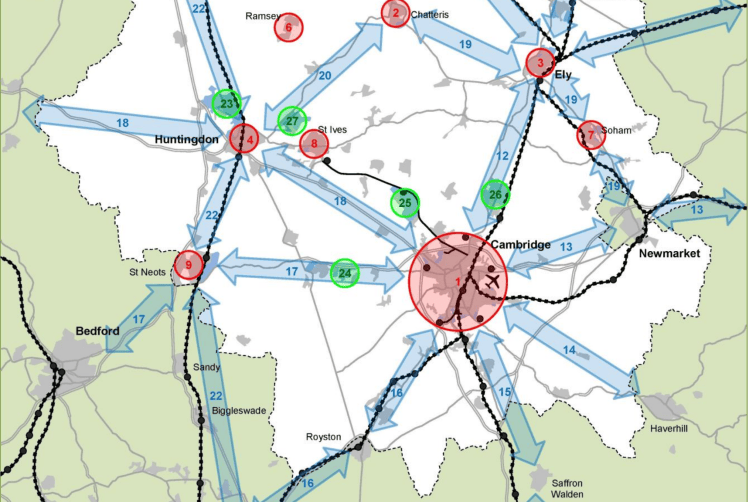
Above – Coverage of Action Plans covering Cambridge, the market towns and
the main transport corridors (Cambs CC LTP (2015) p2-10)
All of the above was approved under the leadership of the Conservative Group that ran a minority council with the effective confidence and supply support of TeamNigel which tore into their safe seats in the 2013 county council elections. Although the latter lost all their seats in 2017, they returned under a different TeamNigel brand and drew level with the Conservatives in 2025 – the latter’s group leader losing his seat in the process. The County Council is now under a Liberal Democrat majority but local government reform will see the creation of a new unitary structure for Cambridgeshire and Peterborough, news of which we should have in the next month or so.
There are some things in the 2015 Cambridgeshire Transport Plan worth checking over again
Such as:
- “What does £1,000,000 of investment in transport infrastructure buy?” on p14
- “What has already been achieved?” on p15
- “Local Developer contributions” on p16 – mindful that *someone* in local government needs to be keeping a check on who has committed what, who has handed over the money / built what they said they would, and what was actually completed, and what it achieved.
Furthermore:
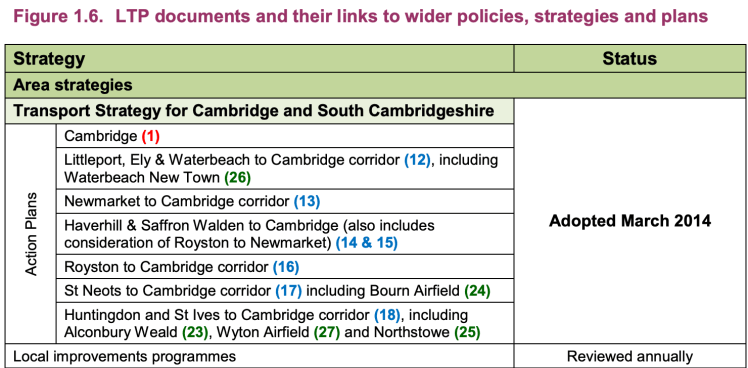
Above – CambsCC LTP (2015) p22 – progress update?
Because ***all of these*** should be completed by 2031.
But then how many people involved in the writing of that document could have predicted the abolition of Cambridgeshire County Council by then?
My blogposts relating to all of the above-mentioned towns effectively incorporate all of them into a light/suburban rail network. Ultimately the seamless movement from one form of public transport to another (eg heavy rail to tram, bus to light rail, very safe cycle parking at transport hubs – which we don’t have) are essential to achieving the significant reduction of motor traffic on our roads.
Cambridgeshire County Council and a bridge over the railway line at Foxton
They mentioned it in their 2015 strategy.
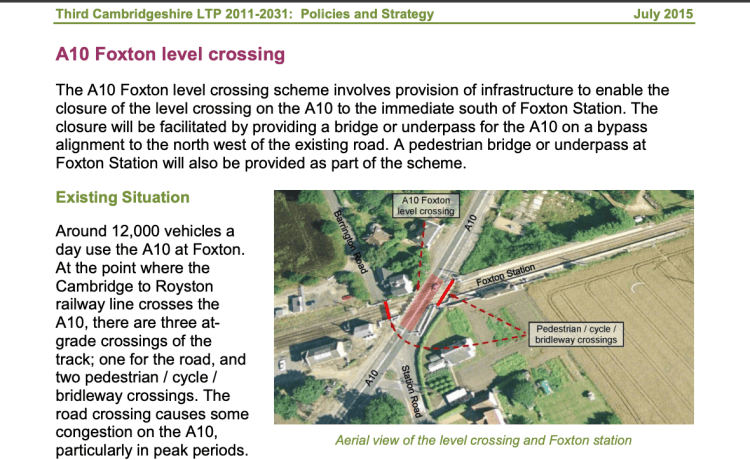
Above – CambsCC LTP (2015) p197 – progress update?
But then so did William Davidge in his report over 90 years ago in his Cambridgeshire Regional Plan (for what is now Greater Cambridge plus the southern half of East Cambridgeshire District)

Above – a detail from Davidge’s 1934 map (p87) of proposed protected green spaces, and road improvements (we’re still waiting for the bridge over the railway at Foxton – next year being the 90th year from which this proposal was published!
“At Foxton on A10, Royston-Cambridge Road, the double level crossing adjoining the station is one of the most obstructive. The County Council have the question of improvement in hand, and a scheme has been evolved for bridging over the main road and diverting the local road to avoid a crossing altogether.”
Above – Davidge (1934) p45
If that level crossing was one of the most obstructive ***in 1934*** why on earth have successive county councils and governments refused to build a bridge over it?
The Tories in Government wanted Cambridge to grow, but chose to cut transport funding
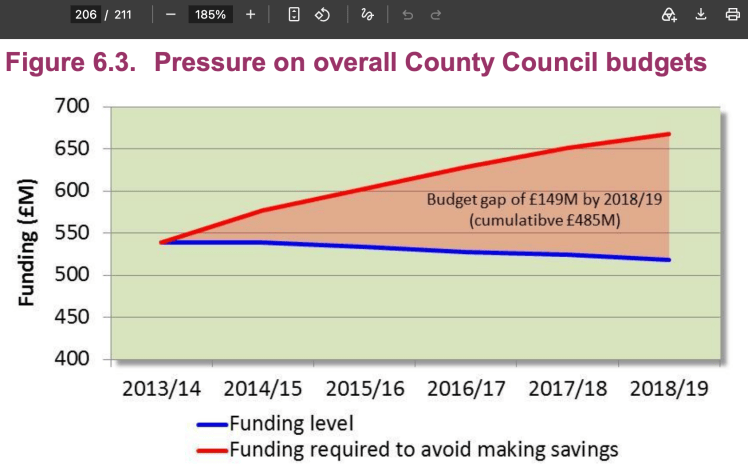
Which is why I’m in favour of local tiers of government having much greater powers of taxation and revenue raising that are independent of HM Treasury – similar to how other countries have local and regional tiers of government protected by their constitutions from interference from the federal level.
The impact of the system we currently have is that the vast majority of the policy-making functions and the lobbying efforts go towards Westminster. Furthermore, the local government and local public services sector end up becoming so financially dependent on Treasury decisions that the culture of dependency spreads across the rest of the institutions to the extent that innovation and new ideas are inhibited because of the instinct to wait for funding to be confirmed – and reconfirmed in every ministerial reshuffle.
Anyway, Parliament’s back for the autumn session. Which also means expect a stack of written ministerial statements as it has been nearly a month since the final set pre-party conference season.
If you are interested in the longer term future of Cambridge, and on what happens at the local democracy meetings where decisions are made, feel free to:
- Follow me on BSky
- Spot me on LinkedIn
- Like my Facebook page
- Consider a small donation to help fund my continued research and reporting on local democracy in and around Cambridge
- Below – The LRTA Campaign and its publications – a reminder if you want trams and light rail for Cambridge (cheap back copies can also be bought here).