
The former head of the Prime Minister’s Strategy Unit in Tony Blair’s Government wrote that ‘Power without preparation serves no one‘ at the end of his recent blogpost. Taking that statement and applying it to ’empowering communities’ across the country, what preparations should they/we be making?
“I’ve been struck this year by several comments and conversations with people right at the heart of British government who believed they were severely constrained as to what they could do… …All were mistaken, in fairly basic ways, about how the system works. This points to an odd paradox in the British state. It has great power, and those at its centre have unusually concentrated power. Yet many who hold that power don’t understand it, and therefore flail around or denounce it when they fail.
Above – Prof Sir Geoff Mulgan, University College London, 23 October 2026
What this blogpost tries to do is to make the connection between post-compulsory education institutions (colleges, universities, and adult education organisations) and their roles in raising the collective knowledge of the people that they share their towns and cities with – and specifically in the context of influencing decisions made about where they live. These might include:
- learning how to campaign for improvements to a local community facility
- scrutinising big future infrastructure plans on transport and housing
- doing the required training to meet the requirements of a future job or civic role.
After all, how many of us have looked into the requirements of what is needed to stand for election to a board of governors of an NHS Trust? (How many people know that such roles exist?)
Note the above does not imply you need a certificate for something. Requirements could be that you stand for election and win enough votes to take up such a post.
Pride in place: Peterborough – early community engagement
Peterborough has not one but two Pride in Place projects allocated to it – one for each of the parliamentary constituencies that cover the city. People can also browse Peterborough City Council’s calendar here – any meeting beginning with ‘Orton’ or ‘Paston’ is likely to be about what’s happening with their ten year programme which will allocate up to £40million of central government funding.
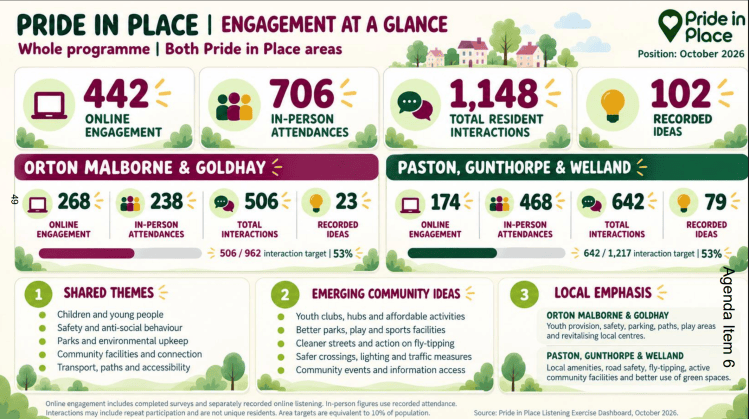
Above – Pride in Place at a glance, Peterborough CC October 2026 dashboard, slide 1
Community action is hard work – with no guarantee of success either
Remember what the Welsh Actor Michael Sheen said in 2017 when he gave the Raymond Williams Lecture that year:
Have a watch of Mr Sheen here from 1h01m – it’s really, really powerful.
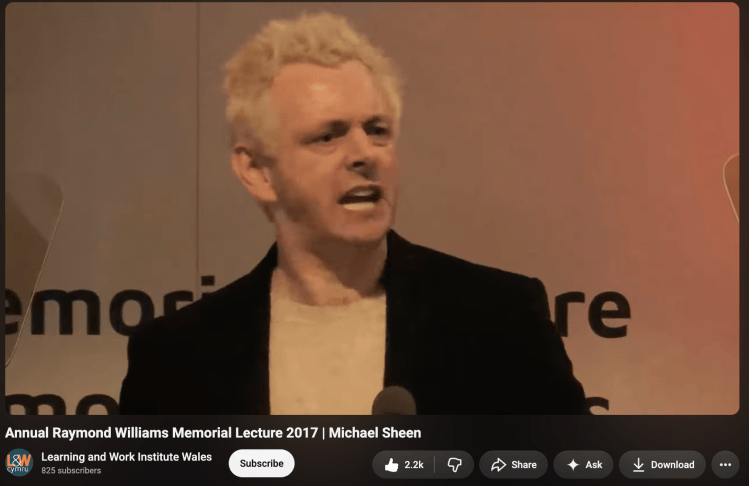
“You have to learn how to listen.
It’s not just a question of standing there with a clipboard and asking questions with the right look on your face.
You have to show up.
And stay around.
Above – Michael Sheen’s masterclass to politicians, CTO 13 September 2022
Pride in Place – learning from history
I wrote about Pride in Place back in September 2025 noting it sounded very much like the New Deal for Communities (NDC) programme that I worked on at the end of my civil service years.
If you are involved in any of the Pride in Place programmes, please familiarise yourselves with the evaluation reports for the NDC programme one of the evaluation reports from the NDC Programme 2000-2010.
In that blogpost of September 2025 I picked up on a speech by a former French Foreign Minister.
“Allocate power where it is exercised most effectively. The goal should be to unleash energy. To give each person the means to stir their own life, open new paths forpassions and talent…People are craving to make their own decisions. People no longer want to vote on a platform every four/five years and have no say in between. Let them participate more actively in policy-making. France has experimented with Citizens Assemblies on Climate Change and end of life care. We need continuous citizen participation. They need to be active, not spectators.”
Above – Barrot (2025) at Harvard.
As I wrote at the time, It’s worth watching his lecture in full – you’ll notice how relevant it is to the UK’s struggle to defend democracy, and also realise how far behind we are in so many areas.
“Fixing democracy starts with fixing citizenship. Raising genuine citizens. Enlightened citizens able and willing to take responsibility for themselves and for others. How do we get there? With enlightenment, power and courage. Power to the people only works if people are properly informed. How can we have a debate if we cannot agree on facts?
Above – Barrot (2025) at Harvard
While Professor Mulgan’s article makes perfect sense to me, how does it read to someone unfamiliar with the essentials of the UK’s political and state structures?
Again, have a read through his article here
“How do Prof Mulgan’s points apply to local government?”
In the Peterborough Pride in Place programmes, they have Neighbourhood Boards which will do the following:
- Lead and oversee community engagement activity
- Develop high-level plans and funding priorities
- Oversee the priorities and day-to-day work of staff working on the project
- Recommend and approve projects and proposals
- Adhere to the Nolan Principles
Above – Peterborough City Council Pride in Place landing page, 03 August 2026
“Won’t the members of neighbourhood boards be trained?”
They will – as the agenda of the first meeting of the Orton project on 19 September 2026 explains. But how do you go beyond the tick-box approach?
“The board may appoint members from the community, voluntary sector, public service representatives or business if it chooses to, to be appointed if the board agrees.”
Providing the means and encouragement by which local residents can learn about how decisions are made about their local communities – and how to influence them, may broaden and diversify the pool of people that become aware. And from that bigger, deeper pool can come a greater number of more talented and passionate people to make those differences in their local areas. In the case of the Pride in Place neighbourhoods, that matters because of the amount of money available to them, and the extended period of time it covers – a decade.
“Democratic societies are more likely to thrive when there is an active and engaged citizenry who contribute positively to political and public life as voters, community members and informed, active citizens.”
Above – Association for Citizenship Teaching – something #Localgov could help support teachers and local schools with in terms of subscription and training costs?
In the case of Greater Cambridge, I would love to see specific units on town planning and transport planning developed to coincide with the emerging work of the development corporation – which is lasting for over two decades. That way, when the first cohorts finish school, there will be a critical mass of them that are already familiar with how to engage with local government and public consultations – including those from central government.
How might local government go about setting this up? Clement Attlee’s Government published guidance on further education institutions in 1947. The contents section alone is enlightening.
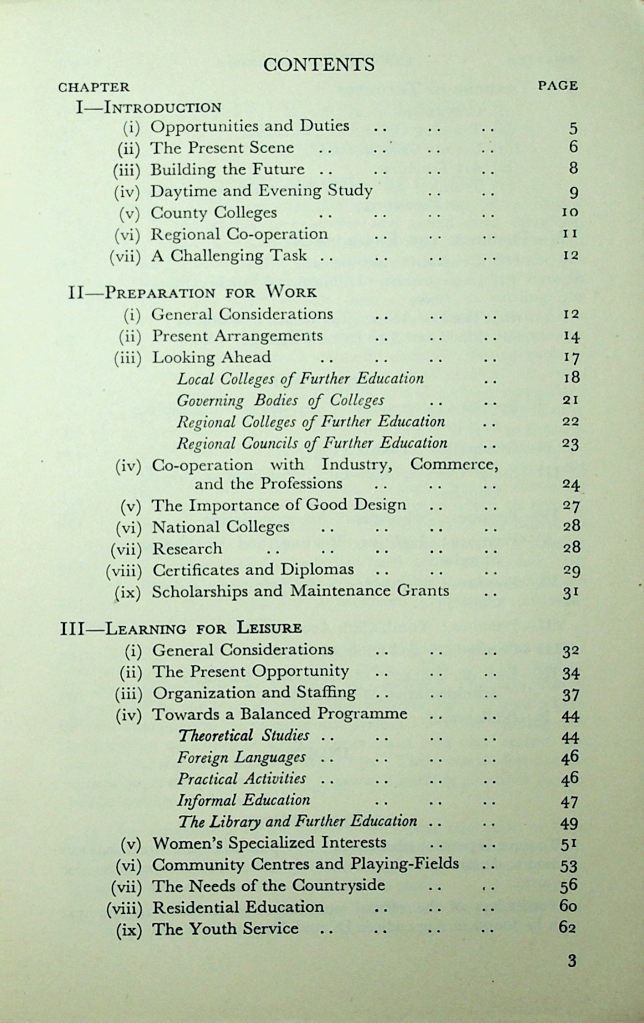
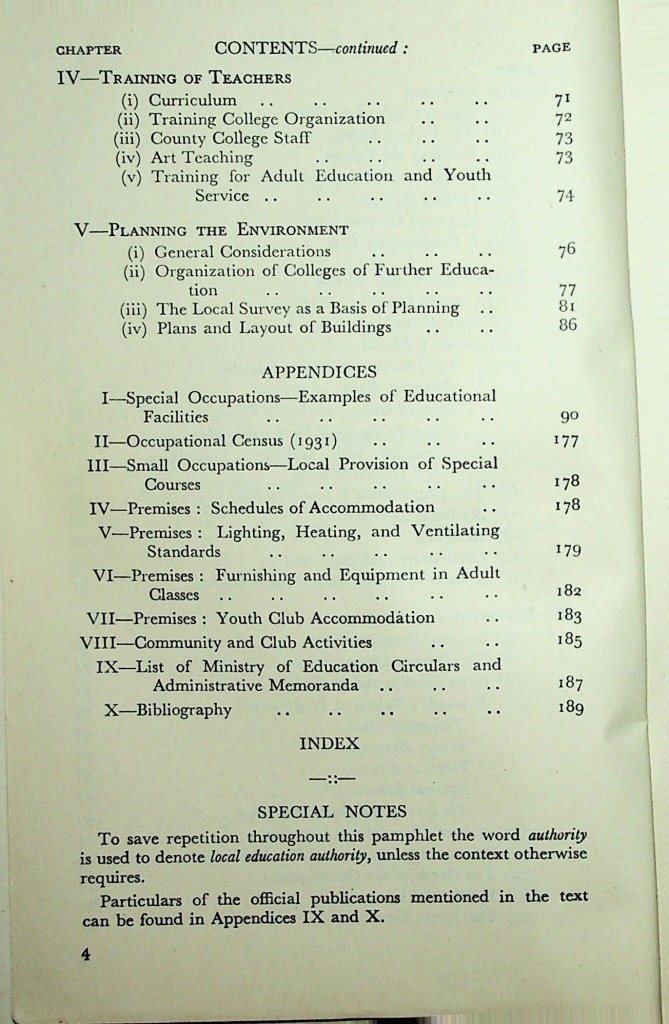
Above – Further Education (1947) pp3-4
Cambridgeshire and Peterborough don’t appear to have any long term provision in further education or lifelong learning for government, politics, and public administration.
Furthermore, the Combined Authority have stated repeatedly that they have no discretionary funding to make provision for such courses. Which means that neither:
…are currently equipped or funded to meet the learning needs of residents wanting to participate more substantively in those communities receiving Pride in Place funding. (…Mindful that none of the above institutions are easy to get to from the neighbourhoods allocated Pride in Place funding. (See Paston here, and Orton Goldhay here))
This is a wider urban transport strategy issue, and one faced by so many places facing multiple deprivation. The neighbourhoods would also make for good historical case studies of what professionals of previous generations across a range of fields got wrong. Including:
- Transport engineering
- Town planning
- Public administration
Because some of the challenges the communities face are ones where poor urban design, and other factors far outside of the control of both local residents and local councillors are at the root cause. There’s a research project or three for any post-graduate students interested in looking at how the design of post-war New Town extensions in Peterborough influenced the current challenges the neighbourhoods face today – challenges that resulted them being selected by ministers for substantial government funding.
“Wouldn’t the Rebel Badge Club concept work better in a community setting?”
It might do – something to suggest to local councillors in the area to have a look given that the concept will be familiar to residents who participated in uniformed youth groups in childhood (eg Scouts/Guides). You can get badges like the kids can!
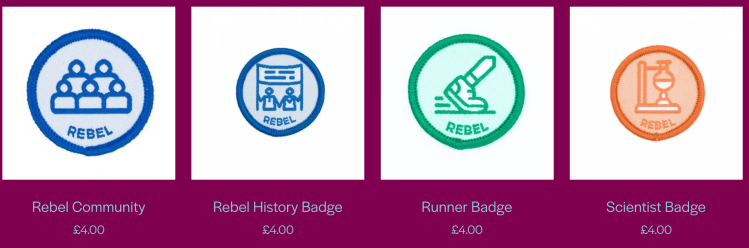
The Pride in Place structures are set up as such to run pilot schemes for things just like this. i.e. low cost, community based, and which bring people together for shared activities across a wide range that can also be hosted locally.
On the fate of local newspapers
Have a listen to Michael Sheen again
He cites the Ph.D thesis and evidence to the Welsh Assemby by Dr Rachel Howells here on the state of local media in Neath and Port Talbot – the latter being a huge heavy industrial area devastated by the decline and cuts in the late 20th Century.
“Journey to the centre of a news black hole: examining the democratic deficit in a town with no newspaper”
You can read Dr Howell’s PhD Thesis here
The findings are damning given how little has been done to sustain local media since. (The topic of a later blogpost?)
It’s not just the newspapers either.
What’s really sad is that things established by local government that were showing promising things, and that could have been developed further ended up being cut – such as the Cambridgeshire.Net site, the victim of county council cuts in the 2010s.
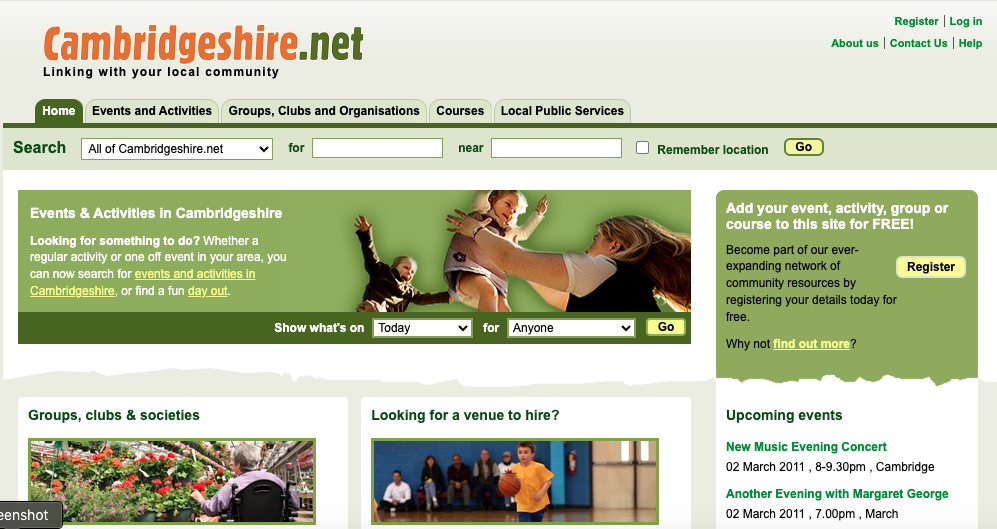
Above – From the Wayback Machine Internet Archive.
I wrote more about the above back in August 2023 here. I concluded it with the following:
“I’d like to see Cambridge having that city-and-district-wide conversation on adult education and lifelong learning, alongside the societies fair where we can get some idea of what sort of fun and leisure activities we’re willing to self-organise, and what new facilities and funding we’d need in the longer term as our city continues to grow.”
Above – making the connections between lifelong learning and community action
The crisis in lifelong learning – today’s headlines sound familiar
Here’s the late Lord Kerslake back in 2018
This was from some work by the UPP Foundation
“…we found few examples of a systematic and strategic approach to the civic role, based on an analysis of the needs of the place. Our proposal, that universities need to do this if they want to go beyond civic engagement to become truly civic universities, forms a central recommendation of the report.”
Several years later I spotted a report from the Universities and Colleges Union on civic universities

You can:
“At a time when many feel disconnected from democratic processes and alienated from formal politics the need to renew and reinvigorate the civic space is greater now than ever“
Our post-compulsory education institutions have a huge role to play in helping shape the future of our cities. The problem is they are not doing nearly enough to engage with the residential communities they share their cities with to raise our collective knowledge and get more people involved.
If you are interested in the longer term future of Cambridge, and on what happens at the local democracy meetings where decisions are made, feel free to:
- Follow me on BSky
- Spot me on LinkedIn
- Like my Facebook page
- Consider a small donation to help fund my continued research and reporting on local democracy in and around Cambridge.


