
What will this ruling mean between now and when the draft Greater Cambridge Local Plan is signed off by the Secretary of State? (Likely within the next 18 months?)
Quoting from: Jamie Childs on Li here:
“The decision highlighted that it was common ground that there was unmet need for 708 affordable dwellings per year and there was a need for 577 custom and self-build homes by 2028.
“Following the publication of the 2026 NPPF the Council had advanced a case to rely on separate supply positions for Cambridge and South Cambridgeshire, rather than together for Greater Cambridgeshire.
“However, the Inspector found that the more appropriate basis for considering housing land supply was the Greater Cambridge position on which the Council could not demonstrate a five year housing land supply.”
Above: Jamie Childs on Li 25 October 2026:
Which is a bit of a blow given the Pigeon Land speculative bid around Shelford Rugby Club that I last wrote about here. That said, with the Greater Cambridge Draft Local Plan due for submission in the next six-eight weeks, and Planning Inspectors due to begin the examination in public early 2027, the problem of land supply should be resolved by the end of next year if planning inspectors decide that the draft local plan is ‘sound’ and can be recommended for approval by the Secretary of State for Housing, Communities and Local Government.’ (This is going by the assessment of other local plans from Bidwells here).
Getting tripped up by a planning appeal for a relatively small development
In the grand scheme of things it’s not a large development – and based on the criteria that the Greater Cambridge Development Corporation has been looking at, would fall below the threshhold for them to process (i.e. 250 units). Yet for the villages, such developments don’t go unnoticed.
Land West Of Moorefield Close Off Pampisford Road Great Abington Cambridgeshire
Its reference on the planning portal is 25/03315/OUT and the ***huge number*** of documents involved in the appeal process is depressing.
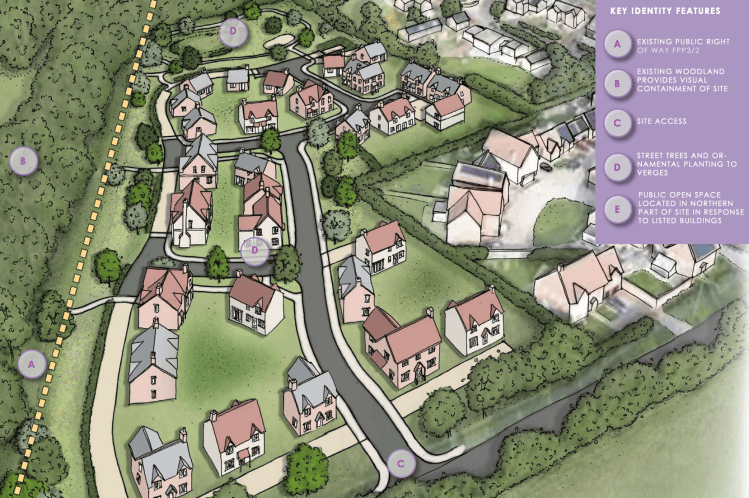
Above – p23 of the Design & Access Statement Part 2, 21 August 2025, Rosconn Group.
I’m holding fire on comments about the architectural style and urban design in this post. (Phew!)
The Planning Inspector’s comments on self-build and affordable housing:
“The section 106 agreement provides for the delivery of 40% of the dwellings to be affordable dwellings for rent and shared ownership housing and would be in line with Policy H/10 of the LP, which sets out that all developments of 11 dwellings or more will provide affordable housing on site. Furthermore, the provision of affordable houses would accord with the Framework which at NDMP HO8 sets out that developments should meet or exceed up-to-date development plan requirements and provided on site. I am satisfied that this planning obligation meets all three tests and so is necessary.”
Above: Planning Inspector decision letter, p13 para 105 You can download the decision letter here.
The inspector’s comment on affordable housing.
“The statement of common ground confirms that the level of unmet need for affordable housing is agreed at 708 dwellings per annum. In addition, there is an identified local need for affordable rental properties in Great Abington. The proposal would provide sixteen affordable homes as part of the development”
Given the approval from the Planning Inspector, it will be interesting to see what local councillors and the Parish Council (the latter having objected to the application) make of the Inspector’s decision and comments. Furthermore, as it was an outline planning application, there will be a host of ‘reserved matters’ applications that will follow. And those will still have to comply with the approved Neighbourhood Plan for The Abingtons. (As far as I’m aware, overturning a refusal on planning permission does not provide a blanket exemption to ignore approved neighbourhood plans).
Open question on affordable and social housing
Given the reliance on the private sector to build affordable and social housing, what recourse do local councils have when developers don’t build enough social housing and affordable housing – contributing to the chronic shortages?
And why didn’t previous governments pick up on this? (Other than the well-documented failings of the old DCLG in the Grenfell Inquiry – including but not limited to the high turnover of housing ministers).
If you are interested in the longer term future of Cambridge, and on what happens at the local democracy meetings where decisions are made, feel free to:
- Follow me on BSky
- Spot me on LinkedIn
- Like my Facebook page
- Consider a small donation to help fund my continued research and reporting on local democracy in and around Cambridge


