New research shows how well-planned public engagement processes that go far beyond box-ticking the minimum legal requirements can bring benefits far beyond town planning policy areas
Gustav Nielson of the Community Design Research Lab at the University of Cambridge presented his report on the Citizens’ Assembly for Westwick Row, Hemel Hempstead at the Cambridge Room in The Grafton Centre earlier. He also researched and wrote a similar piece for the old Hartree Development proposals for the Cambridge Water Works site – the proposed move of the latter having fallen through because Anglian Water said costs had risen.
TL/DR? Designing consultation systems to bring local people together more frequently, and engage them in meaningful group discussions over an extended period of time to the extent that they can see their ideas come to fruition helps strengthen what can be weak community relationships
In a nutshell:
“For the resident members of the Ideas Exchange sessions have provided a space for engaging in informal social interaction over 12 months with neighbours that they otherwise would not be in touch with.
“While the social relationships formed were not necessarily deep relationships—only one typically stayed for lunch after sessions—the importance of these “peripheralˮ social relations should not be underestimated.
“This too becomes clear from the interviews with the participants. The process has also catalysed new peripheral ties and ways of maintaining existing ones outside of the Ideas Exchange and all the residents express that it has been positive to get to know each other and understand one anotherʼs perspectives.”
This now means that we have something of an evidence base – and something for those working on large developments and large sites to consider when it comes to community engagement.
“I might suggest this to Marengo Communications only they seem to appear regularly as communications consultants on big planning applications!”
The reason being that developers are more likely to listen to them than me – especially if they can bring in practitioners such as InvolveUK and The Sortition Foundation who are experienced at designing and delivering the Citizens’ Assembly element.
“Didn’t the Greater Cambridge Partnership screw up their Citizens’ Assembly?”
I think they did – because the outcome recommendations from their process just happened to match what the GCP wanted on the controversial congestion charge for Cambridge. But when they pressed ahead with it such was the backlash from a critical mass of residents, along with a looming electoral backlash that was only avoided at the last minute when Labour candidates pulled their support for congestion charging, that the whole thing was abandoned. I tried to make sense of the 500+ pages of the post-election aftermath in August 2023 here before the whole City Access pillar of the GCP was effectively abandoned. The City Access pillar was supposed to deal with the ‘last mile congestion in Cambridge’s City Centre. That the GCP failed to design and deliver an infrastructure solution to this represents their greatest failure.
Learning from the City Deal’s/GCP’s failures in community engagement
Actually that’s a Ph.D thesis waiting for some to do – only I don’t want to go back over the past decade or so of my existence to realise how much time I spend following the GCP and going to all of those meetings only to find (like so many others) that there was precious little to show for it!
“What does Gustav Nielson’s research show?”
If we take one of the conclusions from the Hartree (2024) report:
“The Ideas Exchange has also prompted conversations around formats for continual citizen-led governance in Hartree based on the Citizens’ Assembly approach. Further, members are bringing their experiences with them into their existing neighbourhood councils.”
Above – Nielson (2024) p21
Which reminds me – Cambridge doesn’t have local neighbourhood forums. We’re still awaiting the news of what will replace the old Area Committees. At some stage local government will have to deal with the anomaly of South Cambridgeshire district having parish councils and the city of Cambridge not having them when the two merge to become a unitary council.
“What’s an ideas exchange?”
Frances Wright of TOWN explains:
“The Ideas Exchange can be considered an extended focus group and explains that the intention has been to respond meaningfully to a 2019 survey by Grosvenor showing
that only 2% of the UK population trusts developers (Grosvenor, 2019).”
Above – Nielson (2024) p14
That Grosvenor report was something former councillor Sam Davies MBE explored.
“[Grosvenor] found that trust in the planning system is almost non-existent. When it comes to planning for large-scale development, just 2% of the public trust developers and only 7% trust local authorities.”
Grosvenor Report 2019 on Building Trust
The report includes suggestions on *how* to increase trust from those very low levels.
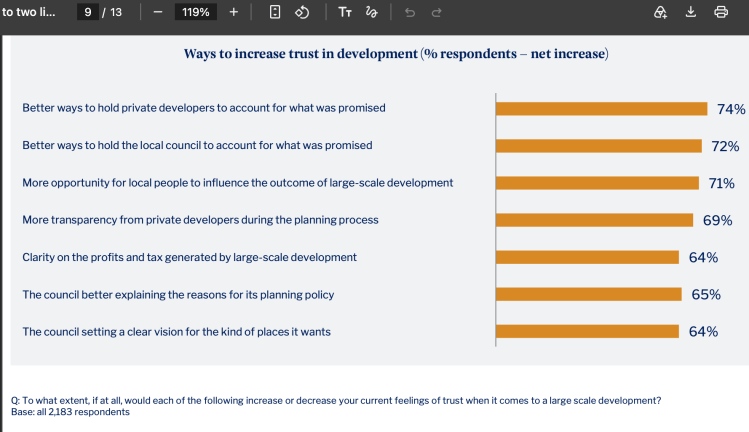
Above – Grosvenor (2019) slide 9
It’s also worth noting that residents made TOWN aware of the failings of the GCP’s Citizens’ Assembly on city access and congestion charging.
“Further, the name “Ideas Exchange” was chosen instead of “Citizens’ Assembly” as there have been mixed opinions of the success of the GCCA [Greater Cambridge Citizens’ Assembly] and because a very strict adherence to all Citizen’s Assembly principles was not intended. Further, the name “Ideas Exchange” was chosen instead of “Citizens’ Assembly” as there have been mixed opinions of the success of the GCCA and because a very strict adherence to all CA principles was not intended.”
Above – Nielson (2024) p14
So basically the Ideas Exchange concept goes beyond what the Citizens’ Assembly is. Useful given that the latter is time/duration specific and has a clear end. An ‘Ideas Exchange’ can be ongoing if that’s what participants want.
Themes from the Ideas Exchange for Hartree
Some of you will know that I did a local history commission for the Hartree project – local residents chose to name the new neighbourhood after the first woman to become Mayor of Cambridge – Eva Hartree, who in the mid-late 2010s was the major figure in my local history research

Above – Mayor Eva Hartree by Palmer & Clarke 1924 in the Cambridgeshire Collection. Colourised by Nick Harris, commissioned by Antony Carpen
Of the themes:

- Building capacity (of residents to take part – including their knowledge of town planning and of local government processes)
- Extending ‘community’ (both depth of relationships and breadth/number of people in an area involved)
- Supporting agency and efficacy (i.e. are residents confident that their participation will make a positive difference and that their suggestions will be listened to?
- Stimulating experimentation (given our experiences with the GCP, what are those institutions involved in the growth of Cambridge going to do differently? (Mindful that the Minister for Housing and Planning has instructed the Greater Cambridge Development Corporation to innovate in this area).
Above – Nielson (2024) p16
Final thoughts on using town planning to reduce loneliness *and* increase our city’s collective knowledge on decision-making for our city
- Proximity (geographical)
- Regularity (frequency)
- Affinity (things you have in common with another person/other people)
I wrote about this back in September 2026
Shaping the future of Cambridge should be a reason why people would want to get together and discuss shared issues with their fellow residents.
Going beyond one-off workshops has to be an aim if people are to get to know each other – and this can be done either in the form of informal but scheduled discussion groups (Eg ‘first Thursday of the month‘ or ‘every Wednesday for eight weeks‘ or in the format of a book group) in the same location/s (from community centres to pubs and cafes) through to a formal series as part of a structured evening class series, ultimately through to an accredited university module.
The shared successes of new amenities and facilities that could result from participation could in itself be an additional incentive.
“How do you ensure it’s not just the usual suspects that participate?”
I.e. Me.
Given the budgets that the larger developers have, they have to be willing to go far beyond standard practices. Furthermore, the state needs to make some concessions and show flexibility – especially with people on low incomes. For example:
- Citizens’ Assemblies pay their participants – what options are there to paying people for their time and input.
- Could an evening class / scheduled series of workshops pay the participants, especially those on local income?
- Could the Government relax its rules on additional income for people in receipt of social security support/benefits/UC? (i.e. stating that such payments are exempt and don’t require any additional paperwork so as to keep the higher incentive for participation?)
- Could there be a form of accreditation for participants to enable them to demonstrate what they have learnt to future employers/educational establishments? (And could the successful achievement and award as a result of meeting the requirements include a small financial reward – again as an incentive?)
- Could food – in particular hot meals / shared dining, be part of the events? (Again, thinking combating poverty and multiple deprivation)
- Could decent creche and childcare facilities be included – especially if larger numbers of people could be involved to the extent that even the children would look forward to taking part? Could some of the activities involve the children being listened to and have their ideas developed with them?
Given the amount of money that developers spend on consultants, the difference that some of the funding could make to community development across Cambridge could be significant.
If you are interested in the longer term future of Cambridge, and on what happens at the local democracy meetings where decisions are made, feel free to:
- Follow me on BSky
- Spot me on LinkedIn
- Like my Facebook page
- Consider a small donation to help fund my continued research and reporting on local democracy in and around Cambridge.


